
Mercury is the smallest planet in our solar system and the closest one to the sun, orbiting the sun in just 88 Earth days. The planet’s rocky and barren plains are washed in solar wind and radiation, leaving temperatures to rise as high as 800 degrees Fahrenheit during the day and fall to -290 degrees Fahrenheit at night!
Astronomers for years speculated on the surface’s unique dark gray look. A new study, announced in 2016, confirmed that graphite (yes, the same stuff in your pencil) coats the lonely lands of this small planet.1 Even with its darker surface, Mercury reflects light that finds its way to us.
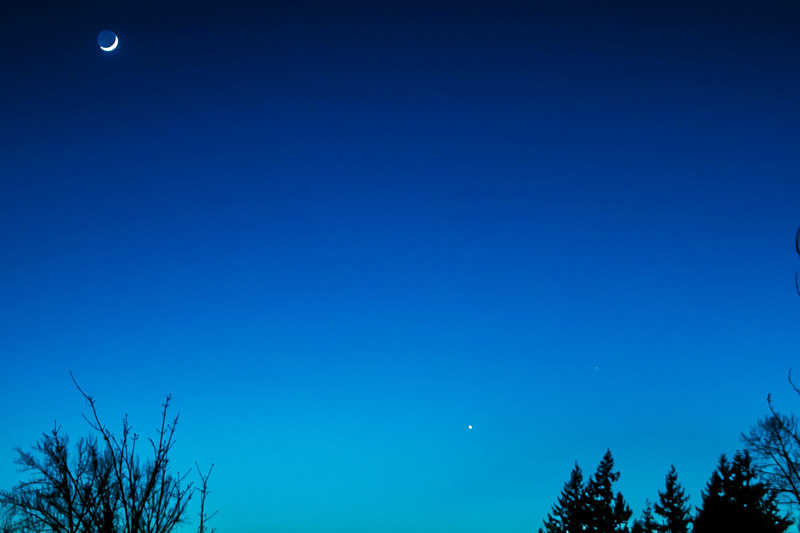
In 2018, I finally grasped Mercury’s light during sunset, catching it with binoculars as well as my DSLR camera from a park near our house. Venus joined the photo, too. Keep reading below to learn about the curious connection Mercury made for me to the infamous serial killer Ted Bundy.
My Observations
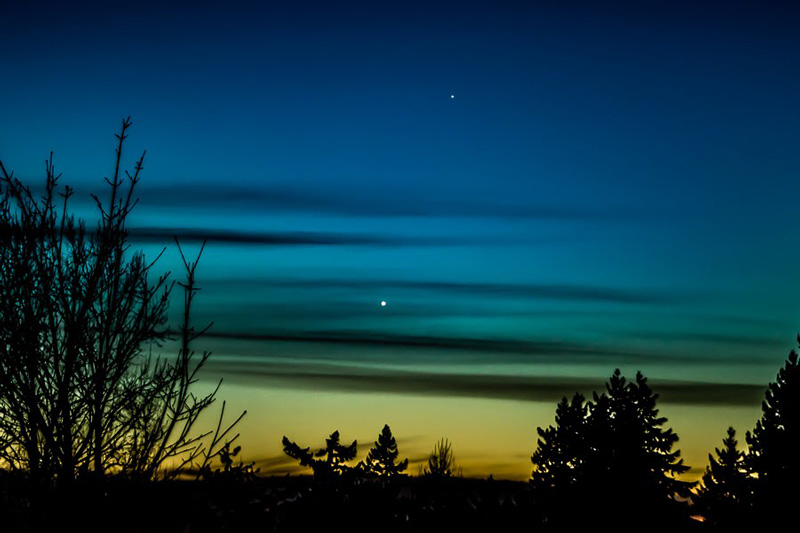
Photo: Canon 70d, f6.3, 86mm, ISO 500, 0.5-sec exp.
On March 10, 2018, my daughter, wife, and I walked down to the local park to see Mercury and Venus. We were greeted by a few kids having fun on the playground; they were laughing and enjoying the unusually warm weather.
As I set up my camera gear, I pointed out the western horizon to my daughter, who, in a loving effort to help me, was ready to start scanning for a few “stars” to pop up. My eyes looked down at the camera settings, up at the horizon, then back down.
Then, the neighborhood noise around me faded as if someone had the volume control on a remote. The scene changed for me.
All of a sudden, I was waking up as a teenager in my childhood home back in Colorado. I punched the alarm, wiped my eyes, and rolled over to turn on the small color TV.
“It’s official. Earlier this morning at 7:16 a.m. eastern time, Ted Bundy was put to death by electrocution at the Florida State Penitentiary.”
I watched the news footage as a hearse pulled away from the prison. Ted Bundy, the boogieman from my childhood who terrorized so many, was gone. My alarm usually didn’t go off at 6 a.m., an hour earlier than usual. On this morning, January 24, 1989, things were different; I wanted to know if Bundy was still among the land of the living.
In a bizarre coincidence, when the news anchor broke away to the weather for a quick report, the weatherman mentioned that Venus and Mercury would be viewable right before sunrise. What an interesting fact to point out during a newscast, especially on this morning with every other minute centered on the crimes of Ted Bundy.
I took advantage of the moment. My bedroom window faced directly east, a perfect view with only a few lower trees. The purple pre-dawn sky looked clear, and only a few streams of white puffed out chimneys.
So there I was, scanning left and right across the horizon, as the news broke in and out of live coverage from Florida. My memories of fearing Ted Bundy, who escaped from a Colorado jail when I was young, faded as I focused on the horizon. Distant rising aircraft from Stapelton Airport crossed my view every few minutes.
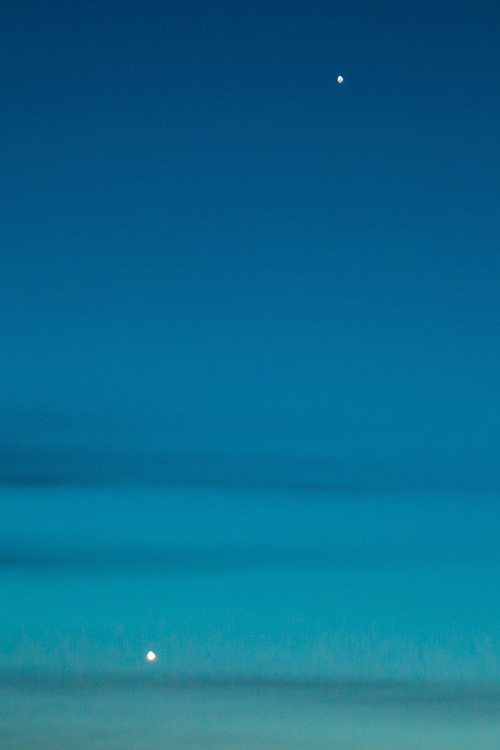
I found Venus but couldn’t make out another point of light. As the sun approached from beneath the horizon, the cold dark sky turned to purple and then blue. For a few moments, I thought I saw a faint light. Was it Mercury? Maybe, I thought to myself. But I never could officially attest to seeing the elusive planet. Time passed, life got busy, and I never dedicated a good effort to finding Mercury.
Years later, 29 in fact, I finally saw the planet with my eyes during a beautiful sunset, ironically not far from Ted Bundy’s childhood home.
It’s sad to connect someone like Bundy to the planet Mercury—of all things. But, it’s part of my long story as an amateur astronomer and, perhaps more importantly, a reminder that light always replaces the dark in one way or another.
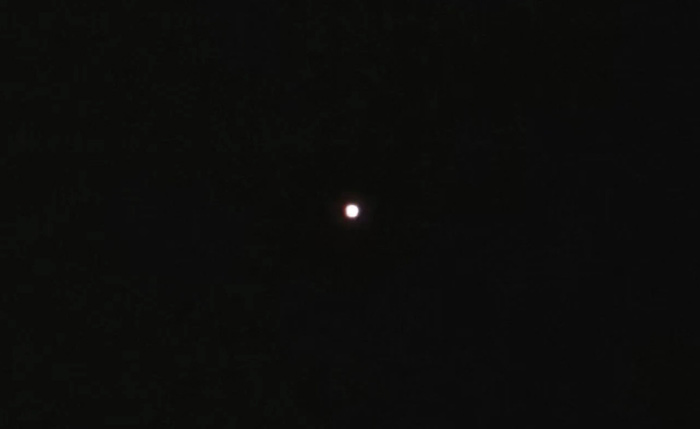
On June 16, 2025, I observed Mercury in the evening sky from Tampa, Florida. As I was setting up my telescopes for a night of stargazing, I noticed Mercury hovering just above a row of townhomes in the distance. Without hesitation, I decided to capture the moment with my Seestar S50, as I never know when I might have another chance to see the planet high in the sky.
Sources and Notes
The photo of Mercury in the top banner is in the public domain in the United States because it was solely created by NASA. Details here.
1 Grush, Loren. “We Finally Know How Mercury Gets Its Dark Gray Color: An Ancient Carbon Crust.” The Verge, The Verge, 8 Mar. 2016, https://www.theverge.com/2016/3/7/11174232/mercury-carbon-crust-discovered-nasa-messenger-dark-gray.
Sunset photos of Mercury and Venus by Wayne McGraw
 The Garden Astronomer

3 thoughts on “Mercury: On Finding the Elusive Planet”