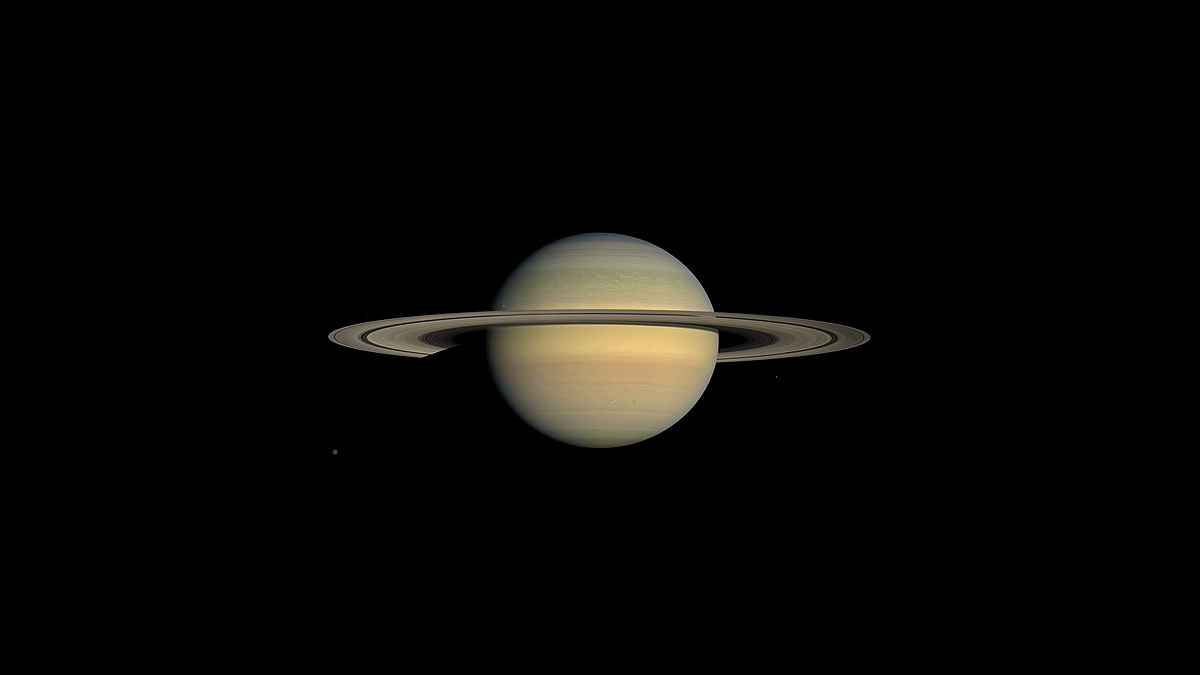
Saturn, the second-largest planet in our solar system, is a breathtaking sight to behold. I’d be willing to bet many amateur astronomers fell in love with astronomy because someone showed them Saturn in a telescope.
Like the gas planet Jupiter, Saturn has captivated astronomers and stargazers for centuries. In fact, the earliest recorded observations of Saturn date back to Babylonian astronomers in the 8th century BCE, who recorded the planet’s movements in their star catalogs. The ancient Greeks also observed Saturn and the Roman astronomer Galileo Galilei was the first to observe the planet through a telescope in 1610. He noticed the planet’s distinctive rings, although he did not realize what they were then. Later observations by Dutch astronomer Christiaan Huygens in 1655 revealed the true nature of the calls.
Speaking of the rings, there are seven major rings and countless smaller ones. Ice particles ranging in size from tiny grains to boulders several meters across make up the rings. They orbit the planet in a flat plane and are thought to be the remnants of a moon shattered by a collision with a comet or asteroid.
Saturn has more than 80 known moons, each with unique characteristics. Some of the most notable moons include Titan, Enceladus, Mimas, and Iapetus. Titan is Saturn’s largest moon and is the only moon in our solar system with a thick atmosphere, and it has liquid lakes and rivers on its surface.
Backyard astronomers, both those new to the hobby and those long-timers like me, often return to Saturn to take in its beauty and to share the planet with others. Even those observing under heavy, light-polluted skies can usually see the dim “star” of Saturn in the sky, and the planet looks great through any sized telescope.
My Observations
I’ve had the pleasure of showing Saturn to guests over the years. With the gorgeous HD-resolution photos of Saturn from NASA that the public enjoys in magazines and on the internet, I imagine the person looking through my scope will see Saturn and say, “That’s it? It’s so small.” That doesn’t happen. Every time, people are moved in awe of its allure and mystery. I love sharing Saturn. And I never pass a season without paying the golden planet a visit.
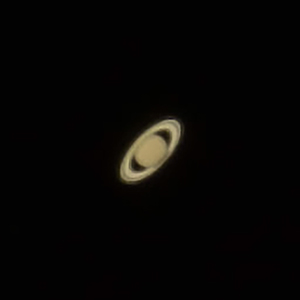
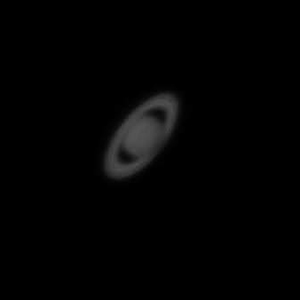
As I did with the Jupiter photos on the site, I produced the following photos of Saturn using a video recording technique. First, I shot a 1-minute video for each of these with my Canon 70D DSLR hooked directly into the telescope. Then, I ran the video file through software, which extracted the frames, aligned them, and stacked them. The results are what you see below. I’m mainly a visual astronomer with minimal astrophotography skills, but still, one with little knowledge and some basic equipment can take some decent planet photos. These were both done on a 6-inch Orion Dobsonian scope.
Sources and Notes
Banner photo of Saturn produced using public domain image. Credit: NASA / JPL / Space Science Institute Source: https://en.wikipedia.org/wiki/File:Saturn_during_Equinox.jpg
1 “In Depth.” NASA, NASA, 17 Oct. 2022, https://solarsystem.nasa.gov/planets/saturn/in-depth/.
Photo of Saturn under “My Observations” by Wayne McGraw
 The Garden Astronomer

4 thoughts on “Saturn: Breathtaking Light of the Night”