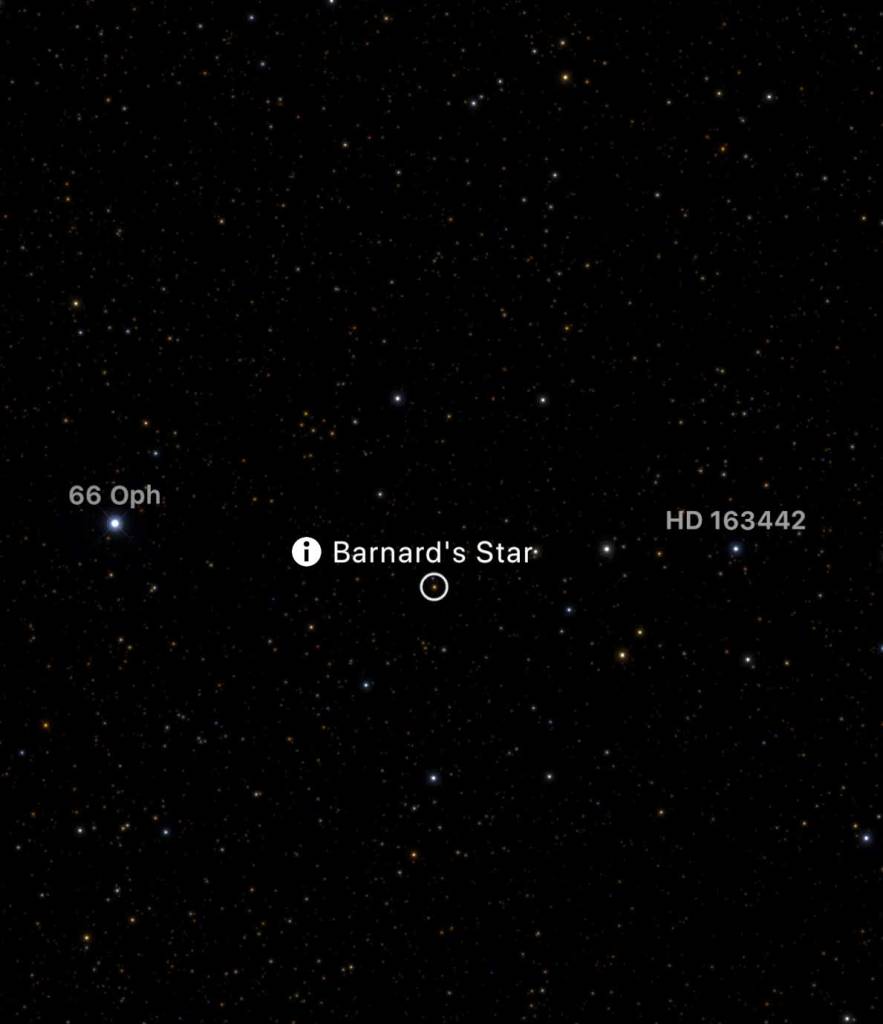
Barnard’s Star is one of our closest stellar neighbors, lying just under six light‑years away in the constellation Ophiuchus. Although invisible to the naked eye at magnitude 9.5, it shines steadily in small telescopes under dark sky conditions. As a red dwarf of spectral type M4, its surface temperature hovers around 3,200 K—cooler and much dimmer than our Sun, yet endlessly fascinating to amateur and professional astronomers alike.
What truly sets Barnard’s Star apart is its extraordinary proper motion. If you’re trying to wrap your head around what proper motion is for a star, think of the night sky like a giant movie screen where most of the stars are fixed “set pieces” in the background. Proper motion is just the tiny, year‐by‐year shift of one star, in this case Barnard’s Star, against that backdrop.
First measured by E. E. Barnard in 1916, Barnard’s Star is a red dwarf that moves across the sky at a speed of over 10 arcseconds per year. This is the fastest apparent motion of any known star. If you compare photographs of the same star field taken a decade apart, you would notice that Barnard’s Star has shifted significantly against the static backdrop. In fact, it moves so quickly across the night sky that, over an 80-year lifetime, it travels nearly half the width of the full Moon. This presents a rare opportunity to witness a star’s journey unfold within a human lifetime.

Public Domain Photo
In recent years, Barnard’s Star has also become a prime target in the search for exoplanets. As of this writing in 2025, four planets have been discovered around the star. Though its faint light prevents direct imagery of any companions with backyard equipment, Barnard’s Star is not just an object of astronomical curiosity, but a symbol of the next frontier in our quest to understand distant worlds.
My Observations
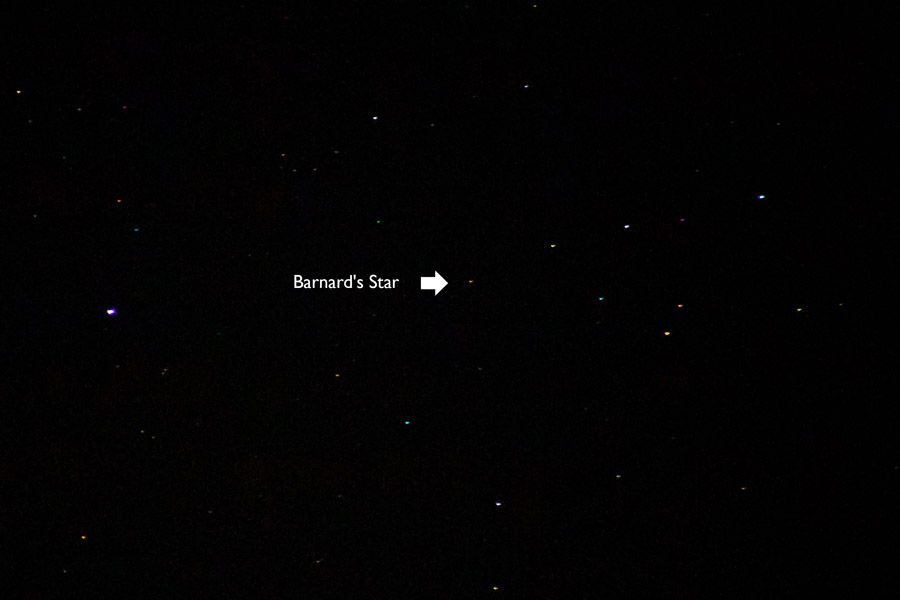
| Date | October 2, 2019 |
| Time | 9:54 p.m. |
| Location | Seattle, WA |
| Camera | Canon 77d on tripod |
| Lens | ƒ/6.31, 400mm, ISO6400 |
| Canon 70D on tripod | Above Average |
| Transparency | Average |
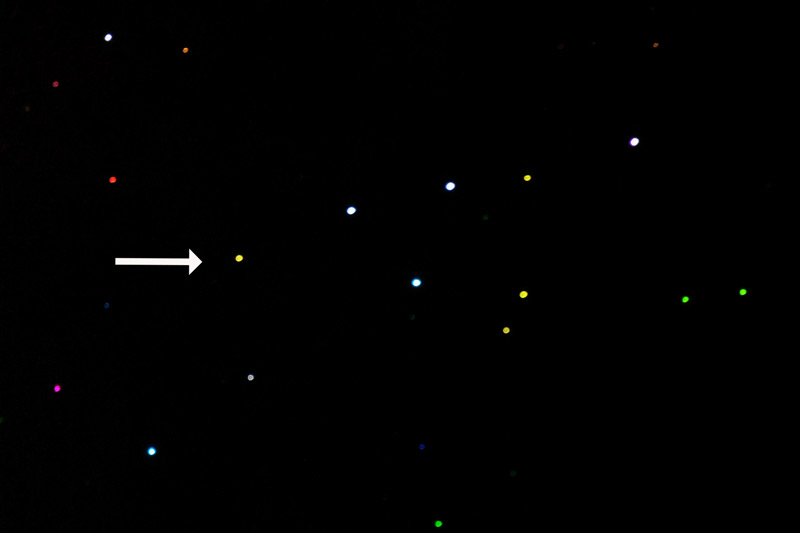
Before I started this site in 2020, I experimented with my DSLR camera, which was equipped with a 400mm lens mounted on a tripod. My goal was to capture faint stars that I had difficulty spotting with my telescope using long-exposure photography. On one particular night, the haze and light from Tacoma to the south were washing out the sky, making it hard to identify which dim star was Barnard’s Star through my scope. So, I decided to use my camera to locate it instead.
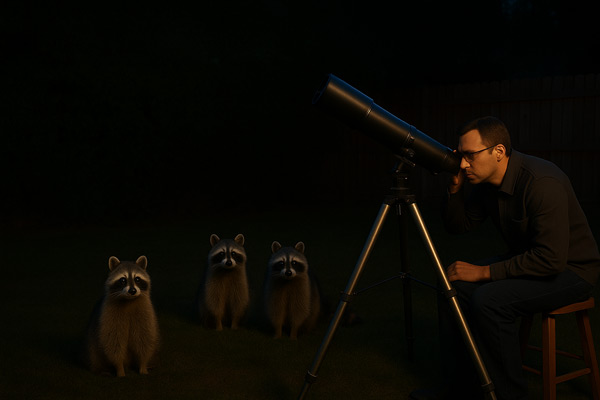
I remember that evening vividly as I rushed to set up my camera before Barnard’s Star passed beneath the trees in my backyard. While I struggled to align the camera, I noticed some bushes about ten feet away rustling. Curiosity got the better of me, and I turned on my headlamp to investigate, only to be startled by a pair of reflecting eyes staring back at me. I must have jumped ten feet in surprise! Standing frozen in their tracks, a family of raccoons looked directly at me, and I couldn’t look away either. To my surprise, instead of running away, they continued to watch me for about thirty seconds before leisurely making their way back into the bushes.
Key Stats
| Constellation | Ophiuchus |
| Best Viewing | Summer-Autumn |
| Visual Magnitude | +9.5 |
| Absolute Visual Magnitude | 13.2 |
| Distance from Earth | 5.9 ly |
| My Viewing Grade | C+ |
| Designations | Runaway Star, HIP 87937, LFT 1385, Proxima Ophiuchi, V2500 Ophiuchi. |
Sources and Notes
Sketch by Wayne McGraw
 The Garden Astronomer