
Since the dawn of time, people have admired the bright presence of Venus in the sky. Often referred to as the morning or evening star, our sister planet has played a notable role in many ancient cultures and religions. Ironically, this planet, named after the Roman goddess of love and beauty, is a toxic world with sulfuric acid clouds. It’s those clouds, however, that reflect the sunlight and make Venus a beautiful star, also known as the “Bringer of Light.”
My Observations
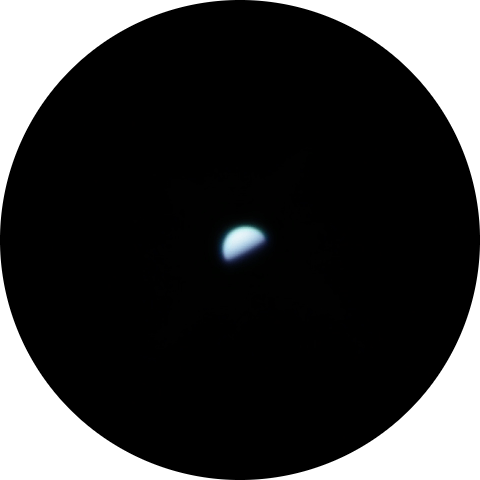
| Date | April 8, 2020 |
| Time | 8:50 p.m. |
| Location | Seattle, WA |
| Scope | Meade 8″ SCT |
| Seeing | Above Average |
| Transparency | Above Average |
When I think of Venus, two memories rush to my mind. My first memory entails climbing up to the second-story roof of my childhood home in Colorado to watch sunsets. All the homes in the mid-century neighborhood had one level, but my dad decided to build an addition after I came along. So upon this perch, I had the best view for miles with all the other rooftops below me. Then, I recall one day when a bright star appeared over the mountains. Soon enough, I confirmed the star was Venus and started tracking the planet each night with my binoculars until it set over the western horizon. Those were some of my favorite moments from my childhood—just me watching Venus chase the sun until the mountains swallowed both up.
Also, during my teenage years, I happened to catch Venus during sunrise while looking for the elusive planet Mercury. It was on the early morning of January 24, 1989, while watching the local newscast before sunrise. I had woken up earlier to learn about the fate of the infamous serial killer Ted Bundy, who was executed that morning. During the short weather segment, which broke away from the live coverage, the weatherman added that viewers could try to spot both Venus and Mercury in the predawn sky. You can read more about this bizarre coincidence in my history on the Mercury page.
The second memory is recent and is captured in the photo to the right. This is Venus over my house in Seattle on April 8, 2020—about 40 years after those memorable times I had in Colorado.
This time, sadness makes the moment unforgettable. A few weeks earlier, my family and I (as with so many) entered quarantine after the World Health Organization declared the COVID-19 pandemic on March 11th. Many stayed in their homes waiting for the virus to pass as if it was some type of alien invader soon to depart, while doctors, nurses and so many brave essential and front-line workers dedicated their lives to save lives.

On April 8th, I had finished a long day of work, while my wife helped my daughter adjust to schooling at home. I needed a moment to escape and noticed the skies were clear. As I gathered up my telescope and gear near the garage door, I listened to the painful TV news blaring in from the other room. In disbelief, I headed out through the garage.
I threw my notebooks down, set up the telescope, and tinkered with several eyepieces. Right then, out of the corner of my eye, I noticed Venus. To my surprise, Venus was high in the sky. Instantly, my mind raced back decades when I used to watch this old friend set behind the mountains. Venus’ sharp light reminded me of better days and how the steadfast stars in the heavens shine down regardless of life’s circumstances.
It was a moment of solace. The twilight faded into black, and the neighborhood went silent, minus a chorus of spring peeper frogs in the distance. I knew all at once that the pandemic would destroy lives, but life would manage to move forward. I didn’t waste another moment; I ran into the house, grabbed the camera, and took several photos of Venus, so I could look back and never forget the “bringer of light.”
Key Stats
| What constellation When Observed | Taurus |
| Visual Magnitude When Observed | -4.62 |
| Distance from Earth When Observed | .5908 AU |
Sources and Notes
Photo of Venus by NASA/JPL-Caltech. his file is in the public domain in the United States because it was solely created by NASA.
 The Garden Astronomer
2 thoughts on “Venus: The Bringer of Light”