

The Actual Astronomy Podcast hosted by Chris Beckett & Shane Ludtke featured my observation of Messier 51 on Episode #314 with guest Alister Ling
My sincere thanks to Chris Beckett for highlighting this observation log.
Episode #314: Audio | Show Notes
Described as a grand spiral staircase sweeping through space, Messier 51 (M51) is one of the great galaxies in our night sky. From Earth, we enjoy a face-on view of the galaxy, giving us a majestic view of its spiral arms. In the springtime, when the Whirlpool is highest in the sky, backyard astronomers and photographers aim their scopes toward its location near the Big Dipper to capture its beauty. Of note, M51 is not in Ursa Major as some may think. It actually makes its home in the constellation of Canes Venatici.
If you are just learning about M51, you’ll notice the galaxy has a yellowish companion: a dwarf galaxy, also known as NGC 5195. This smaller galaxy glides behind the larger one, tugging on its arms. The ongoing interaction creates incredible forces within M51. Consequently, these forces lead to compressed hydrogen gas and star birth! I suggest looking through photographs of the galaxy. Look for bright blue regions near the center where hot blue stars are in the early stages of their life. I’ve found the more I look through images of this galaxy, I’m drawn in by its multitude of colors.
The astronomer Charles Messier first recorded his observations of M51 more than 200 years ago in October 1773.
The Whirlpool Galaxy is more than just a majestic galaxy to me. See my observations below.
My Observations
| Date | April 15, 2020 |
| Time | 11:15 p.m. |
| Location | Seattle, WA |
| Magnification | 127x |
| Scope | Meade 8″ SCT |
| Eyepiece | 16mm |
| Seeing | Average |
| Transparency | Average |

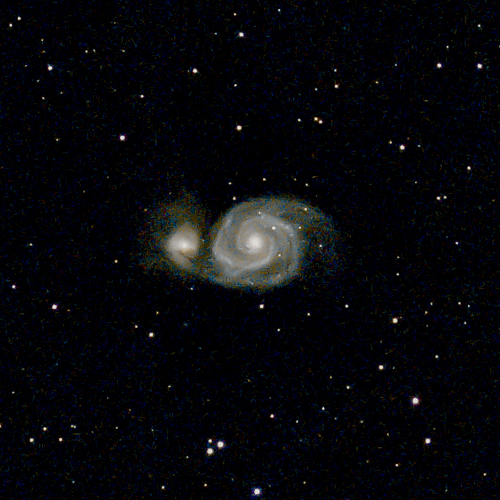
M51 can be a difficult object to see when observing under light-polluted skies. As my sketch shows, the galaxy appears as a faint patch of light from the city, even with an 8-inch scope. On the other hand, it’s possible to photograph the Whirlpool with a standard DSLR camera with a larger lens on a motorized mount that allows for longer exposures.
Even though I’m a novice astrophotographer, I tried my hand at shooting M51 on April 15, 2020 during the early days of the COVID-19 pandemic. Earlier that day, my goddaughter Charlotte was born—a moment of solace and happiness in a darkening world. I set out determined to shoot the majestic Whirlpool as a reminder that the beauty of the universe would not be tarnished by tragedy. Also, I imagined years in the future, hoping that when Charlotte and her generation would face their own trials (wars, disease), she could look upon M51 with a telescope and remember how her uncle looked to the heavens on her birthday to enjoy the Creator’s beauty during a scary and trying time for the entire world.
Key Stats
| Constellation | Canes Venatici |
| Best Viewing | Spring |
| Visual Magnitude | +7.9 |
| Absolute Magnitude | -21.75 |
| Distance from Earth | 28 million ly |
| Diameter | 111,000 ly |
| Apparent Size | 14 x 12 arcmin |
| Milky Way Location | NA |
| My Viewing Grade | B- |
| Designations | NGC 5195, NGC 5194, Rosse’s Galaxy, Question Mark Galaxy, UGC 8493 |
Historical Observations
Charles Messier observation on October 16, 1773
“Very faint nebula, without stars, near the eye of the Northern Greyhound [hunting dog], below the star Eta of 2nd magnitude of the tail of Ursa Major.” 1
Charles Smyth’s observation around September 1836
“A pair of lucid white nebulae, each with an apparent nucleus, with their nebulosities running into each other, as if under the influence of a condensing power. “ He continues later in the passion: “We have then an object presenting an amazing display of the uncontrollable energies of the OMNIPOTENCE, the contemplation of which compels reason and admiration to yield to awe. On the outermost verge of telescopic reach we perceive a stellar universe similar to that to which we belong, whose vast amplitudes no doubt are peopled with countless numbers of percipient beings; for those beautiful orbs cannot be considered as mere masses of inert matter. And it is interesting to know that, if there be intelligent existence, an astronomer gazing at our distant universe, will see it, with a good telescope, precisely under the lateral aspect which theirs presents to us. But after all what do we see? Both that wonderful universe, our own, and all which optical assistance has revealed to us, may be only the outliers of a cluster immensely more numerous. The millions of suns we perceive cannot comprise the Creator’s Universe. There are no bounds to infinitude; and the boldest views of the elder Herschel only placed us as commanding a ken whose radius is some 35,000 times longer than the distance of Sirius from us.”1
Sources and Notes
The banner photo of M51 is attributed to NASA/JPL-Caltech and is in the public domain in the United States.
1Historical observation from messier.seds.org.
Observation photo and sketch by Wayne McGraw
 The Garden Astronomer
4 thoughts on “Messier 51: The Great Whirlpool”