
Messier 4 (M4) is a brilliant globular cluster in the constellation of Scorpius, which is best viewed in summer.
At approximately 5,500 light-years away, M4 is one of the nearest globulars to Earth and one of the brightest in the night sky. With a magnitude of +5.6, even backyard astronomers fighting against light pollution should have a relatively easy time locating the cluster with its 100,000 stars. Of note, the blazing star Antares lies nearby, so anyone having trouble should zero in on Antares and then slew their scope in that area. A pair of binoculars will show a bright fuzzy patch, while a small telescope (or larger) will resolve individual stars.
As with many astronomical objects, it’s difficult to imagine how large particular objects are in the night sky with the naked eye. If we could magically erase all light pollution and turn up M4’s brightness, we would see a cluster larger in diameter than the moon! This is so as M4 is 36 arcminutes in diameter, while the moon is 31.
Historically speaking, Philippe Loys de Chéseaux discovered M4 in 1745, and Charles Messier independently rediscovered and cataloged it on May 8, 1764.1
My Observations
| Date | August 2, 2020 |
| Time | 11:16 p.m. |
| Location | Seattle, WA |
| Magnification | Canon 70d |
| Scope | Meade 8″ SCT |
| Eyepiece | 600mm Lens |
| Seeing | Above Average |
| Transparency | Above Average |
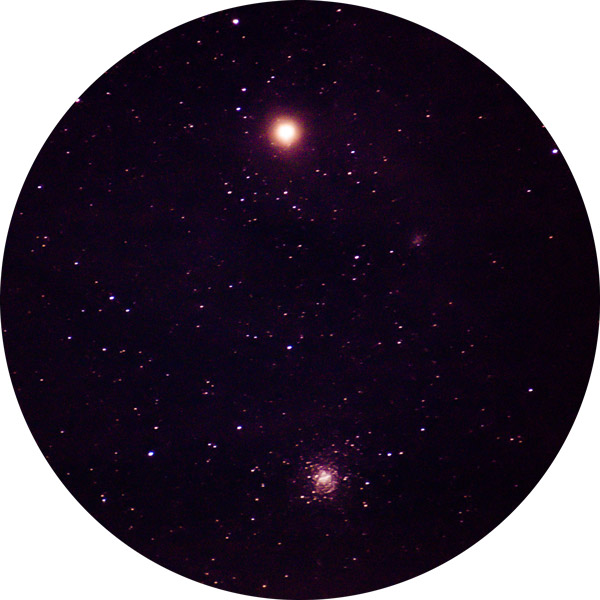
I remember my excitement on this night in Sacramento, California. It was our family’s first trip away since the start of the pandemic. The California skies were clear and crisp, and I enjoyed that Scorpius rose higher on the firmament than in Seattle. I used my Canon 70d attached to a SkyTracker device to take multiple exposures of it.
Later that evening, I started scrolling through the images. Even with the unprocessed ones, I could easily make our M4 with its brilliant presence near the flaming Antares. I was instantly taken back to 1986 when I first saw M4, as it was one of the first objects I found with our small family telescope. I recall telling myself how these mesmerizing globular clusters are like chandeliers hanging in a hallway on the way to heaven. To see M4 all these years later took away the sadness of the last few months and reminded me of how life changes, but the stars in the sky remain.
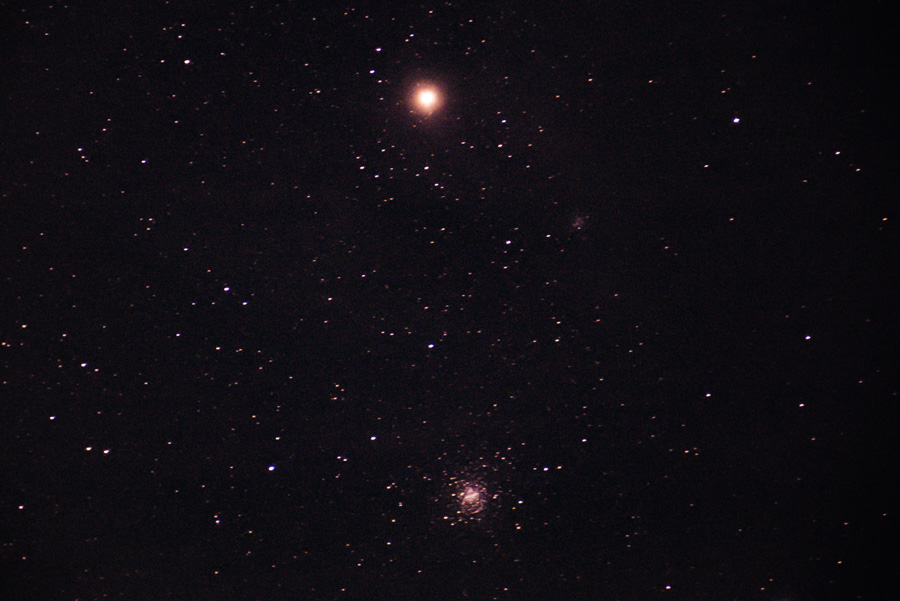
Observation on June 16, 2025, from Tampa, Florida: Low patches of clouds sail in and out above the townhome on this evening. Still, my excitement over seeing Scorpio come into view got the best of me, so I decided to try imaging M4 with the Seestar S50. Like a camera flash, lightning from a thunderstorm in the distance flashed across the darker skies while I photographed the cluster.
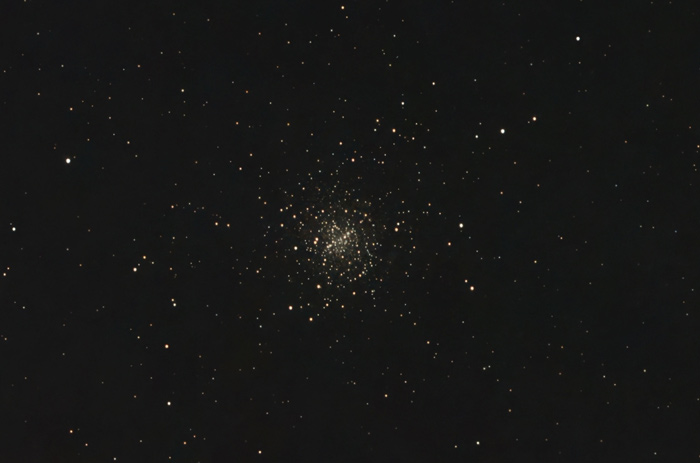
Key Stats
| Constellation | Scorpius |
| Best Viewing | Summer |
| Visual Magnitude | +5.63 |
| Absolute Magnitude | -6.08 |
| Distance from Earth | 7,200 ly |
| Diameter | 35 ly |
| Apparent Size | 36 arcmin |
| Milky Way Location | Scutum Arm |
| My Viewing Grade | A |
| Designations | M4, NGC 6121 |
Historical Observations
1746: Philippe Loys de Chéseaux
“One which is near Antares, which I have found, for this year, at RA 242d 1′ 45″ and declination 25d 23′ 30″. It is white, round, and smaller than the previous ones; I don’t know anyone who noted it previously.” 2
1783: William Herschel
“A rich cluster of considerably compressed small stars surrounded by many straggling ones. It contains a ridge of stars running through the middle from south preceding [SW] to north following [NE]. The ridge contains 8 or 10 pretty bright stars. All the stars are red.” 2
Sources and Notes
Banner photo of Messier 4: ESO Imaging Survey, https://www.eso.org/public/usa/images/eso1235a/, This file is licensed under the Creative Commons Attribution 4.0 International license.
1 Garner, Rob. “Messier 4.” NASA, NASA, 6 Oct. 2017, https://www.nasa.gov/feature/goddard/2017/messier-4.
2 Frommert, Hartmut, and Guy McArthur. Messier 4, http://www.messier.seds.org/Mdes/dm004.html.
 The Garden Astronomer