
Messier 13 is a globular cluster in the constellation Hercules. It’s best viewed in summer.
“This is but a little Patch, but it shews it self to the naked Eye when the Sky is serene and the Moon absent.”1 Edmund Halley wrote these words hundreds of years ago—in 1714 in fact—upon observing the Great Hercules Cluster. Messier 13 made history in 1974 when astronomers sent a message toward it, hoping that exterrestrial ears might hear the signal. The catch is it will take 25,000 years to reach the mass of stars. Today, trying to view M13 under light-washed city summer skies is practically impossible. Still, M13 joins the bright clusters of M3 and M5 as a great target for those in urban areas with binoculars or telescope in hand.
My Observations
| Date | May 28, 2021 |
| Time | 11:15 p.m. |
| Location | Seattle, WA |
| Magnification | 78x |
| Scope | Meade 8″ SCT |
| Eyepiece | 26mm |
| Seeing | Average |
| Transparency | Average |
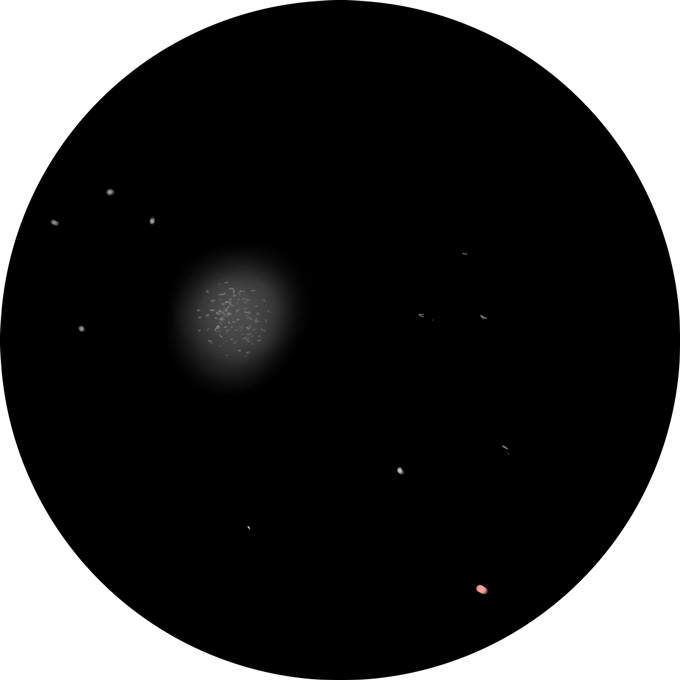
As I look through the scope, I realize Messier 13 lives up to its reputation as a good object for backyard astronomers. The cluster is well-defined and bright. I am able to pick out some individual stars.
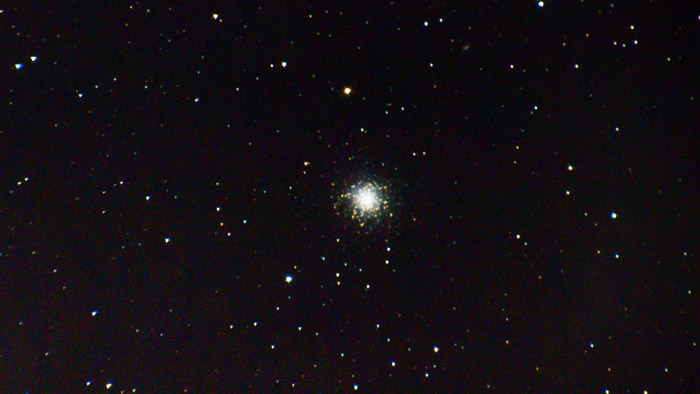
Backyard Photo
Key Stats
| Constellation | Hercules |
| Best Viewing | Summer |
| Visual Magnitude | +5.8 |
| Absolute Magnitude | -8.5 |
| Distance from Earth | 25,000 ly |
| Diameter | 134 ly |
| Apparent Size | 20 arcmin |
| Milky Way Location | Orion Spur |
| My Viewing Grade | A |
Historical Observations
June 1 to 2, 1764 observation by Charles Messier
“In the night of June 1 to 2, 1764, I have discovered a nebula in the girdle of Hercules, of which I am sure it doesn’t contain any star; having examined it with a Newtonian telescope of four feet and a half, which magnified 60 times, it is round, beautiful & brilliant, the center brighter than the borders: One perceives it with an ordinary [non-achromatic] refractor of one foot, it may have a diameter of three minutes of arc: It is accompanied by two stars, the one and the other of the ninth magnitude, situated, the one above and the other below the nebula, & little distant. I have determined its position at its passage of the Meridian, and compared with the star Epsilon Herculis.”
Sources and Notes
1 Quote from Edmund Halley from Astronomy Now
Messier 13 photo top of page: Sid Leach/Adam Block/Mount Lemmon SkyCenter
Charles Messier Observations: SEDS Messier Database
Sketch by Wayne McGraw
AKA: Great Hercules Cluster, M13, NGC 6205
 The Garden Astronomer
Hi Wayne, I really like how organized and complete your blog is. Its a delight to read and go over your sketches and images and know what to expect. I am starting out with astronomy and blogging myself and will be sure to drop in often.
LikeLiked by 1 person
Thank you so much for this encouraging and kind note. I’m really glad you find the site helpful. Astronomy is such a rewarding journey, and pairing it with blogging is a wonderful way to slow down, reflect, and share what you’re discovering along the way.
I appreciate you stopping by. You’re always welcome here, and don’t hesitate to reach out if you have any questions through my contact page.
Wishing you clear skies above… and in life itself. Keep looking up!
Wayne
LikeLike