
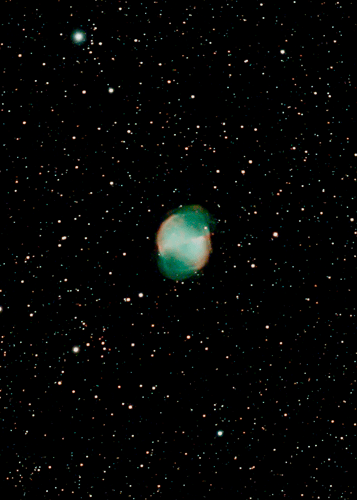
Messier 27 is a planetary nebula in the constellation Vulpecula. It is also known as the Dumbbell Nebula due to its distinctive shape resembling a dumbbell or hourglass. It’s best viewed in summer and early autumn.
Astronomer William Herschel came up with the name planetary nebula for objects like the M27 because they resembled the round, faint object of the newly-discovered planet Uranus. In my case, I saw the Dumbbell Nebula before finding Uranus in my 8-inch scope, so I didn’t really understand the connection. However, the minute I finally saw Uranus, I saw why Hershel invented the name.
M27 is about 1,360 light-years away from Earth and has a visual magnitude of 7.5, making it visible with binoculars (from a dark site) or a small telescope from most locations. Along with the popular M57 Ring Nebula, M27 is a great target and example of a planetary nebula for backyard astronomers.
Historically speaking, the French astronomer Charles Messier first recorded the nebula in July 1764.1
My Observations
| Date | July 30, 2022 |
| Time | 12:30 a.m. |
| Location | Seattle, WA |
| Magnification | 85x |
| Scope | Meade 8″ SCT |
| Eyepiece | 24mm |
| Seeing | Above Average |
| Transparency | Above Average |

It’s past midnight. The hours leading up to now have been rewarding, for the night sky has given up some gems. As I prepared to pack up the equipment and haul it back to the garage, I remembered that I needed to sketch M27 since I never did upon seeing it in August 2020.
As I finish this sketch, I’m taken aback by the time that has passed. When I first saw M27 in the scope, we were still early on in the pandemic journey. It’s not that we’ve completely arrived, but life has scratched its way back. In a month, I’ll see my daughter leave for college when only yesterday (it seems) she started high school, but COVID erased so much of it. Still, I’m grateful that chapters change, life moves on, and the stars don’t fall from the sky.
Right now, the sky is crisp, and M27 breaks through to greet me. I did add the Ultra High Contrast filter, and I can just pick up on the hourglass—or at least I think I’m seeing it! I forgot how large it looks in the eyepiece as well—a faint, mostly round haze that seems to float in front of other stars.
I first observed M27 on August 18, 2020, at 10:35: Due to the bright suburban skies I work under, I wasn’t expecting to find M27. To my surprise, I found the nebula without much delay. I relied on peripheral vision for the first few seconds as I confirmed I found the object. The dumbbell floats like a dim cloud among the faint stars in the eyepiece. While it appears mostly gray in color, it seems to me there is a green tinge. Bortle Class: 7
Key Stats
| Constellation | Vulpecula |
| Best Viewing | Summer, Early Autumn |
| Visual Magnitude | +7.4 |
| Absolute Magnitude | -1.07 |
| Distance from Earth | 1,400 ly |
| Diameter | 3 ly |
| Apparent Size | 8 x 5.7 arcmin |
| Milky Way Location | Orion Spur |
| My Viewing Grade | B+ |
| Designations | M 27, Apple Core Nebula, NGC 6853 |
Historical Observations
July 12, 1764, observation by Charles Messier
“I have worked on the research of the nebulae, and I have discovered one in the constellation Vulpecula, between the two forepaws, & very near the star of fifth magnitude, the fourteenth of that constellation, according to the catalog of Flamsteed: One sees it well in an ordinary refractor of three feet & a half. I have examined it with a Gregorian telescope which magnified 104 times: it appears in an oval shape; it doesn’t contain any star; its diameter is about 4 minutes of arc.”2
Sources
Photo by Stephen Rahn from Macon, GA, USA. This file is made available under the Creative Commons CC0 1.0 Universal Public Domain Dedication.
1“Dumbbell Nebula.” Wikipedia, Wikimedia Foundation, 25 Feb. 2023, en.wikipedia.org/wiki/Dumbbell_Nebula. Accessed 26 Mar. 2023.
2McArthur, Guy, and Hartmut Frommert. “Messier 27.” Messier Object 27, http://www.messier.seds.org/m/m027.html.
 The Garden Astronomer
4 thoughts on “Messier 27 (NGC 6853): The Dumbbell Planetary Nebula in Vulpecula”