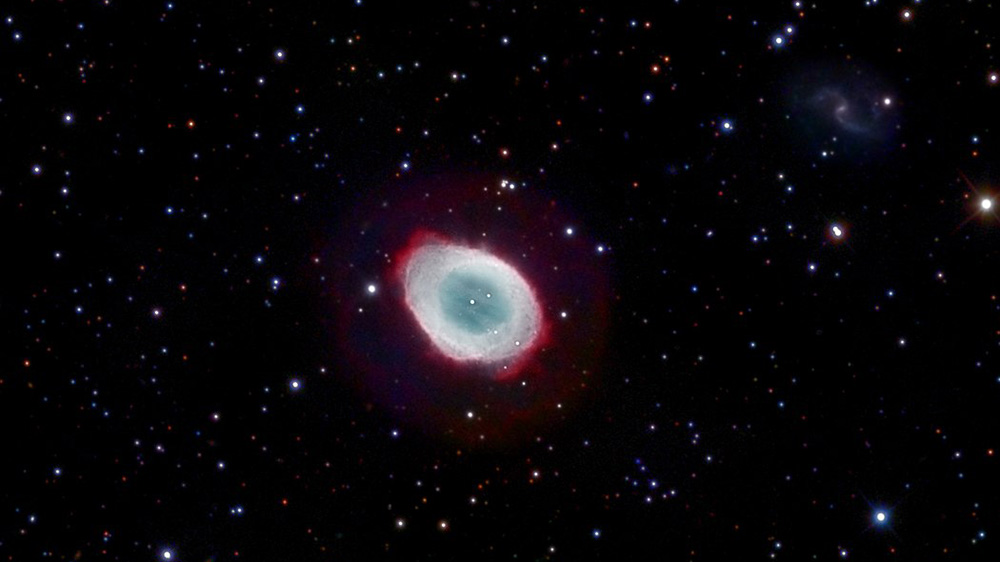
Messier 57, affectionately known as the Ring Nebula, is a planetary nebula in the constellation Lyra. It is best viewed during the summer months.
M57 gets its name from its distinctive ring-like shape, which is created by a shell of gas and dust surrounding a dying star at its center. The central star has blown off its outer layers of gas, creating a nebula that is illuminated by the star’s remaining core. This gives the Ring Nebula its striking appearance and makes it a popular target for amateur astronomers.
Observing M57 through a telescope is truly a great experience. The nebula appears as a faint smoke ring. The colors of the nebula can vary depending on the type of telescope and filters used, but it typically has a blue-green hue that is caused by the presence of oxygen ions in the gas cloud.1
Overall, Messier 57 is an awesome backyard target that is well worth observing. Its unique shape, bright colors, and intriguing location in the sky make it a true gem of the night sky.
My Observations
| Date | August 18, 2020 |
| Time | 10:30 p.m. |
| Location | Seattle, WA |
| Magnification | 113x |
| Scope | Meade 8″ SCT |
| Eyepiece | 18mm |
| Seeing | Above Average |
| Transparency | Average |
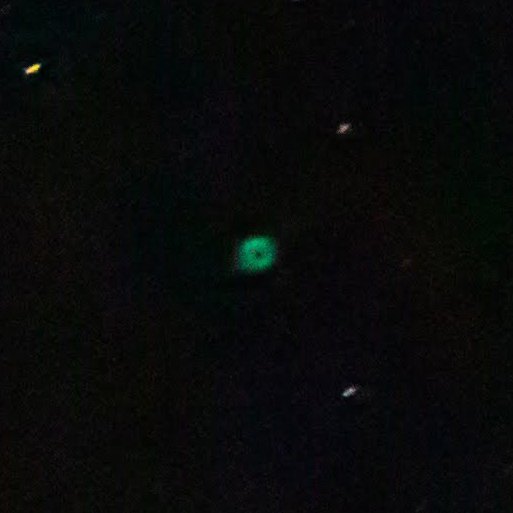
M57 is a great object to show others new to astronomy. As I view the planetary nebula tonight, I’m reminded that it never grows old on me. Using a light pollution filter makes the ring appear slightly brighter. While tonight is not my first time seeing the famous nebula, I can actually recall my first time viewing it. I was in my 20s back in Colorado. I had recently purchased my first “real” telescope—a Meade 8-inch Newtonian on a heavy motorized mount. That thing was SO heavy to carry in and out of the house!
I remember moving it back and forth across Lyra, straining to see something that looked like a donut. After a few minutes, there it was. A faint ring looked back at me on that Colorado summer night. What a great object to see with a brand-new scope!
Key Stats
| Constellation | Lyra |
| Best Viewing | Summer |
| Visual Magnitude | +8.8 |
| Absolute Magnitude | +0.7 |
| Distance from Earth | 6,000 ly |
| Diameter | 57 ly |
| Apparent Size | 1.4 x 1.1 arcmin |
| Milky Way Location | Orion Arm |
| My Viewing Grade | A- |
| Designations | ARO 9, M57, NGC 6720 |
Historical Observations
January 31, 1779, observation by Charles Messier
“A cluster of light between Gamma & Beta Lyrae, discovered when looking for the Comet of 1779, which has passed it very close: it seems that this patch of light, which is round, must be composed of very small stars: with the best telescopes it is impossible to distinguish them; there stays only a suspicion that they are there. M. Messier reported this patch of light on the Chart of the Comet of 1779. M. Darquier, at Toulouse, discovered it when observing the same comet, and he reports: “Nebula between gamma and beta Lyrae; it is very dull, but perfectly outlined; it is as large as Jupiter & resembles a planet which is fading.”
Sources
Photo top of page by “Jschulman555” and the file is licensed under the Creative Commons Attribution-Share Alike 4.0 International license.
1“Ring Nebula.” Wikipedia, Wikimedia Foundation, 16 Mar. 2023, en.wikipedia.org/wiki/Ring_Nebula. Accessed 1 Apr. 2023.
2Charles Messier Observations: SEDS Messier Database
 The Garden Astronomer
11 thoughts on “Messier 57 (NGC 6720): The Ring Nebula”