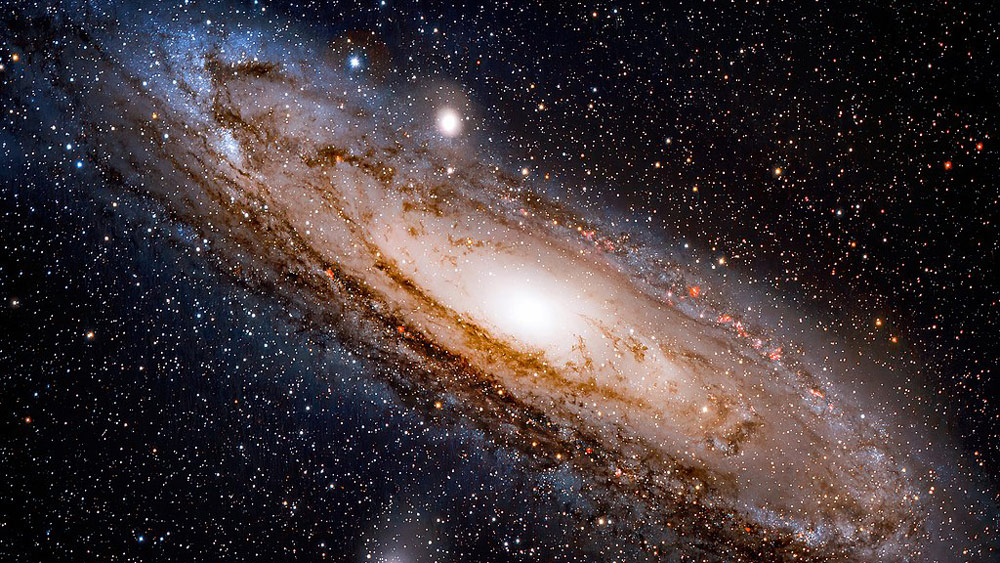
Messier 31 (M31) is a galaxy in the constellation Andromeda, also known famously as the Andromeda Galaxy. This spiral galaxy is one of the most well-known and beloved objects in the autumn and early winter night sky.
My father owned an old textbook by Dr. John Duncan titled Astronomy, which was first published in 1926. As a kid, I would flip through the coffee-stained pages looking at the black-and-white photos of the moon, nebula, and clusters. Near the end of the book, Duncan included a beautiful photo of Andromeda. I credit this photo for starting my love affair with the night sky before I had a telescope.
Located about 2.5 million light-years away from Earth, Messier 31 is the nearest galaxy to our own Milky Way. It spans over 220,000 light-years across and is one of the largest galaxies in our own local group of galaxies near us.
Today, Messier 31 is a popular target for amateur and professional astronomers alike. With a magnitude of 3.4, it’s visible to the naked eye in dark skies and is easily spotted through binoculars or a small telescope, even under suburban skies. In fact, it’s often one of the first deep-sky objects that aspiring astronomers observe.
Historically speaking, Messier 31 was first discovered in 964 AD by Persian astronomer Abd al-Rahman al-Sufi, who described it as a “small cloud” in his writings. However, it wasn’t until the 18th century that the galaxy was recognized as a separate entity from the Milky Way.1
Whether you’re observing M31 through a telescope or simply gazing up at the stars, the galaxy is a sight to behold.
My Observations of M31
| Date | October 6, 2020 |
| Time | 9:34 p.m. |
| Location | Seattle, WA |
| Magnification | 127x |
| Scope | Meade 8″ SCT |
| Eyepiece | 16mm |
| Seeing | Average |
| Transparency | Average |
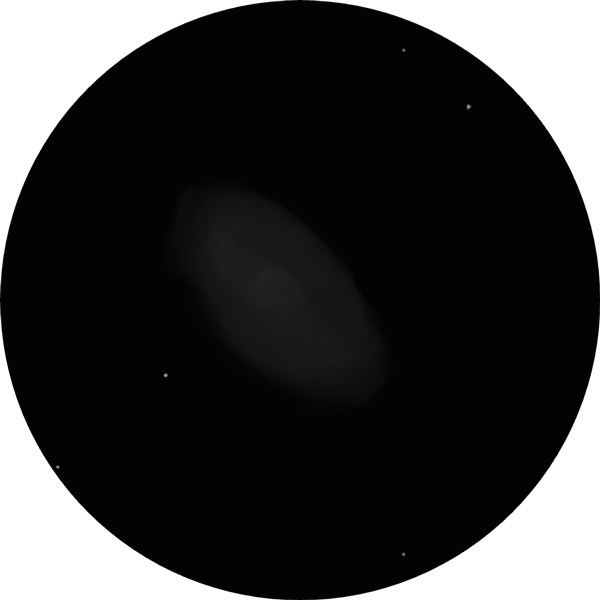
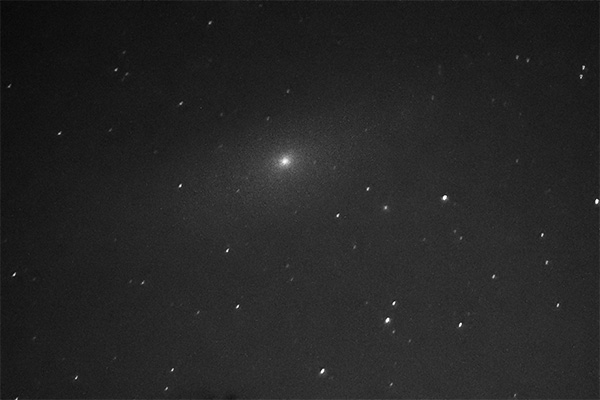
Tonight is my first time observing M31 through an 8-inch scope. Unfortunately, a rising moon is scratching out any dark skies left from the early evening. After trying various eyepieces with the scope, I prefer 16mm. I know for a fact that the Great Andomeda Galaxy is big enough to “spill” out over the field of view I’m looking at right now. I’m really “zoomed” in at 16mm. But for some reason right now, 16mm is picking up the most light from the object. I’m not great at drawing, but the sketch gives one a somewhat close idea of my view. The photo below shows Andromeda how it’s looking through my eyepiece. The galaxy crosses diagonally with a slightly brighter core region.
Key Stats
| Constellation | Andromeda |
| Best Viewing | Autumn |
| Visual Magnitude | +3.28 |
| Absolute Magnitude | -21.17 |
| Distance from Earth | 2.5 million ly |
| Diameter | 220,000 ly |
| Apparent Size | 177 x 69 arcmin |
| My Viewing Grade | B |
Historical Observations
August 3, 1764 observation by Charles Messier
“The sky has been very good in the night of August 3 to 4, 1764; & the constellation Andromeda was near the Meridian, I have examined with attention the beautiful nebula in the girdle of Andromeda, which was discovered in 1612 by Simon Marius, & which has been observed since with great care by different astronomers, & at last by M. le Gentil who has given a very ample & detailed description in the volume of the Memoirs of the Academy for 1759, page 453, with a drawing of its appearance. I will not report here what I have written in my [observing] Journal: I have employed different instruments for examining that nebula, & above all an excellent Gregorian telescope of 30 pouces focal length, the large mirror having 6 pouces in diameter, & magnifying 104 times these objects: the middle of that nebula appeared rather bright with this instrument, without any appearance of stars; the light went diminishing up to extinguishing; it resembles two cones or pyramids of light, opposed at their bases, of which the axis was in the direction form North-West to South-East; the two points of light or the two summits are about 40 minutes of arc apart; I say about, because of the difficulty to recognize these two extremities. The common base of the two pyramides is 15 minutes [of arc long]: these measures have been made with a Newtonian telescope of 4 feet & a half focal length, equipped with a micrometer of silk wires. With the same instrument I have compared the middle of the summits of the two cones of light with the star Gamma Andromedae of fourth magnitude which is very near to it, & little distant from its parallel.”2
Sources and Notes
Photo by David (Deddy) Dayag. The file is licensed under the Creative Commons Attribution-Share Alike 4.0 International license.
1Garner, Rob. “Messier 31 (The Andromeda Galaxy).” NASA, NASA, 6 Oct. 2017, https://www.nasa.gov/feature/goddard/2017/messier-31-the-andromeda-galaxy.
2Charles Messier Observations: SEDS Messier Database
 The Garden Astronomer
7 thoughts on “Messier 31 (NGC 224): That’s No Nebula! That’s a Galaxy! Welcome to Andromeda”