
Messier 35, also known by the name the Show-buckle Cluster, is an open cluster in the constellation of Gemini. It’s best viewed in the winter months.
With at least a pair of binoculars, most stargazers, including those living with urban light pollution, will be able to enjoy M35. The cluster is spread out. It takes up as much of the sky as our moon. Due to this fact, telescope observers should use low power to take in the full view. M35 is 2,800 light years away from us and around 100 million years old. The astronomer Philippe Loys de Chéseaux discovered the cluster between 1745-46. Years later, in the summer of 1764, the famed astronomer Charles Messier cataloged the object.
My Observations
| Date | November 7, 2020 |
| Time | 12:25 a.m. |
| Location | Seattle, WA |
| Magnification | 85x |
| Scope | Meade 8″ SCT |
| Eyepiece | 24mm |
| Seeing | Average |
| Transparency | Average |
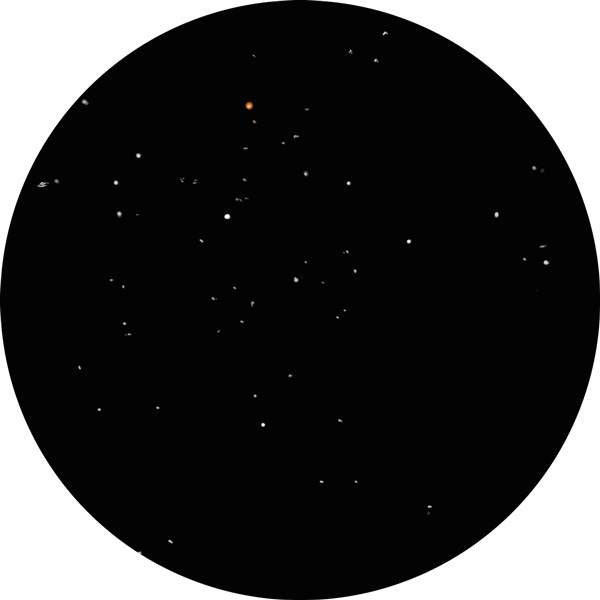
What a beautiful cluster! I’m noticing several lines — or chains — of stars emanating from the central core, looking somewhat like spokes on a tire. These strings of stars give M35 an intriguing appearance. I read in my astronomy app that the M35 contains more than 120 stars between 6 and 12 magnitudes. I can’t count that many due to my light-polluted location, but I’m still in awe. Even at this later hour in the cold of night, I don’t want to take my eyes off the cluster.
Also viewed on March 9, 2022, at 9 p.m.: The drawing on this webpage is from this evening. My original drawing from November 7, 2020, didn’t have the same detail. Also, I noticed the brighter orangish star in the cluster.
Key Stats
| Constellation | Gemini |
| Best Viewing | Winter |
| Visual Magnitude | +5.1 |
| Absolute Magnitude | -4.7 |
| Distance from Earth | 3,000 ly |
| Diameter | 40 ly |
| Apparent Size | 40 arcmin |
| Milky Way Location | Orion Spur |
| My Viewing Grade | A |
Historical Observations
August 30-31, 1764 observation by Charles Messier
“In the night of August 30 to 31, 1764, I have observed a cluster of very small stars, near the left foot of Castor, little distant from the stars Mu and Eta of that constellation [Gemini]. When examining this star cluster with an ordinary refractor of 3 feet, it seemed to contain nebulosity; but having examined it with a good Gregorian telescope which magnified 104 times, I have noticed that it is nothing but a cluster of small stars, among which there are some which are of more light; its extension may be 20 minutes of arc. I have compared the middle of this cluster with the star Eta of Castor; its right ascension has been concluded at 88d 40′ 9″, and its declination at 24d 33′ 30″ north.”
Sources
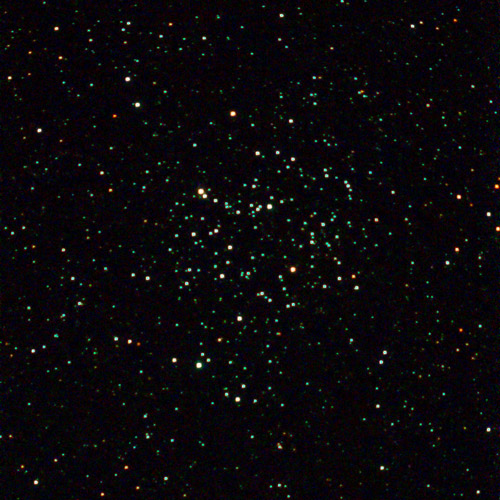
M35 photo provided by Stephen Rahn from Macon, GA, USA and is made available under the Creative Commons CC0 1.0 Universal Public Domain Dedication
Charles Messier Observations: SEDS Messier Database
 The Garden Astronomer