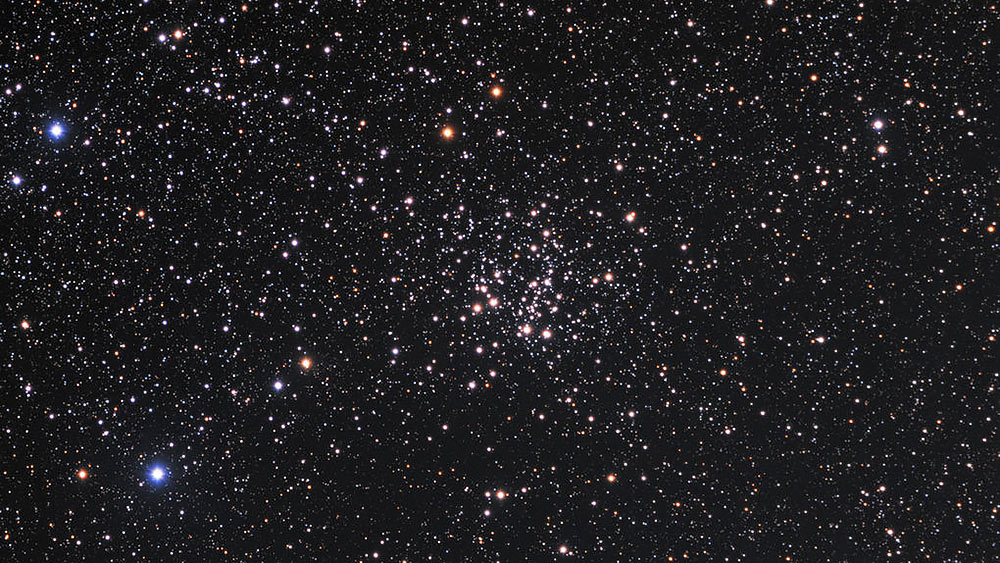
NGC 663, also known as Caldwell 10, is an open star cluster in the constellation of Cassiopeia. It is best viewed in autumn through early winter. The famed astronomer William Herschel first recorded the cluster on November 3, 1787.
Suburban skygazers with large binoculars may be able to make out NGC 663, but a telescope will be better. The cluster is notable for several reasons: it contains several double stars, lies in front of a molecular cloud, so most background stars are blocked, and it hosts a high number of “Be” stars.
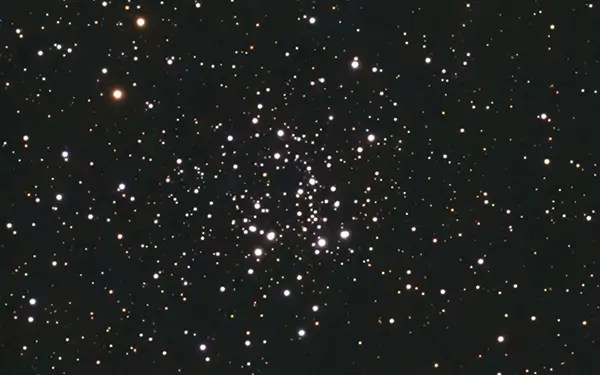
A 2025 study suggests that NGC 663 may be one of the most massive young clusters in the Perseus spiral arm of the Milky Way. With its youth and unusually rich population of massive stars, NGC 663 provides an ideal setting for understanding how massive stars evolve and influence one another within a cluster.
My Observations
| Date | November 8, 2020 |
| Time | 9:15 p.m. |
| Location | Seattle, WA |
| Magnification | 85x |
| Scope | Meade 8″ SCT |
| Eyepiece | 24mm |
| Seeing | Average |
| Transparency | Average |
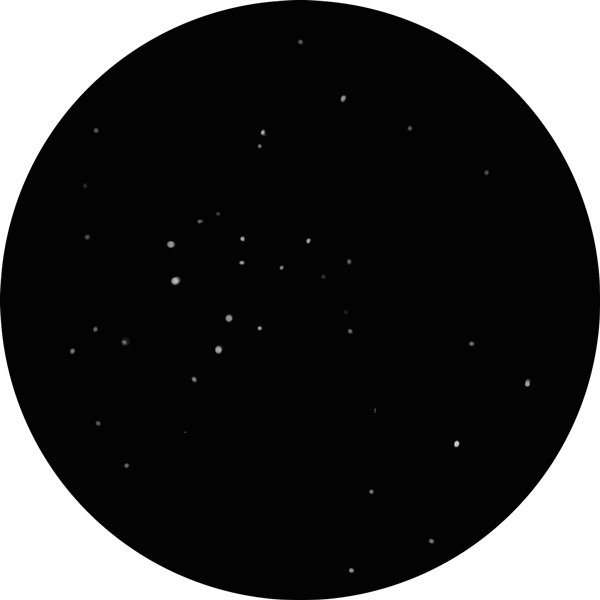
Even with a quarter moon out tonight, I’m able to view NGC 663 using my 24mm eyepiece. There are 5-6 brighter stars in my view, and I believe some of these may be doubles. Unfortunately, the stars’ brightness drops off considerably. I’m sure that on a moonless, dark-sky night, my eyepiece would be fuller of brighter stars, but I also wonder whether I’m seeing how the molecular cloud in this region obscures the stars. More research is needed, and future observations on my end.
Key Stats
| Constellation | Cassiopeia |
| Best Viewing | Late fall/winter |
| Visual Magnitude | +7.1 |
| Absolute Magnitude | -4.8 |
| Distance from Earth | 8,000 ly |
| Diameter | 32 ly |
| Apparent Size | 14 arcmin |
| Milky Way Location | Perseus Arm |
| My Viewing Grade | B |
| Designations | Caldwell 10, Lawnmower Cluster |
Sources and Notes
Marco, A., Negueruela, I., Castro, N., & Simón‑Díaz, S. (2025). NGC 663 as a laboratory for massive star evolution. Instituto de Astrofísica de Canarias. https://www.iac.es/en/science-and-technology/publications/ngc-663-laboratory-massive-star-evolution
Photo of NGC 663 is by Hewholooks and is licensed under the Creative Commons Attribution-Share Alike 3.0 Unported license.
 The Garden Astronomer
One thought on “NGC 663: A Star Cluster Known for its Massive Star Evolution”