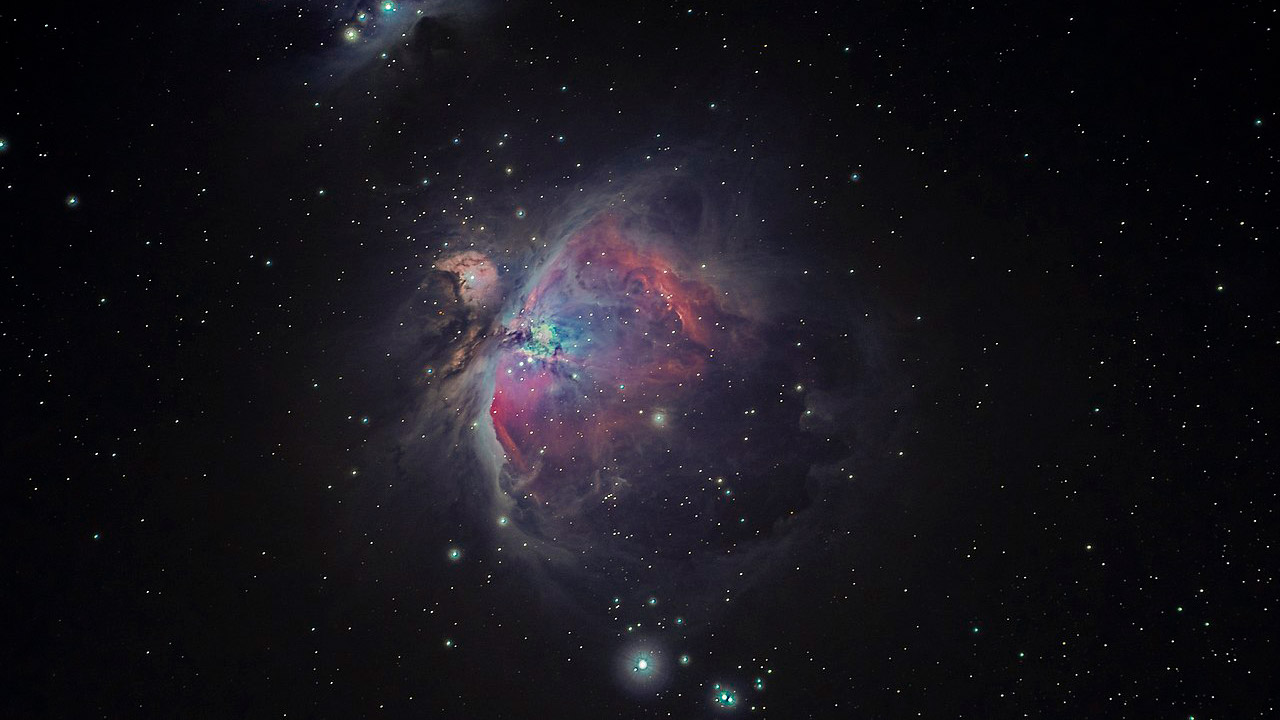
Messier 42, known as the Great Orion Nebula, is in the constellation Orion. It’s best viewed in the winter. The Great Orion Nebula never fails to impress winter stargazers. I don’t care if I’m looking at M42 with a small pair of binoculars or larger scope, I find it difficult to break my gaze at this beautiful stellar nursery.
Covering an area four times the size of the moon, M42 shines at a relatively bright magnitude of 4, making it the brightest diffuse nebula in the night sky. The Orion Nebula is a diffuse nebula, meaning that it is a cloud of interstellar gas and dust that is illuminated by nearby stars. It is estimated to be approximately 24 light-years across and is located at a distance of about 1,344 light-years from Earth.
The nebula is home to a number of young, hot stars that were formed from the gas and dust within the cloud. These stars are known as the Trapezium Cluster and can be seen as a bright cluster of stars near the center of the nebula.
Before taking your next look at M4, be sure to check out NASA’s virtual fly-by movie, which will leave observers even more in awe of this celestial object.
My Observations
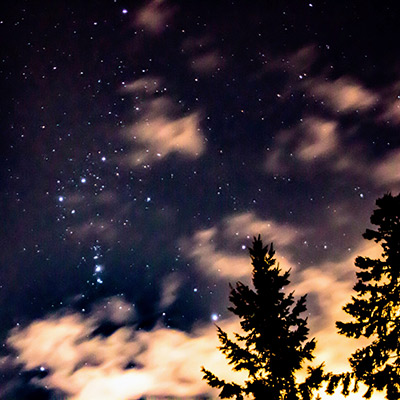
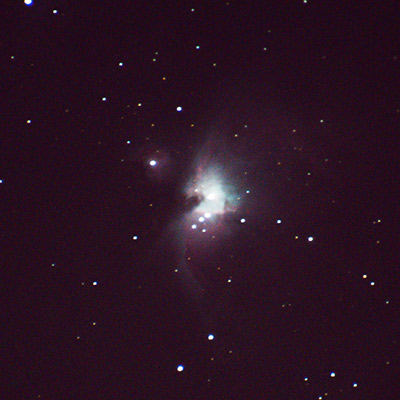
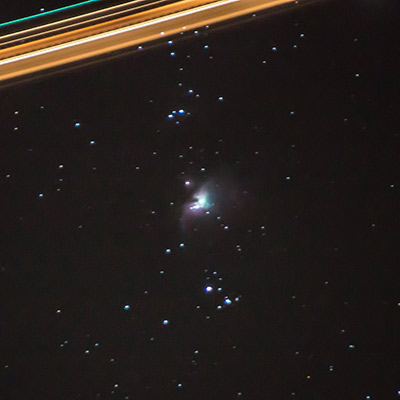
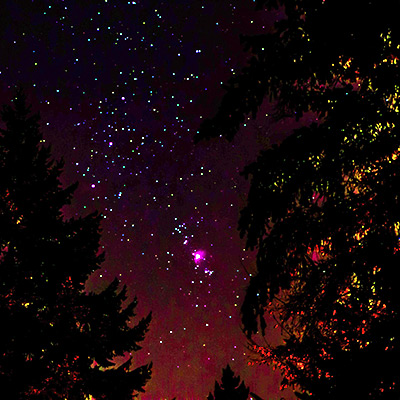
November 7, 2020 at 12:12 a.m., Seattle, Washington: Tonight is my first time viewing M42 with the 8-inch Meade (sketch not made). The night is exceptionally crisp and clear for a winter’s night in the Pacific Northwest. The way this nebula illuminates an eyepiece never gets old! Staring longer than usual, my eyes are playing a game with me. It’s as if this stellar nursery is breathing in and out. The misty “clouds” spread beautifully and fade into the darkness of the firmament. This object never fails to impress. I’m switching over the Star Adventurer and Canon for a few photo. Photos from that night below.
Key Stats
| Constellation | Orion |
| Best Viewing | Winter |
| Visual Magnitude | +4.0 |
| Absolute Magnitude | -4.17 |
| Distance from Earth | 1,350 ly |
| Diameter | 35 ly |
| Apparent Size | 85 x 60 Arcmin |
| My Viewing Grade | A+ |
Historical Observations
1611 observation by Cysatus
“Caeterum huic phaenomeno similis stellarum congeries est in firmamento ad ultimam stellam Gladii Orionis, ibi enim cernere est (per Tubum) cougestas itidem aliquot stellas angustissimo spatio et circumcirca interque ipsas stellulas instar albae nubis candidum lumen affesum.” [This phenomenon is similar to the congeries of stars that is in the firmament towards the last star of the Sword of Orion; there truely is seen (by telescope) a congestion of stars in a narrow space and all round and between those stars light diffuses like a shining white cloud.]2
March 10, 1758 observation by Le Gentil
“It appeared to have the shape of the open jaws of some animal. I observed toward the west, an extension of light forming a rectangle: this light is very diffuse. The three stars in a straight line in the ‘lower jaw’ appear completely detached from the nebula.”2
Sources and Notes
Photograph of the Orion Nebula taken from a backyard in Petaluma California by amateur astronomer Bryan Goff. This file is licensed under the Creative Commons Attribution-Share Alike 4.0 International license.
1“Orion Nebula.” Wikipedia, Wikimedia Foundation, 31 Mar. 2023, en.wikipedia.org/wiki/Orion_Nebula. Accessed 1 Apr. 2023.
2Historic Observations: SEDS Messier Database
 The Garden Astronomer
3 thoughts on “Messier 42 (NGC 1976): A Cosmic Fire and Stellar Nursery in Orion”