
Messier 82 (M82) is known as a starburst galaxy because it’s characterized by intense star formation. It lies nearly 12 million light-years away in the constellation Ursa Major and is best viewed in the spring.
While M82 may look like a lonely smudge of light in the backyard telescope, it’s not passive at all! Instead, it’s a hopping place known for its remarkably high rate of star formation. Supernovas occur frequently there as well. So what’s causing this frenetic activity? Gravity from M82 is interacting with the neighboring Bode’s Galaxy (M81). In addition, M82’s newborn stars emit radiation and particles into the surrounding gas structures of the galaxy, which spurs additional star formation. 1 I like to visualize these two galaxies as two weather fronts mixing together to create turbulent winds and violent thunderstorms.
From the average suburban backyard, M82 is bright enough to see using binoculars, especially if the skies are moonless and very clear. Using a telescope will certainly help pick up M82 more easily, along with M81. Both are great targets for amateur astronomers starting out in the hobby.
Historically speaking, the German astronomer Johann Bode discovered the galaxy on December 31, 1774, describing it as a “small nebulous patch.”
My Observations
| Date | March 11, 2021 |
| Time | 9:20 p.m. |
| Location | Seattle, WA |
| Magnification | 102x |
| Scope | Meade 8″ SCT |
| Eyepiece | 20mm |
| Seeing | Average |
| Transparency | Average |
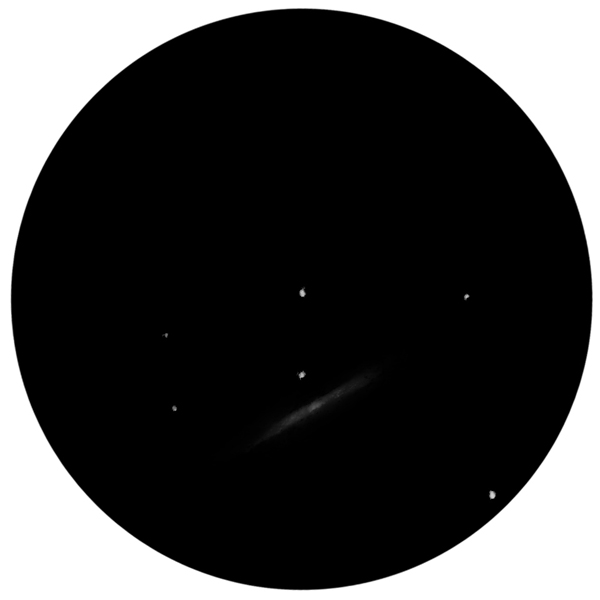
Even from brighter suburban skies, I’m glad I can see M82. It’s fainter than M81, but I can still make out the cigar shape fairly well. The center is slightly bulged and fuzzier in the eyepiece. As I stare into the eyepiece, my mind wanders; I imagine the flurry of star creation and enormous, unimaginable energy in the wispy image I see.
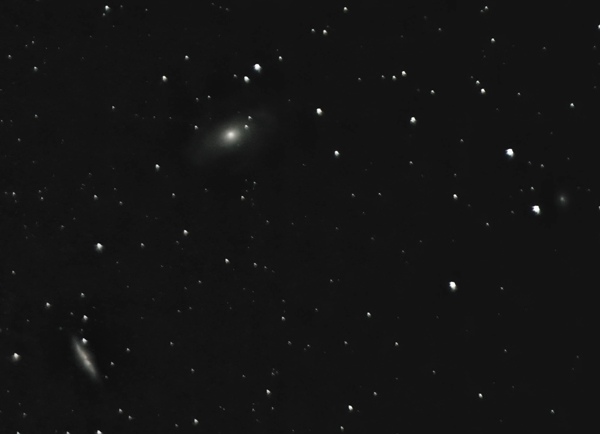
Below is a related photo I took a year earlier.
Key Stats
| Constellation | Ursa Major |
| Best Viewing | Spring |
| Visual Magnitude | +8.1 |
| Absolute Magnitude | -19.8 |
| Distance from Earth | 12 million ly |
| Diameter | 38,000 ly |
| Apparent Size | 11 x 5 arcmin |
| Milky Way Location | N/A |
| My Viewing Grade | B |
Historical Observations
December 31, 1774, by Johann Elert Bode
“I found through the seven-foot telescope, closely above the head of Ursa Major, east near the star d at its ear, two small nebulous patches separated by about 0.75 degrees, the positions of which relative to the neighbored small stars are shown in the tenth figure. The patch Alpha (M81) appears mostly round and has a dense nucleus in the middle. The other, Beta (M82), on the other hand, is very pale and of elongated shape. I could determine the separation of Alpha to d as 2deg 7′, to Rho as 5deg 2′ and to 2 Sigma as 4deg 32′ with some accuracy; Beta was too faint and disappeared from my eyes as soon as I shifted apart the halves of the objective glass.”1
February 9, 1781, by Charles Messier
“A nebula near the ear of the great Bear [Ursa Major], on the parallel of the star d, of fourth or fifth magnitude: its position was determined from that star. This nebula is a little oval, the center clear, and one can see it well in an ordinary telescope of 3.5 feet.”1
Sources and Notes
Photo of M82 by NASA/ESA and The Hubble Heritage Team (STScI/AURA). Photo is in the public domain because it was created by NASA and ESA.
1 Garner, R. (2017, October 6). Messier 82 (the cigar galaxy). NASA. Retrieved April 30, 2022, from https://www.nasa.gov/feature/goddard/2017/messier-82-the-cigar-galaxy
2 Guy McArthur, H. F. (n.d.). Messier 81. Retrieved April 30, 2022, from https://www.messier.seds.org/Mdes/dm081.html
Sketch by Wayne McGraw
 The Garden Astronomer
One thought on “Messier 82 (NGC 3034): The Cigar Galaxy”