
In the constellation Coma Berenices lies the faint, yet fascinating spiral galaxy Messier 64, which is best viewed during springtime.
Discovered by Edward Pigott in March 1779, Messier 66 remains an intriguing object due to the strange behavior of the gas inside the galaxy. According to NASA, the “gas in the outer regions of this remarkable galaxy is rotating in the opposite direction from the gas and stars in its inner regions. This strange behavior can be attributed to a merger between M64 and a satellite galaxy over a billion years ago.” 1 The galaxy is also notable for birthing a lot of new stars in the region where the gases from the outer and inner regions collide.
My Observations
| Date | April 16, 2021 |
| Time | 10:39 p.m. |
| Location | Seattle, WA |
| Magnification | 145x |
| Scope | Meade 8″ SCT |
| Eyepiece | 14mm |
| Seeing | Good |
| Transparency | Good |
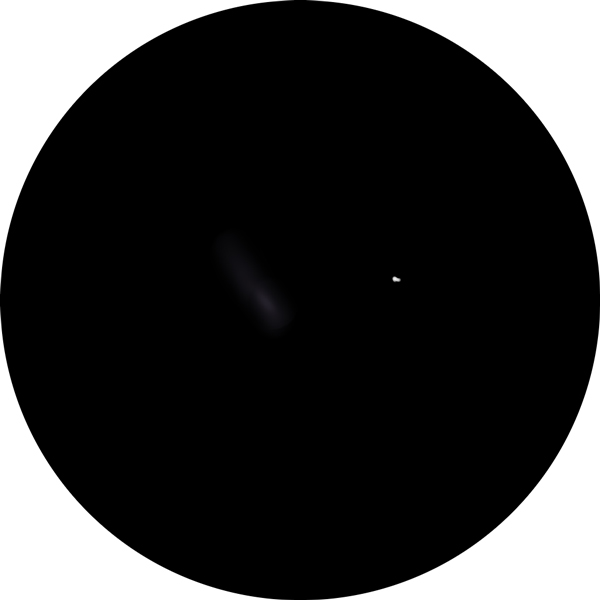
Messier 64 has a slightly brighter magnitude (+8.5) compared to the Messier 66 galaxy that I observed an hour ago. At least at this moment, M64 is not as bright as M66. I want to revisit this object in the future to see if the dimming is due to current weather conditions at my house, or perhaps M64 is not as bright as I expected.
Key Stats
| Constellation | Coma Berenices |
| Best Viewing | Spring |
| Visual Magnitude | +8.4 |
| Absolute Magnitude | -19.8 |
| Distance from Earth | 14 million ly |
| Diameter | 44,000 ly |
| Apparent Size | 10.5 x 5.3 arcmin |
| Milky Way Location | N/A |
| My Viewing Grade | C+ |
Historical Observations
Entry dated March 1, 1780, by Charles Messier
“Nebula discovered in Coma Berenices, which is about half as apparent as that which is below the hair M53.” 2
Sources and Notes
Photo of M66 by NASA/ESA and The Hubble Heritage Team (STScI/AURA). Photo is in the public domain because it was created by NASA and ESA.
1 https://www.nasa.gov/feature/goddard/2017/messier-64-the-black-eye-galaxy
2Historical observation from messier.seds.org.
Sketch by Wayne McGraw
AKA: M64, M 64, Sleeping Beauty Galaxy or Evil Eye Galaxy and designated Messier 64 or NGC 4826
 The Garden Astronomer
One thought on “Messier 64 (NGC 4826): The Black Eye Galaxy”