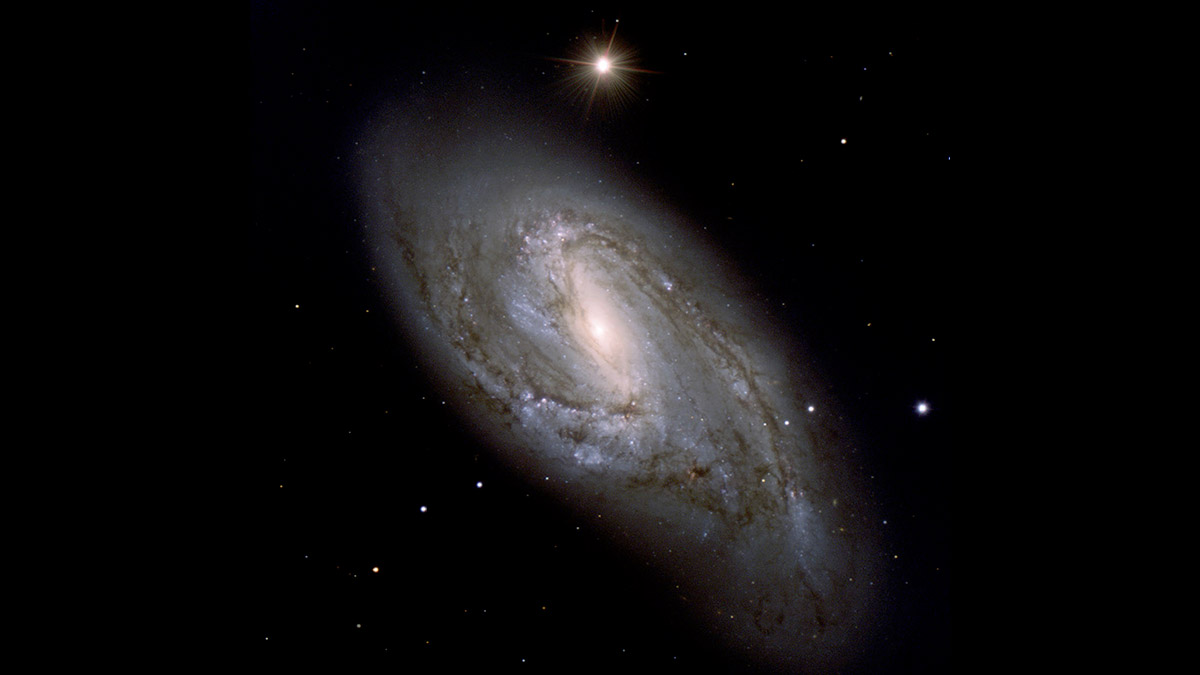
A small cluster of galaxies graces the spring sky in the constellation Leo. This grouping called the Leo Triplet, consists of spiral galaxies Messier 65, Messier 66, and NGC 3628. Though these three objects are dim and can be a struggle to see from suburban skies, backyard astronomers will appreciate that they are close together, so finding one aid in navigating to the others.
Messier 66 (M66) is best viewed during early springtime. In smaller telescopes, it will appear long and thin, mirroring the observation recorded by Charles Messier on March 1, 178O calling the object: “Very long and very faint.”
My Observations
| Date | April 16, 2021 |
| Time | 9:45 p.m. |
| Location | Seattle, WA |
| Magnification | 145x |
| Scope | Meade 8″ SCT |
| Eyepiece | 14mm |
| Seeing | Good |
| Transparency | Good |

Like most galaxies I view from the backyard, M66 is rather dim. Trying different eyepiece powers helps, and I landed on 14mm. It is a diagonal wisp of gray streak running just below a few brighter stars.
Key Stats
| Constellation | Leo |
| Best Viewing | Spring |
| Visual Magnitude | +8.9 |
| Absolute Magnitude | -21.4 |
| Distance from Earth | 37 million ly |
| Diameter | 111,000 ly |
| Apparent Size | 10.3 x 4.6 arcmin |
| Milky Way Location | N/A |
| My Viewing Grade | B- |
Historical Observations
Entry dated March 1, 1780 by Charles Messier
Nebula discovered in Leo; its light is very faint & it is very close to the preceding M65: They both appear in the same field [of view] in the refractor. The comet of 1773 & 1774 has passed between these two nebulae on November 1 to 2, 1773. M. Messier didn’t see them at that time, no doubt, because of the light of the comet.’2
Sources and Notes
Photo of M66 by NASA/ESA and The Hubble Heritage Team (STScI/AURA). Photo is in the public domain because it was created by NASA and ESA.
1https://en.wikipedia.org/wiki/Sombrero_Galaxy
2Historical observation from messier.seds.org.
Sketch by Wayne McGraw
 The Garden Astronomer
One thought on “Messier 66 (NGC 3627): A Galaxy Member of the Leo Triplet”