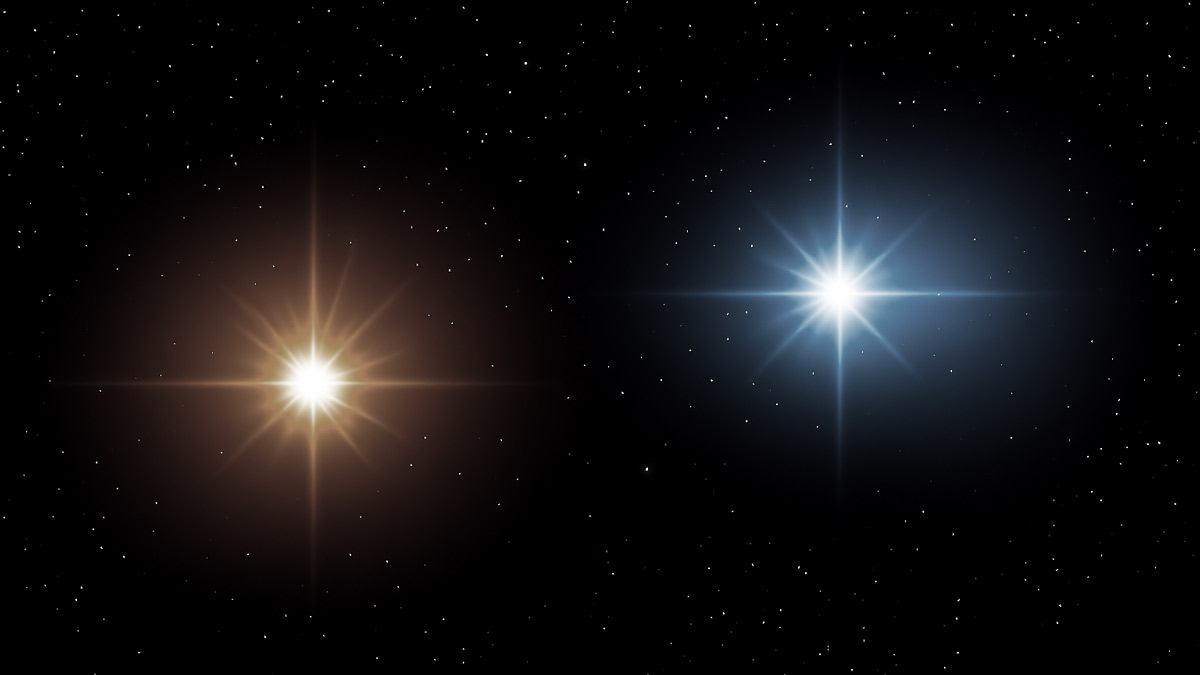
24 Comae Berenices is a striking double star in the constellation Coma Berenices. It’s best viewed in spring.
What makes this double stand out is the beautiful contrast between the brighter amber star and the smaller blue star. Many observers compare the allure of 24 Comae Berenices to the summer double Albireo in the Cygnus. Estimates show the stars are roughly 1400 AU apart, and the primary amber-colored star is nearly 20 times the size of our sun. X-Ray emissions emanate from the double; it’s believed the source is the secondary blue star.
My Observations
| Date | April 22, 2021 |
| Time | 10:17 p.m. |
| Location | Seattle, WA |
| Magnification | 203x |
| Scope | Meade 8″ SCT |
| Eyepiece | 10mm |
| Seeing | Above Average |
| Transparency | Above Average |

Slewing south of Cor Caroli with my scope, I make my way to 24 Comae Berenices. My first thought: This is a dimmer version of Albireo.
The brighter star gives me pause. The literature says it’s an orangish hue, but right now, it strikes me as shiny gold. The star is playing with my senses. The smaller star is a rich blue color.
Spring may be known as Galaxy Season, but we shouldn’t forget spring has a host of multiple star systems to enjoy.
Key Stats
| Constellation | Coma Berenices |
| Best Viewing | Spring |
| Visual Magnitude | +5.11 | +6.48 |
| Absolute Visual Magnitude | +2.9 |
| Separation | 20.4″ | 1390 AU |
| Position Angle | 272° |
| Distance from Earth | 169 ly |
| Orbital Period | Unknown |
| Milky Way Location | Orion Spur |
| My Viewing Grade | A |
| Designations | SAO 100160, HIP 61418, 24 Com |
Sources and Notes
Sketch by Wayne McGraw
 The Garden Astronomer
One thought on “24 Comae Berenices: An Amber and Sapphire Double Graces the Spring Sky”