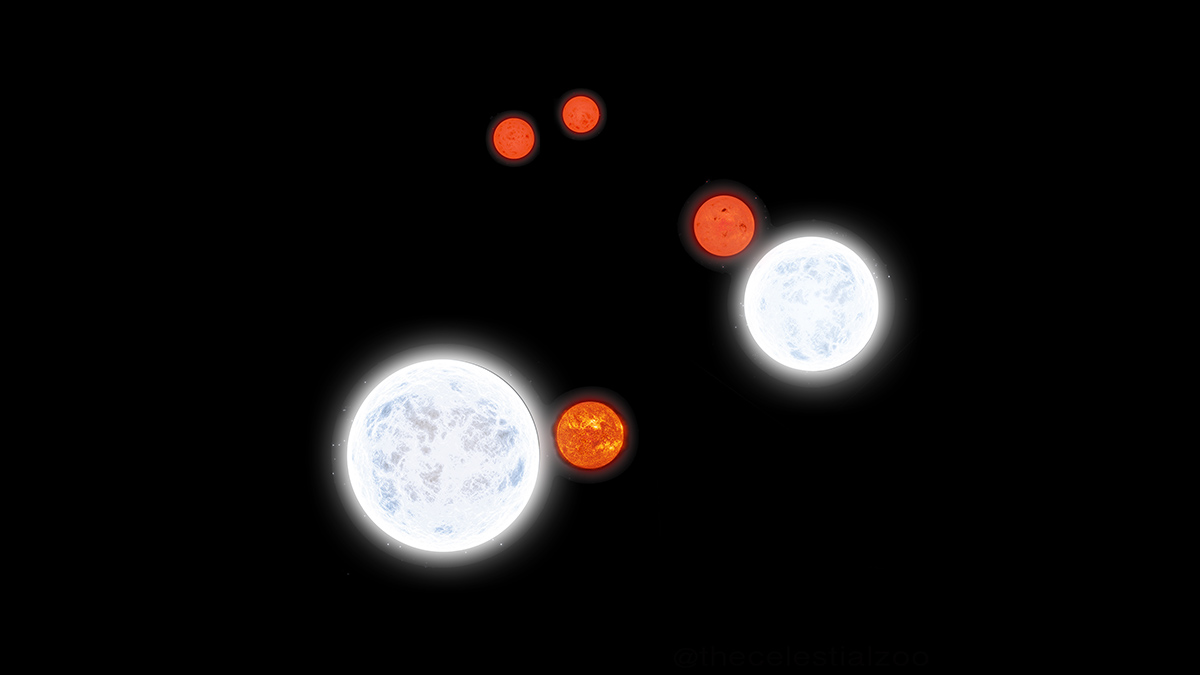
Known as one of the brightest stars in the sky and a twin of Pollux, Castor is a bluish-white double star in the constellation of Gemini. It’s best viewed during winter.
Look through a telescope at Castor, and you’ll see a nice double star. But there is more to this wintertime light. Using a spectroscope, astronomers have identified SIX stars in the Castor system. So cool! The double star you see (stars Castor A and B) orbit each other every 445 years and are separated by an average of 104 Astronomical Units (1 AU is the distance from the Earth to the Sun at 93 million miles).
They’re close enough that you need at least a modest telescope to see the separation clearly, but when you do, it’s unforgettable. Each gleaming star seems to echo the other, as if Gemini’s mythological twins decided to double their presence in the heavens.
My Observations
| Date | April 22, 2020 |
| Time | 9:45 p.m. |
| Location | Seattle, WA |
| Magnification | 127x |
| Scope | Meade 8″ SCT |
| Eyepiece | 16mm |
| Seeing | Average |
| Transparency | Average |

This is my first time viewing Castor through a larger scope. Though Castor A and B are roughly the same bright white color and don’t offer a strong contrast of color, the stars are brilliant and sharp in my eyepiece tonight. Castor makes a great and easy target.
Key Stats
| Constellation | Gemini |
| Best Viewing | Winter |
| Visual Magnitude | +1.6 +3.0 |
| Absolute Visual Magnitude | +0.61 |
| Distance from Earth | 51 ly |
| Separation | 5.2″ | 81 AU |
| Orbital Period | Unknown |
| Milky Way Location | Orion Spur |
| My Viewing Grade | A |
Sources and Notes
Photo of Castor in the banner is by Pablo Carlos Budassi. This file is licensed under the Creative Commons Attribution-Share Alike 4.0 International license.
Sketch by Wayne McGraw

 The Garden Astronomer
One thought on “Castor: You Are Not Just Seeing Double”