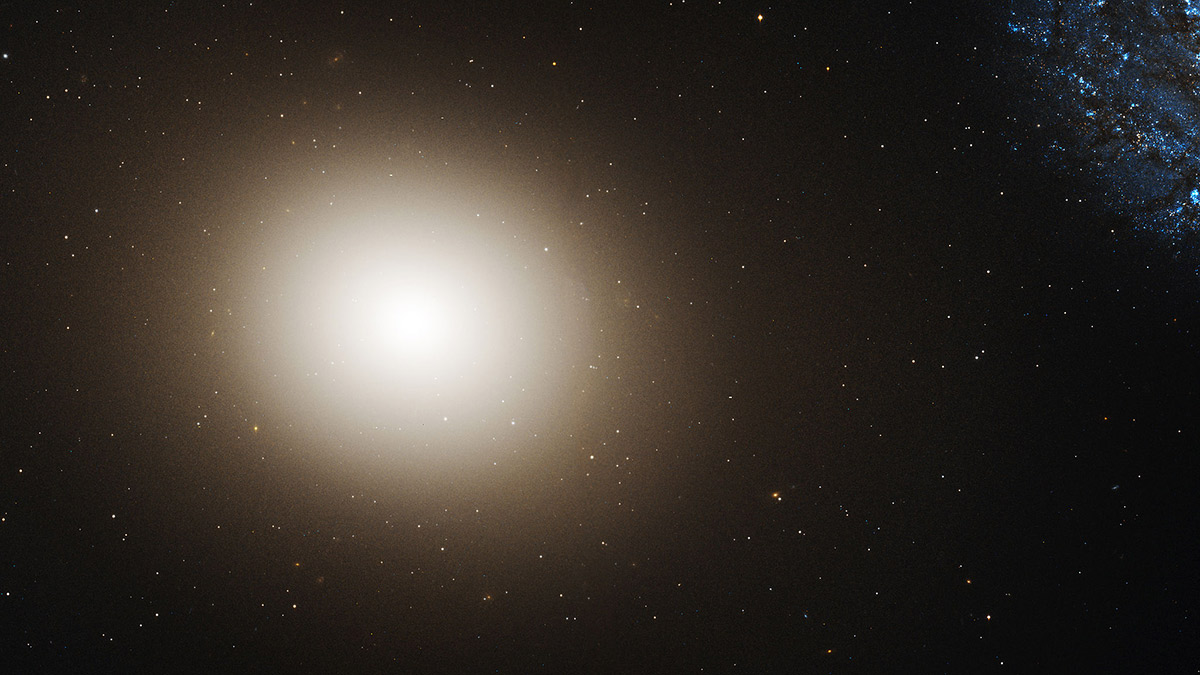
Messier 60 is a giant elliptical galaxy in the Virgo constellation. It’s best viewed in spring.
According to NASA, M60 has a diameter of 120,000 light-years and is as massive as one trillion suns. At its center is a supermassive black hole with a mass 4.5 billion times that of our sun. It’s easy to believe humans cannot even imagine the sizes of these objects.1
Historically speaking, astronomer Johann Gottfried Keohler observed M60 in 1779. Around 150 years later, the astronomer Edwin Hubble referenced this galaxy in his famous 1929 paper on receding galaxies. It so happens M60 was the fastest-moving galaxy in his study.2
My Observations
| Date | May 6, 2021 |
| Time | 10:40 p.m. |
| Location | Seattle, WA |
| Magnification | 145x |
| Scope | Meade 8″ SCT |
| Eyepiece | 14mm |
| Seeing | Below Average |
| Transparency | Average |

Ahh, I’ve only been out an hour, and it looks like this will be my last observation for the night. With my glasses off so I could study M60, I didn’t even notice the two clusters of clouds that hover now above me. Virgo in the east is still clear, but will soon be covered. Like many of the galaxies I’ve seen tonight, this elliptical galaxy is a rather featureless smudge just bright enough to contend with the light pollution where I live. I’m moving the scope back and forth and using averted vision to see if I can see light from M59, but I’m not seeing anything at the moment. I’ll have to return to this galaxy on another clearer night to check I can make out M59.
Key Stats
| When to view | Spring | R.A. (2021) | 12h 44m 43s |
| Constellation | Virgo | Dec (2021) | −11° 26′ 16″ |
| Visual Magnitude | +8.79 | Distance | 56 million ly |
| Absolute Magnitude | -22.37 | Age | ? |
| Apparent Size | 6.8 x 5.5 arcmin | Milky Way Locations | N/A |
| Diameter | 120,000 ly | My Viewing Grade | C |
Historical Observations
Entry dated April 15, 1779
“Nebula in Virgo, a little more distinct than the two preceding [M58 and M59], on the same parallel as Epsilon [Virginis], which has served for its [position] determination. M. Messier reported it on the Chart of the Comet of 1779. He discovered these three nebulae while observing this Comet which passed very close to them. The latter passed so near on April 13 & 14 that the one & the other were both in the same field [of view] of the refractor, and he could not see it; it was not until the 15th, while looking for the Comet, that he perceived the nebula. These three nebulae don’t appear to contain any star.”3
Sources and Notes
Photo of M60 by NASA/ESA and The Hubble Heritage Team (STScI/AURA). Photo is in the public domain because it was created by NASA and ESA.
1https://www.nasa.gov/feature/goddard/2017/messier-60
2https://en.wikipedia.org/wiki/Messier_60
3Historical observation from messier.seds.org.
Sketch by Wayne McGraw
 The Garden Astronomer
3 thoughts on “Messier 60 (NGC 4649): Hubble’s Fastest Moving Galaxy”