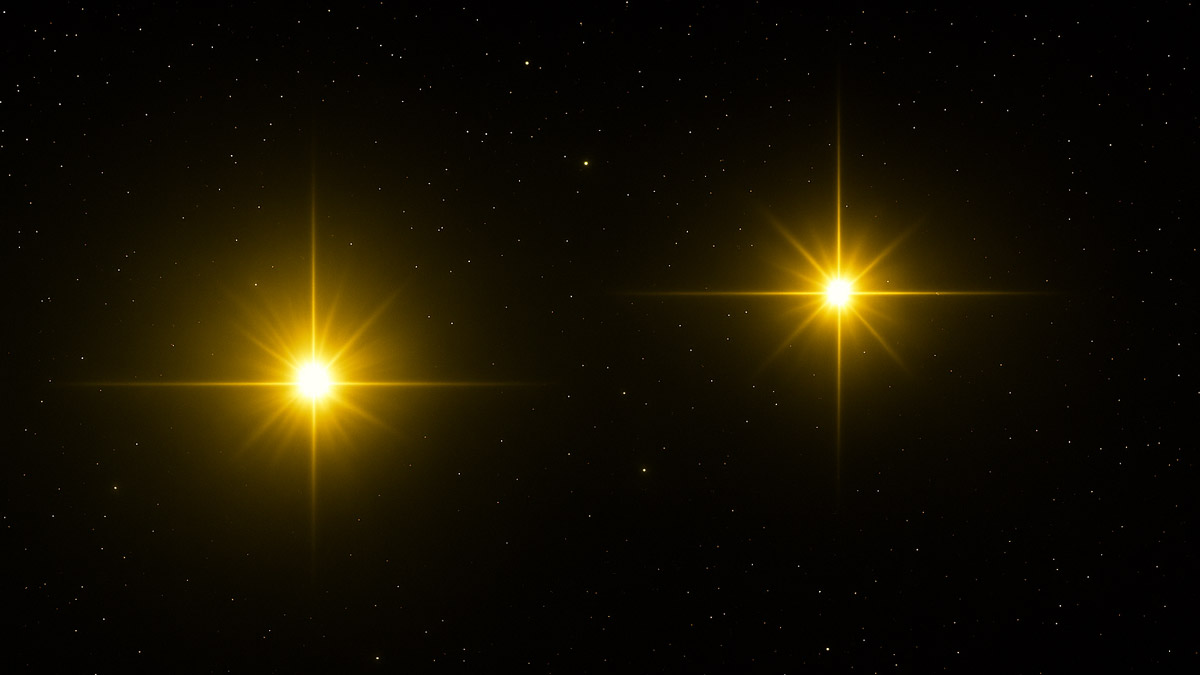
Mu Boötis is a spring treat for those who enjoy observing multiple star systems. The system’s proper name is Alkalurops, which means “club” in Greek and represents a shepherd’s staff.
With the naked eye from a dark site, one can see the primary star, Alkalurops A. It has a yellow, white color. Nearby are the binary stars Alkalurops B & C. Splitting these two stars requires a 4-inch telescope or larger at considerable power.
For some perspective on distance, astronomer Jim Kaler provides a good mental picture. “From Alkalurops A, the BC pair would appear as a brilliant “double sun” (at that distance, however, starlike) 100 times or so brighter than our Venus, separated by up to a degree apart.”1
Don’t let your spring pass by without visiting the constellation Boötes to enjoy its triple gem, Mu Boötis.
My Observations
| Date | May 15, 2021 |
| Time | 10:45 p.m. |
| Location | Seattle, WA |
| Magnification | 254x |
| Scope | Meade 8″ SCT |
| Eyepiece | 8mm |
| Seeing | Average |
| Transparency | Below Average |
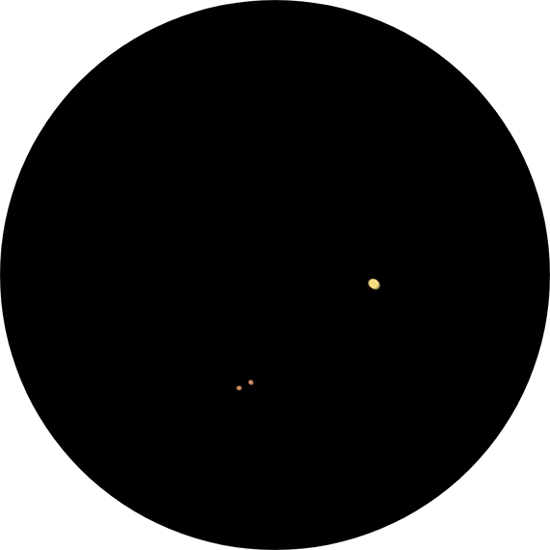
While the skies are clear of clouds, the air seems heavy and it’s tougher to pull out fainter objects. With my zoom eyepiece set at 18mm, I’m seeing the primary star and and I’m unable to split stars B&C. As I turn the eyepiece to 8mm, I’m able to split the double. I believe most observes say the close pair are yellow and orange in color.
For me tonight, both stars look the same brightness and color — and the color seems a lighter reddish hue.
Key Stats
| Constellation | Boötes |
| Best Viewing | Spring |
| Visual Magnitude | +5.9 | +7.0 |
| Absolute Magnitude | +1.6 |
| Distance from Earth | 237 ly |
| Separation | 108″ |
| Orbital Period | 260 yrs |
| Milky Way Location | Orion Spur |
| My Viewing Grade | B |
| SAO Number | 64686 |
Sources and Notes
Sketch by Wayne McGraw
1http://stars.astro.illinois.edu/sow/alkalurops.html
AKA: μ Boötis, 51 Boötis
 The Garden Astronomer