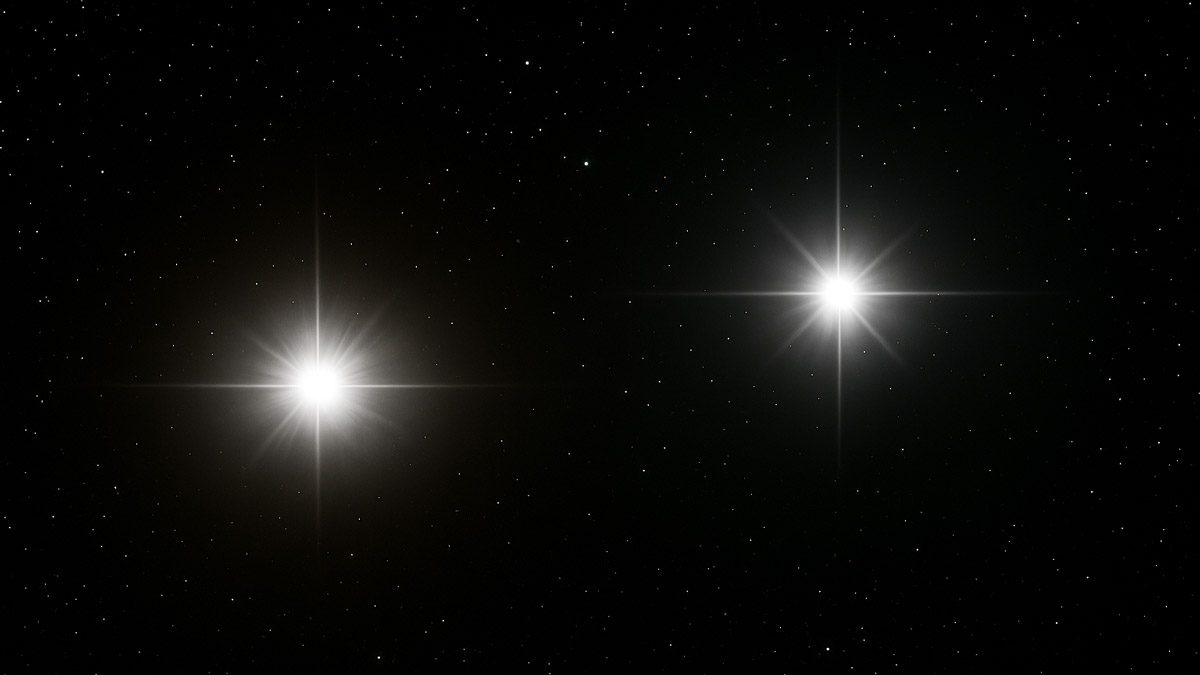
The prominent springtime constellation Boötes contains a host of nice double stars. Like the colorful double star Xi Bootis in Bootes, Pi Bootis is a naked eye object under darker sky conditions with a magnitude of +5. While the pair is fairly bright, they are close in proximity, so you will need at least a small to moderate sized telescope (4-6 inch) to split them well.
Jim Kaler points out an interesting fact about the primary star (Pi-1) in Pi Bootis. Jim explains that Pi-1 is a fine example of a mercury-manganese star. Due to the nature of how iron and elements are diffused in the star, mercury is “enhanced by 350,000!” Read Jim’s comprehensive take on the STARS website.
My Observations
| Date | May 28, 2021 |
| Time | 11:37 p..m. |
| Location | Seattle, WA |
| Magnification | 169x |
| Scope | Meade 8″ SCT |
| Eyepiece | 12mm |
| Seeing | Average |
| Transparency | Above Average |
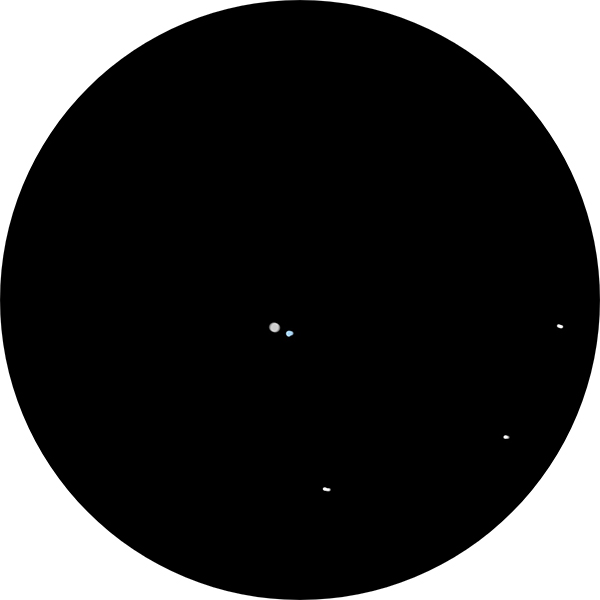
Pi Bootis doesn’t have the same allure as its next door neighbor Xi Bootis with tis yellow and violet hue. The stars are a dim white, though some say the secondary star is a pale blue.
Key Stats
| Constellation | Boötes |
| Best Viewing | Late Spring |
| Visual Magnitude | +4.9 | +5.8 |
| Absolute Magnitude | +0.0 |
| Separation | 5.5″ | 515 AU |
| Position Angle | 114° |
| Distance from Earth | 306ly |
| Orbital Period | Unknown |
| Milky Way Location | Orion Spur |
| My Viewing Grade | B- |
| Desingations | SAO 101138, Struve / STF 1864 |
Sources and Notes
The double star banner on this page is an artist’s impression showing the double star OGLE-LMC-CEP0227 in our neighboring galaxy the Large Magellanic Cloud. This media was created by the European Southern Observatory (ESO).This file is licensed under the Creative Commons Attribution 4.0 International license.
Sketch by Wayne McGraw
 The Garden Astronomer