
On summer nights, when the constellation Hercules makes its way to the top of the sky, two of the greatest globular clusters tag along: Messier 13 and Messier 92. These ancient objects of the universe are must-see objects, and one can get a good view of them with a simple pair of binoculars.
Many observers speak of the Hercules Globular Cluster (Messier 13) for its beauty and brightness. But not far off the path is Messier 92. M92 may stand in the shadows of the Great Globular Cluster, but it mustn’t be overlooked. Its dense, bright core is bright enough for the naked eye to see from dark skies. Also, it’s only a little dimmer than M13.
Using binoculars or a telescope, observers will find a splendid view of this glowing patch of stars hanging from high above our galactic plane. Smaller optics will only show a fuzzy patch of light, while larger scopes (say 6 inches and more) will start to pull out individual stars.
My Observations
| Date | June 1, 2021 |
| Time | 11:05 p.m. |
| Location | Seattle, WA |
| Magnification | 64x |
| Scope | Meade 8″ SCT |
| Eyepiece | 32mm |
| Seeing | Good |
| Transparency | Average |
| Date | May 29, 2021 |
| Time | 12:10 a.m. |
| Location | Seattle, WA |
| Magnification | 102x |
| Scope | Meade 8″ SCT |
| Eyepiece | 20mm |
| Seeing | Good |
| Transparency | Average |
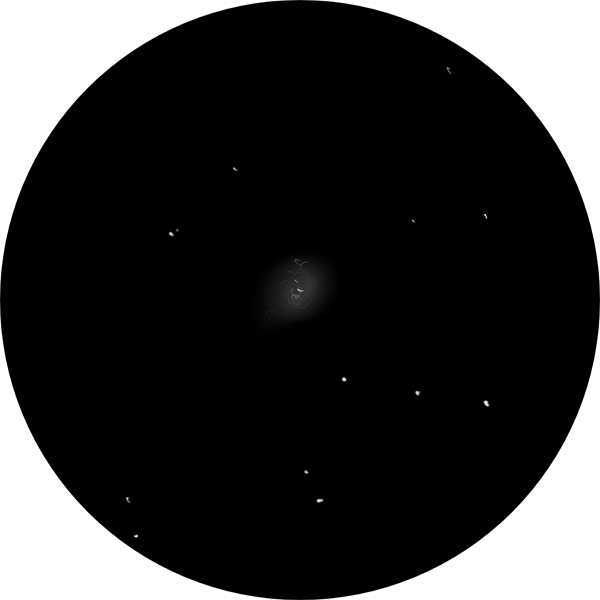
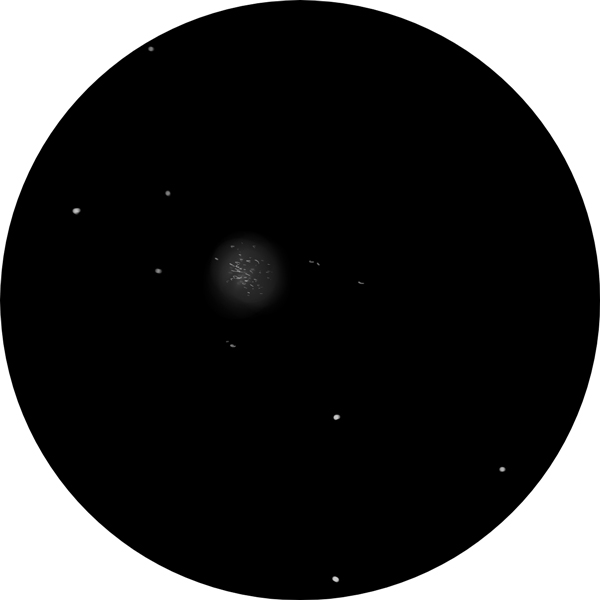
I’ve come to realize the appearance of Messier 92 in my scope is not much different than Messier 13. I know M13 is brighter, but the first time I slewed my telescope to M92, I had to double-check to be sure I wasn’t sitting on M13!. I know if I perhaps had a larger scope and better seeing conditions, this opinion would differ. But from my vantage point in the suburbs, hopping between both of the great clusters provides equal enjoyment.
Key Stats
| Constellation | Hercules |
| Best Viewing | Spring |
| Visual Magnitude | +6.4 |
| Absolute Magnitude | -8.1 |
| Distance from Earth | 27000 ly |
| Diameter | 110 ly |
| Apparent Size | 14 arcmin |
| Milky Way Location | Perseus Arm |
| My Viewing Grade | A |
Historical Observations
December 27, 1777, observation by Johann Elert Bode
“A nebula. More or less round with pale glow. On this occasion, I also want to announce that on December 27, 1777 I have discovered a new nebula in Hercules, not known to me, southwest below the star s in his foot, which shows up in a mostly round figure with a pale glimmer of light. Its longitude is about 11 deg [Sgr] [251 d] and its latitude 66d north.T ogether with two small [faint] stars, which don’t occur at Flamstead, it appears in the reversing telescope as shown in fig k (in the following volume).”
March 18, 1781, observation by Charles Messier
“Nebula, fine, distinct, & very bright, between the knee & the left leg of Hercules, it can be seen very well in a telescope of one foot [FL]. It contains no star; the center is clear & brilliant, surrounded by nebulosity & [it] resembles the nucleus of a large Comet: its brightness, its size, approach much that of the nebula which is in the girdle of Hercules.”
Sources and Notes
Photo of Messier 92 banner is by ESA/Hubble & NASA; Acknowledgment: Gilles Chapdelaine
Historical Observations: SEDS Messier Database
Sketch and photo by Wayne McGraw
 The Garden Astronomer
One thought on “Messier 92 (NGC 6341): A Chandelier of Stars”