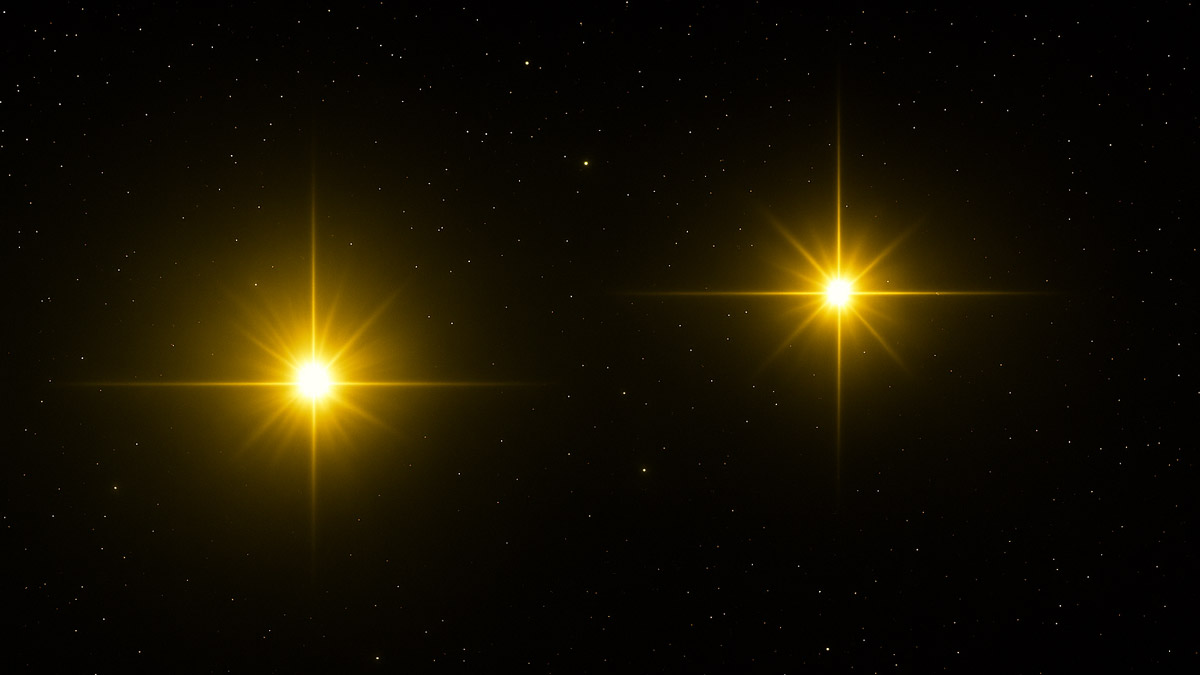
The prominent springtime constellation Boötes contains a host of colorful doubles. One, in particular, Struve 1825, sits near the bright star Arcturus and has an orange and yellow pair. The stars are fairly bright at a magnitude of +6 and +8, but they are close in proximity, so you will want a fairly moderate-sized telescope (6-8 inches) to split them.
Here are a few more fun facts: the pair is 106 light years from the earth with an orbital period of 957 years.
My Observations
| Date | May 29, 2021 |
| Time | 10:45 p.m. |
| Location | Seattle, WA |
| Magnification | 254x |
| Scope | Meade 8″ SCT |
| Eyepiece | 8mm |
| Seeing | Average |
| Transparency | Above Average |
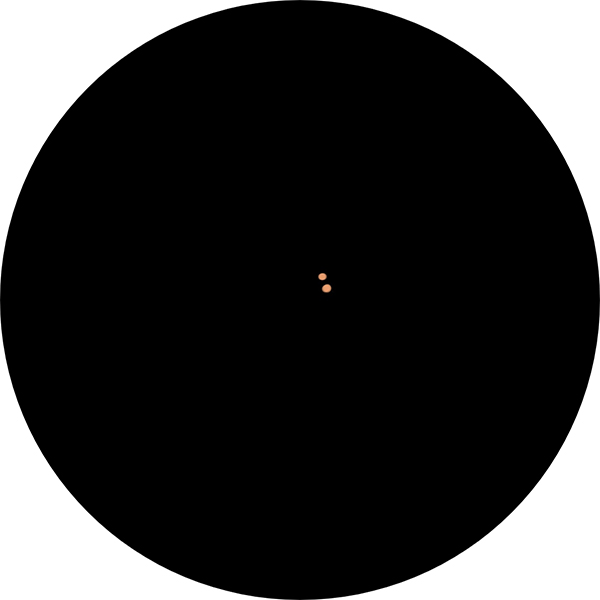
Tonight, I’m searching through a list of late spring objects I have yet to see in the region around Boötes. No question, this pair is close together, but I’m able to separate them well at 254 power and a little less. The primary star appears orange, while the secondary seems to be yellow with a tinge of light green.
Key Stats
| Constellation | Boötes |
| Best Viewing | Late Spring |
| Visual Magnitude | +6.4 | +8.4 |
| Absolute Magnitude | +5.8 |
| Separation | 4.4″ | 175 AU |
| Position Angle | 153° |
| Distance from Earth | 106 ly |
| Orbital Period | 957 years |
| Milky Way Location | Orion Spur |
| My Viewing Grade | B |
| Designations | SAO 83259, HIP 69751 |
Sources and Notes
Sketch by Wayne McGraw
 The Garden Astronomer