
As summertime begins in the northern hemisphere, a rich collection of clusters and nebula move higher in the southern skies, which includes Messier 16. Messier 16 (also known as the Eagle Nebula or Star Queen Nebula) is a diffuse emission nebula located in the constellation Serpens. The object is named after its shape, which resembles an eagle with outstretched wings.
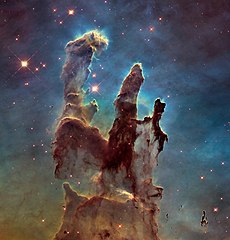
It goes without saying that astronomers must love Messier 16, as its stunning beauty and fascinating features make it a truly remarkable object in the night sky. It’s also home to the famous Pillars of Creation, a series of towering columns of gas and dust that are being sculpted by the intense radiation from nearby young stars. These pillars are several light-years in length and are a stellar nursery, containing many newly forming stars.
Of note, it is the intense radiation from the young stars throughout the area that causes the surrounding gas and dust to glow brightly in visible and infrared light.1
While Messier 16 is a fairly bright object (magnitude +6), suburban astronomers will want to use a narrowband filter to enhance the visibility of the Eagle Nebula. Specifically, using a narrowband filter that isolates the emission line of hydrogen-alpha (Ha) can bring out the intricate details of the gas and dust clouds in the nebula. Ha filters can also help to minimize the effects of light pollution and atmospheric haze, making the nebula easier to see and photograph from light-polluted areas.
Historically speaking, the French astronomer Jean-Philippe de Cheseaux discovered the nebula in 1745. A year later, Charles Messier independently discovered it on June 3, 1746.2
My Observations
| Date | August 4, 2021 |
| Time | 11:05 p.m. |
| Location | Seattle, WA |
| Magnification | 145x |
| Scope | Meade 8″ SCT |
| Eyepiece | 14mm |
| Seeing | Average |
| Transparency | Average |
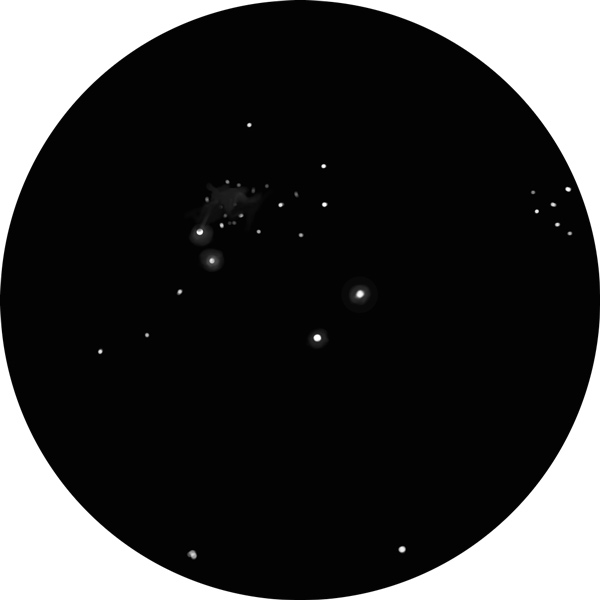
This is my first time seeing the Eagle Nebula in my life. For some reason, I never searched for the nebula when I was younger. And in recent years, I’ve struggled to find it low in the southern skies as it poked in and out from the Douglas Fir trees surrounding my backyard. For tonight, I moved the scope down a narrow dirt driveway that runs by the neighbor’s house. This allowed me to get a good angle to see beyond the trees.
The stars in my eyepiece are varied in size and brightness. What a beautiful field this is. I wish I could bring out more nebulosity, though. Among a small dim smattering of stars in the top right of my eyepiece, some hazy nebulosity seems to float “above” the stars. I’ve tried to capture this on the sketch. Even with a narrowband filter, I struggle to pull a lot of the nebulosity.
My overall take: I was hoping to see more detail with my 8-inch SCT, but I realize I’m fighting light-polluted skies. Still, the Eagle is pulling me in, and I must target this object from darker skies in the future.
| Constellation | Serpens |
| Best Viewing | Summer |
| Visual Magnitude | +6.40 |
| Absolute Magnitude | -4.82 |
| Distance from Earth | 5,700 ly |
| Diameter | 58 ly |
| Apparent Size | 35 x 28 arcmin |
| Milky Way Location | Sagittarius Arm |
| My Viewing Grade | B |
| Designations | M 16, NGC 6611, LBN 67 |
Historical Observations
The nebula was first discovered by Jean-Philippe de Cheseaux in 1745. Messier recorded the following note a year later on June 3, 1746:
“A cluster of small stars, enmeshed in a faint glow, near the tail of Serpens, at little distance to the parallel of Zeta of this constellation; with an inferior telescope this cluster appears like a nebula. (diam. 8′)”2
Years later, in July 1835, the astronomer William Smyth wrote a colorful description worth noting:
“A scattered but fine large stellar cluster, on the nombril of Sobieski’s shield, in the Galaxy, discovered by Messier in 1764, and registered as a mass of small stars in the midst of a faint light. As the stars are disposed in numerous pairs among the evenescent points of more minute components, it forms a very pretty object in a telescope of tolerable capacity.”2
Sources and Notes
Banner photo of Messier 16: Created by the European Southern Observatory (ESO). Source file. This file is licensed under the Creative Commons Attribution 4.0 International license.
1 Garner, Rob. “Messier 16 (the Eagle Nebula).” NASA, NASA, 6 Oct. 2017, https://www.nasa.gov/feature/goddard/2017/messier-16-the-eagle-nebula.
2 McArthur, Guy, and Hartmut Frommert. “Messier 16.” Messier Object 16, http://www.messier.seds.org/m/m016.html.
Sketch by Wayne McGraw
 The Garden Astronomer