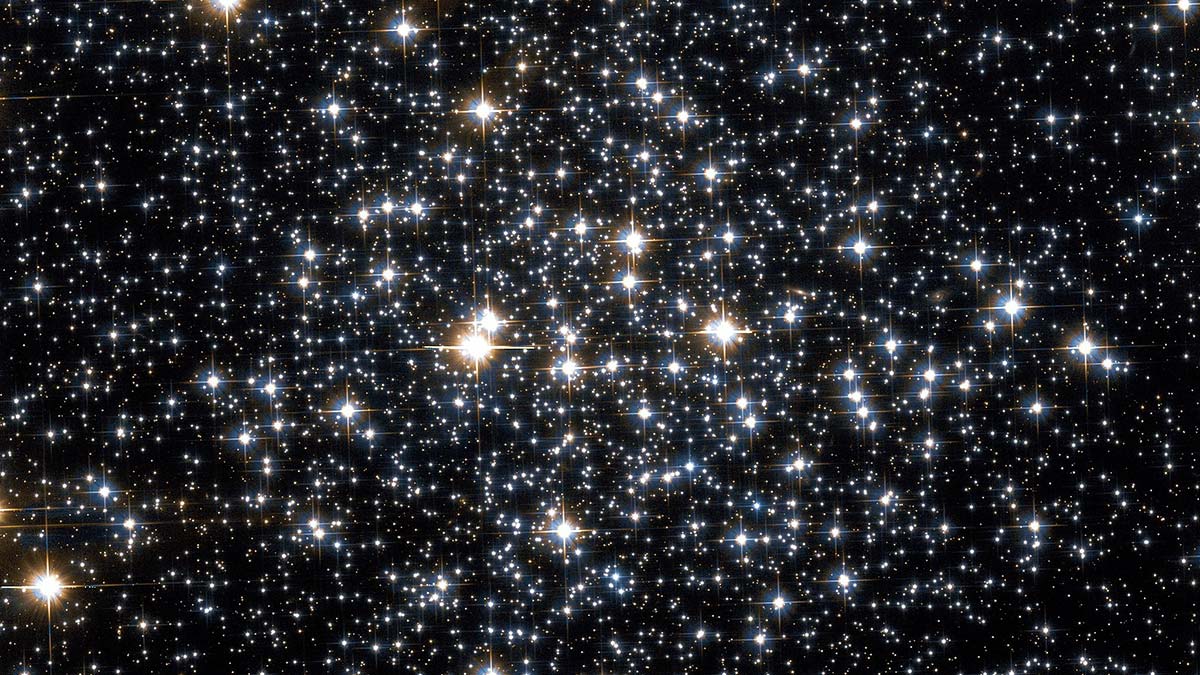
Globular clusters like Messier 71 (M71) make for great targets. With a pair of binoculars away from bright city lights, an observer can see M71 as a fuzzy patch. Move up to the telescope (say 4 inches in diameter and larger), and you can start to make out some individual stars.
For a long time, astronomers viewed M71 as a simple star cluster, but now using modern observing techniques, astronomers mostly agree this is a globular cluster. Also notable is M71’s distance from the earth. At 13,000 light years away, the cluster is considerably farther than most objects we see from our suburban backyards. However, when it comes to globular clusters, M71 is one of the nearest us.
Jean-Philippe Loys de Cheseaux, an astronomer from Switzerland, cataloged this “non comet” in 1745. Years later, Charles Messier independently observed and cataloged it in 1780.
My Observations
| Date | August 4, 2021 |
| Time | 10:20 p.m. |
| Location | Seattle, WA |
| Magnification | 169x |
| Scope | Meade 8″ SCT |
| Eyepiece | 12mm |
| Seeing | Above Average |
| Transparency | Average |
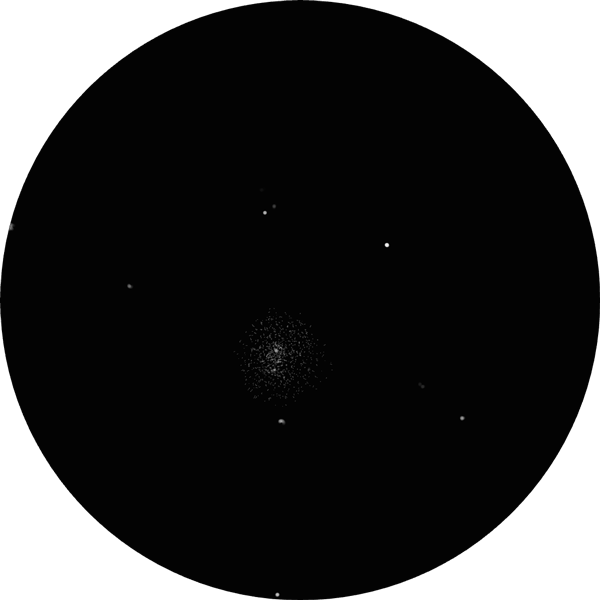
I originally viewed M71 on August 4, 2021 at 10:20 pm.: On this warm (80F) summer evening, the mosquitoes are having their way with me. I’ve even watched a few bats sprint high overhead between the backyards trees. The glow of twilight lingers as I set my scope to M71. The brighter sky washes away M71’s definition, leaving an object in my eyepiece that appears like a wisp of smoke. As I stare through the eyepiece and use averted vision, I’m able to see a few individual star sprinkled on the hazy patch like salt spilled on a countertop.
The drawing shows M71 on September 14, 2023 at 9:15 p.m. using a 12mm eyepiece.
Key Stats
| Constellation | Sagitta |
| Best Viewing | Summer |
| Visual Magnitude | +8.2 |
| Absolute Magnitude | -4.8 |
| Distance from Earth | 13,000 ly |
| Diameter | 12.7 ly |
| Apparent Size | 3.3 arcmin |
| Milky Way Location | Orion Spur |
| My Viewing Grade | B- |
Historical Observations
Charles Messier’s observation on October 4, 1780.
“Nebula discovered by M. Méchain on June 28, 1780, between the stars Gamma and Delta Sagittae. On October 4 following, M. Messier looked for it: its light is very faint & it contains no star; the least light makes it disappear.”1
Sources and Notes
The banner photo of M71 was created for NASA by Space Telescope Science Institute under Contract NAS5-26555, or for ESA by the Hubble European Space Agency Information Centre. Copyright statement at hubblesite.org
1Historical observation from messier.seds.org.
Sketch by Wayne McGraw
 The Garden Astronomer
One thought on “Messier 71 (NGC 6838): A Globular Cluster Close to Home”