
A star that occasionally goes bang,
GILES SPARROW | A HISTORY OF THE UNIVERSE IN 21 STARS
and will one day go boom.
In August 2021, an Irish amateur astronomer named Keith Geary reported the star RS Ophiuchi had brightened to a magnitude of 5. That’s bright enough for anyone in the suburbs to see the star with the unaided eye. Usually, the star shines at a magnitude of 12, which is so dim that most amateur telescopes won’t even pick it up.
So what made RS Ophiuchi so bright in 2021? This white dwarf star is part of a binary star system: one star is a white dwarf, while the other is a red giant. The white dwarf star pulls hydrogen gas from its massive red giant neighbor. Around every twenty years or so, the mass on the surface of the dwarf becomes so great a thermonuclear explosion occurs. This explosion—a nova—is what makes the star brighten beautifully for a short time.
Keep in mind, a nova happens when the surface of a white dwarf explodes. A supernova, on the other hand, is a massive explosion and destruction of the entire star. When it comes to RS Ophiuchi, the surface of the star erupts and then returns to collecting hydrogen from its red giant neighbor. The process keeps repeating, and we know from records that similar eruptions were seen in 1898, 1933, 1958, 1967, 1985, 2006, and 2021
My Observations
| Date | August 11, 2021 |
| Time | 9:45 p.m. |
| Location | Seattle, WA |
| Seeing | Average |
| Transparency | Average |

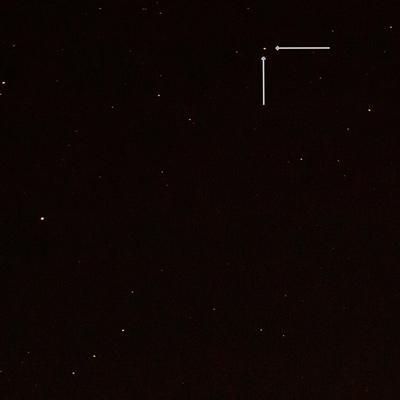
I first thought the star was too low in the Seattle sky to see, but I decided to try anyway. To my surprise, a break in the tall cedar trees south of my home gave me enough space to take a few photos of the nova. Note the two arrows showing which star is RS Ophiuchi.
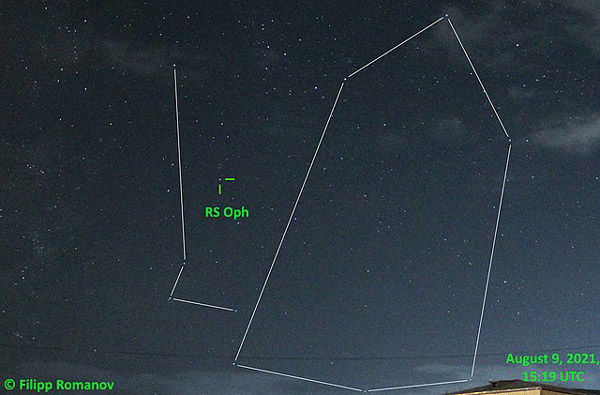
August 9, 2021
Key Stats
| Constellation | Ophiuchus |
| Best Viewing | Summer |
| Visual Magnitude | +4.3 to +12.5 (variable) |
| Distance from Earth | 5,000 ly |
| Orbital Period | Unknown |
| Milky Way Location | Orion Spur |
Sources and Notes
The banner illustration is in the public domain in the United States because it was solely created by NASA. Artist’s conception of a binary system consisting of a white dwarf star (right) accreting hydrogen from a larger companion. This may give a nova.
Photos by Wayne McGraw, unless indicated differently above.
AKA: RS Oph, variable star
 The Garden Astronomer
2 thoughts on “RS Ophiuchi: Star Erupts in the Summer Sky”