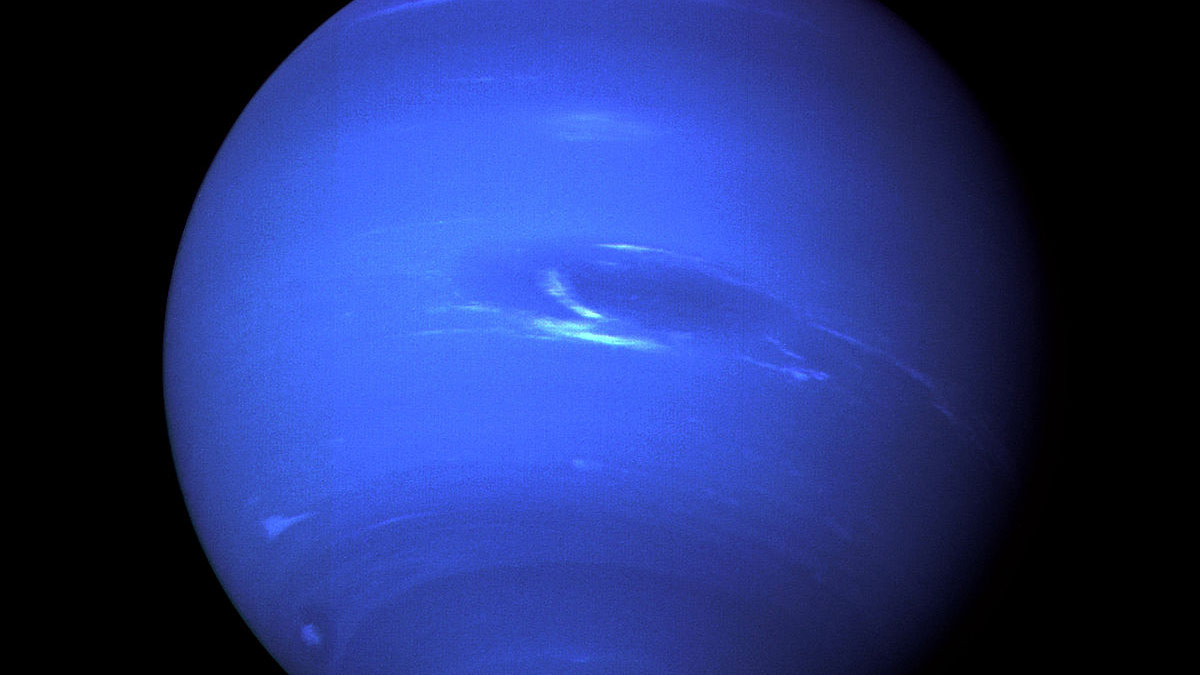
In 1846, during the early hours of September 24th, astronomer Johann Gottfried Galle and his assistant first observed Neptune with a telescope and confirmed its planet status. Several sightings of Neptune occurred before this date, but those earlier observers, including Galileo Galilei in 1612, thought the blue pinpoint of light was a star.
It’s an interesting story about what led to Neptune’s discovery. After studying Uranus‘ movement for years, observers suspected something was “pulling” on the ice giant. So in 1845, the French astronomer Urbain Le Verrier began performing extensive calculations to predict where a possible extra planet affecting Uranus’ orbit might be in the sky. It wasn’t until a year later that JohannnGalle used Le Varrier’s calculations to discover Neptune. The rest is history—minus debate among some people back then about who should take credit for the finding. The story behind revealing Neptune is a worthy read and an important milestone in history.
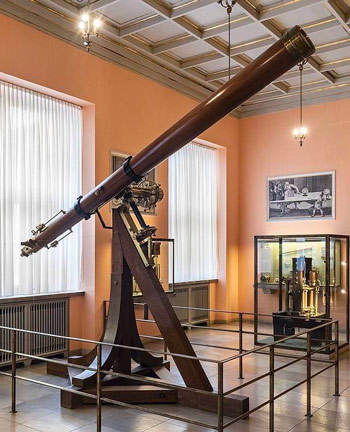
Backyard astronomers need a telescope to bring this dim, beautiful blue planet into view as it resides more than 30 times as far from the Sun as Earth. It’s a great autumn target for observers. As I explain below, it’s well worth the work to find it.
My Observations
Since I was a teenager, I’ve hoped to see Neptune with my own eyes. Tonight I finally observed the elusive icy blue planet, ending a decades-long desire to see all the planets in the solar system. I’m grateful for days like these. I will never take this moment for granted. It’s especially significant as last month marked the 175th anniversary of Neptune’s discovery.
Here’s how my night has gone. Before finding Neptune, I spent the previous two hours studying double stars and clusters in Cygnus. At 8:45 p.m., I used the telescope’s computer to move south from the swan to target Neptune. Unfortunately, high trees east of my backyard blocked my view, but I knew it wouldn’t be long until Neptune sailed out from under the tree canopy. Forty-five minutes later, I navigated toward Neptune’s direction again. This time, the viewfinder aimed directly into the clear dark sky.
A few dim stars appeared in my eyepiece, fighting against the ashen gray background of my Seattle suburban light-polluted sky. Struggling to see any difference in the points of light, I decided to scan the area with my wider 32mm eyepiece, looking for one of the stars to be bluer in color.
Right then, a bluish/white “star” appeared in the top right of the eyepiece, making me wonder if the computer actually hit Neptune on the first try. Pulling out my sky map, I decided to compare the blueish star against the nearest brightest object, a 6th magnitude star known as HR 8931 / SAO 146752. Moving the telescope slightly back and forth, I confirmed HR 8931 and then moved the scope back to the blueish target. I became more excited now with every passing second: I had a blue “star” sitting nearby a yellow brighter star.
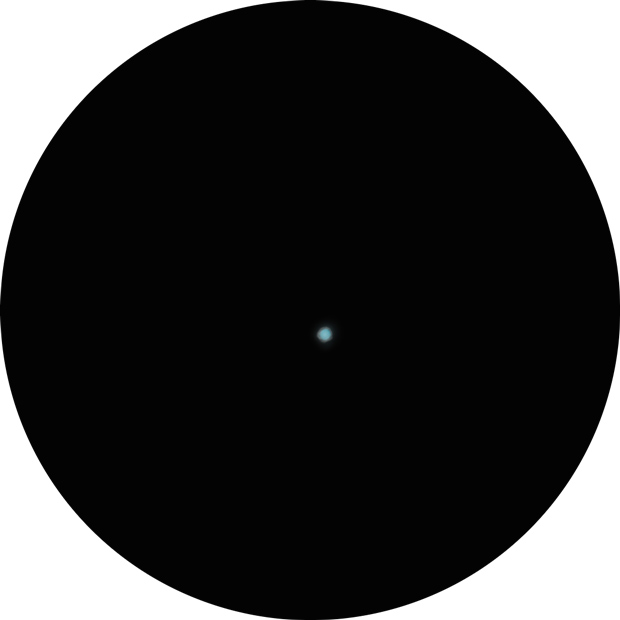
Not wasting a moment, I changed out my eyepiece to the variable one. For those who don’t know, a variable eyepiece acts like an adjustable zoom lens on a camera. I slowly rotated it until stopping the maximum magnification at the 8mm setting. The pinpoint light grew into a fuzzy blue disk. My eyes locked on the planet I’ve wanted to see for so many years. This planet, where it rains diamonds and shines like a sapphire gem among the firmament, was finally mine.
| Date | October 8, 2021 |
| Time | 9:30 p.m. |
| Location | Seattle, WA |
| Magnification | 254x |
| Scope | Meade 8″ SCT |
| Eyepiece | 8mm |
| Seeing | Average |
| Transparency | Above Average |
Key Stats
| Constellation | Aquarius |
| Best Viewing | Fall |
| Visual Magnitude | +7.8 |
| Distance from Earth | 30 AU |
| Diameter | 3.8 Earths |
| Orbital Period | 164 yrs |
| Milky Way Location | Orion Spur |
| My Viewing Grade | A |
Sources
The banner photo of Neptune is in the public domain in the United States because it was solely created by NASA. NASA copyright policy states that “NASA material is not protected by copyright.
Mars, K. (2021, September 22). 175 years ago: Astronomers Discover Neptune, the Eighth planet. NASA. Retrieved April 30, 2022, from https://www.nasa.gov/feature/175-years-ago-astronomers-discover-neptune-the-eighth-planet
Sketch by Wayne McGraw
 The Garden Astronomer
2 thoughts on “Finding Neptune: Viewing My Favorite Planet for the First Time”