Epsilon Monocerotis may not have the awe factor of the triple blue Beta Monocerotis in the constellation Monoceros, but this double is attractive.
The star system lies around 128 light-years away from us and sits not far from the popular Rosette Nebula in the sky. While the two appear close in the sky, the reality is that both are very far apart, as the Rosette Nebula makes its home more than 5,000 light-years away.
My Observations
| Date | January 21, 2022 |
| Time | 8:36 p.m. |
| Location | Seattle, WA |
| Magnification | 169x |
| Scope | Meade 8″ SCT |
| Eyepiece | 12mm |
| Seeing | Below Average |
| Transparency | Below Average |
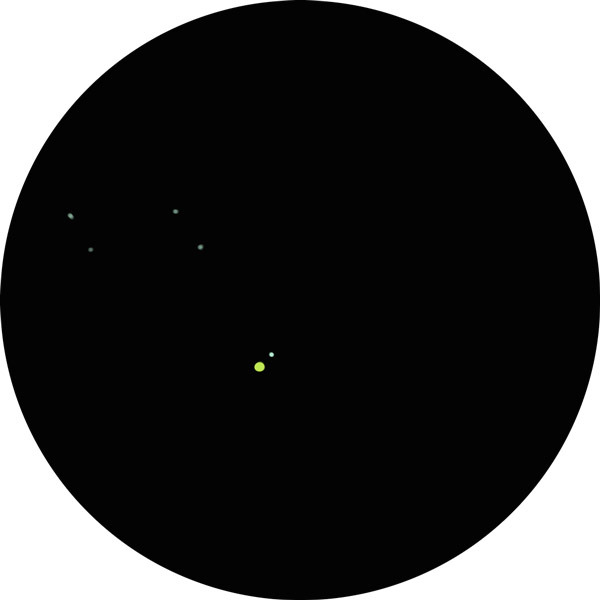
I see a pale yellow primary star with a whiter, smaller companion nearby. I understand that there is a third companion with an apparent magnitude of around 12.7; however, I’m unable to see this star. Nearby, there are four faint, yet equally bright, stars in a parallelogram shape.
Key Stats
| Constellation | Monoceros |
| Best Viewing | Winter / Early Spring |
| Visual Magnitude | +4.4, +6.6 |
| Absolute Visual Magnitude | +1.53 |
| Distance from Earth | 128 ly |
| Separation | 12″ | 450 AU |
| Milky Way Location | Orion Spur |
| My Viewing Grade | B |
| Designations | SAO 113810, 8 Mon, HD 44769 |
Sources and Notes
Sketch by Wayne McGraw
 The Garden Astronomer