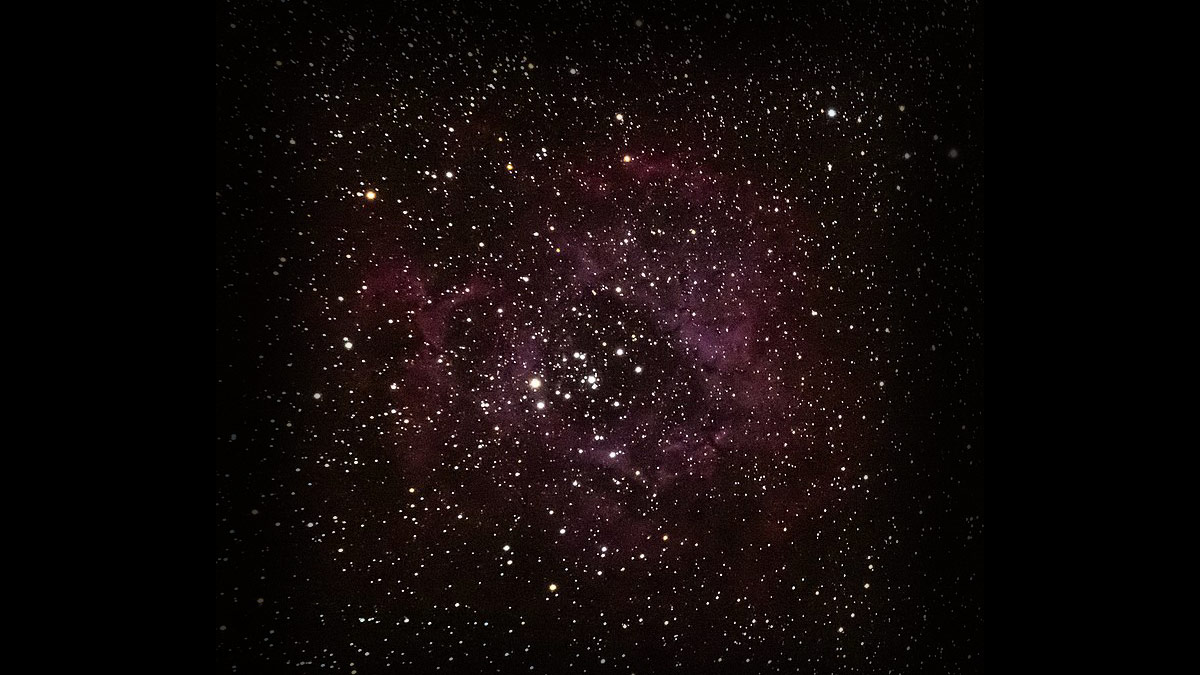
In the faint winter constellation of Monoceros lies NGC 2244, a cluster of stars at the center of the hauntingly beautiful Rosette Nebula. Up in the sky, the nebula spans more than five times the size of the full moon. In actual distances, that’s 130 light years wide! Also, the stars of NGC 2244 owe their lives to the Rosette Nebula since they were born from this nebulosity. And now, the stellar winds from these powerful stars carve out the “hole” at the center of the Rosette.
While the red-colored nebulosity of the Rosette shows up in photos, it’s tough to pick up in telescopes under light-polluted locations. The good news is the beautiful blue-white stars of NGC 2244 are viewable with binoculars and small telescopes, so don’t hesitate to take a look from any location.
Historically speaking, John Flamsteed first recorded the star cluster on the evening of February 17, 1690.
My Observations
| Date | January 28, 2022 |
| Time | 9: 30 p.m. |
| Location | Seattle, WA |
| Magnification | 85x |
| Scope | Meade 8″ SCT |
| Eyepiece | 24mm |
| Seeing | Below Average |
| Transparency | Below Average |
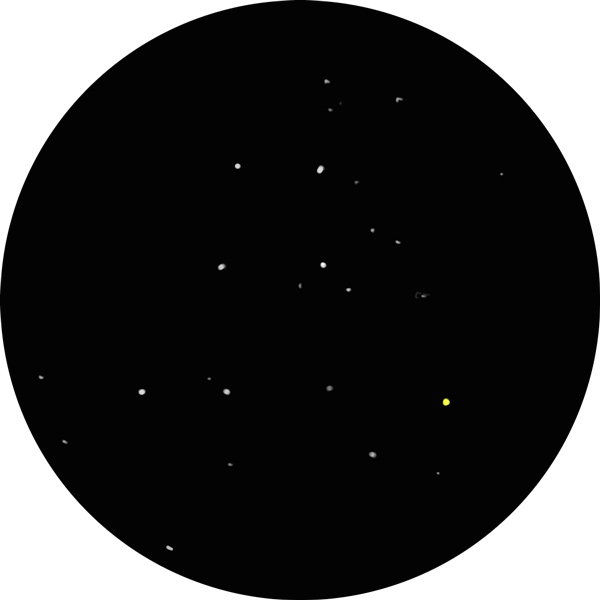
Several small waves of high clouds are now coming from the west, but an opening still exists in Monoceros. As the scope slews to the target, I see several bright blue-white stars in a square pattern in the center.
A warm yellow star punctures the dark sky in this same field of view, signaling its independence. I use averted vision to make out any nebulosity of the Rosette but to no avail. Nevertheless, this is an attractive cluster I want to revisit often.
Key Stats
| Constellation | Monoceros |
| Best Viewing | Winter |
| Visual Magnitude | +4.8 |
| Absolute Magnitude | -6.3 |
| Distance from Earth | 5,400 ly |
| Diameter | 46 ly |
| Apparent Size | 29 arcmin |
| Milky Way Location | Between Orion Spur & Perseus |
| My Viewing Grade | A |
Sources and Notes
Banner photo by Stephen Rahn and made available under the Creative Commons CC0 1.0 Universal Public Domain Dedication.
AKA: Caldwell 50, C 50, Rosette, NGC 2237, NGC 2238, NGC 2239, NGC 2246
 The Garden Astronomer
