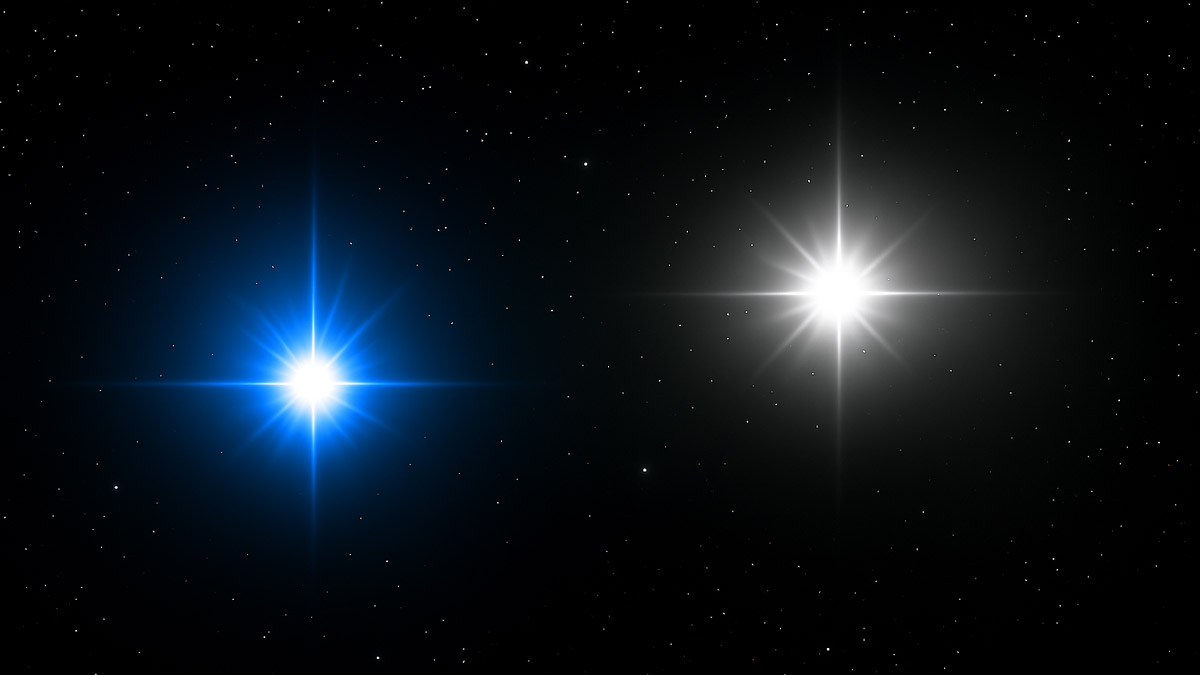
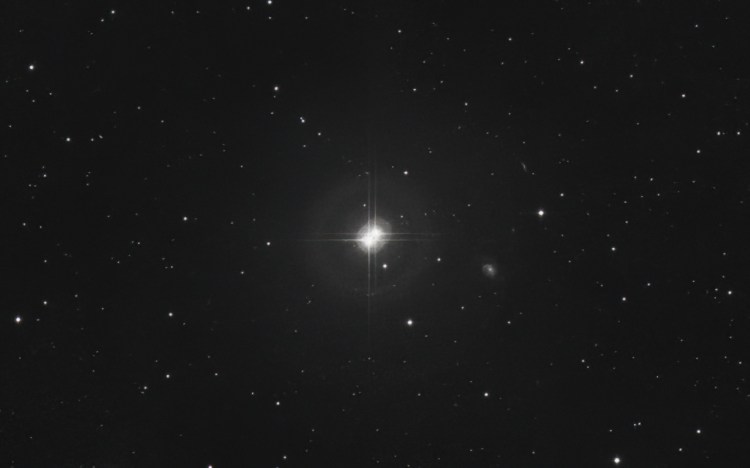
1 Camelopardalis, also known as DL Cam, is a double star in the constellation Camelopardalis and is viewable much of the year as it circles close to the North Star. The famed astronomer William Herschel first recorded this pair on December 18, 1788.
At a magnitude of 5, DL Cam is one of the brightest stars in the dim constellation of Camelopardalis, coming close in brightness to its nearby cousin Beta Camelopardalis. DL Cam’s two stars are fairly tight together for the casual observer—at ten arcseconds apart—but most beginner scopes with decent magnification should be able to split the stars.
The pair’s colors are white and blue, with the astronomers Smyth and Chambers describing them as “white and sapphire.” It should be noted, however, that both stars are white-blue stars. According to Professor Jim Kaler, the primary, and brighter, star is a Class B (B0) giant star, while the secondary companion is a Class B0 sub-giant dwarf. Additionally, both have awesome masses between 16 and 18 times that of our sun. Both of them will most likely meet their fate in separate supernova explosions.1
While the two stars appear close in the sky at 10 arcseconds apart, there is speculation about whether they orbit each other at all, given observations that the pair has barely moved since observations began. Regardless of their relationship, the stars of 1 Camelopardalis make for a good, attainable target for the backyard astronomer.
My Observations
| Date | February 12, 2022 |
| Time | 8:40 p.m. |
| Location | Seattle, WA |
| Magnification | 169x |
| Scope | Meade 8″ SCT |
| Eyepiece | 12mm |
| Seeing | Above Average |
| Transparency | Above Average |
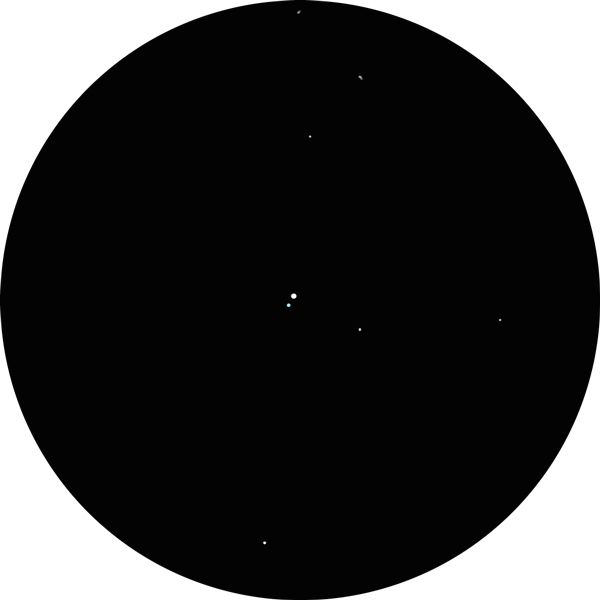
You know, as I stare at this double, I’m reminded somewhat of the icy-blue double I looked at earlier this evening (Gamma Arietis). The difference to me is that 1 Cam’s primary star is whiter. And definitely, the smaller secondary has a blue tint. I’m not sure if I agree with Smyth and Chambers’ “sapphire” observation, but it does have a nice blue tint. The pair sits in a nice area with several stars sprinkled around the field of view.
Key Stats
| Constellation | Camelopardalis |
| Best Viewing | Winter |
| Visual Magnitude | +5.8 | +6.8 |
| Separation | 10.3″ |
| Position Angle | 217° |
| Spectral Class | A=B0, B=B0 |
| Absolute Visual Magnitude | -2.79 |
| Distance from Earth | 3,400 ly |
| Milky Way Location | Orion Spur |
| My Viewing Grade | B+ |
| Designations | DL Camelopardalis, Struve 550 (STF 550), SAO 24670, HIP 21148 |
Other Observations in Camelopardalis
Sources and Notes
1 Kaler, Jim. 1 Camelopardalis, 2 Dec. 2016, http://stars.astro.illinois.edu/sow/1cam.html.
Sketch by Wayne McGraw
 The Garden Astronomer