
Messier 41, also known as NGC 2287, is an open cluster in the constellation Canis Major and is best viewed in winter. Messier 41 has held a special place in my heart since I was ten.
I remember the winter night well as I sat alone on a foldable chair on the south side of our house. Snow crept halfway up my boots as days earlier, a winter storm dumped on the front range of Colorado. The glassy and dry skies allowed the stars to pierce through the firmament in a way I have yet to experience again.
Out to the southeast, I noticed Sirius just as I was starting to pack up for the night. I decided to take a look, so I focused my telescope on the bright star. The spark in my eyepiece, a mix of blue and white flame, pulsated brilliantly — even through my cheap refractor. During that moment, I remembered seeing something circled near M41 on my star chart. So I pulled an Astronomy magazine out from my backpack. There, on the map, a circle with M41 appeared. I paused for a moment to look back up at the sky, loosened the nut on my wood tripod, and started moving the telescope up a down, and left and right, with Sirius flying by like a tracer with each swing. As I slowed down my movements, I passed the cluster. I hurriedly focused on the specks of light while trying to hold the scope still enough to get a good look.
It was as if someone spilled salt on the sky as I looked at the sprinkling of stars. Five minutes passed. I didn’t move my eye away from the light of M41 as a tried desperately to comprehend how stars could exist so close together. I eventually packed up the scope and got into bed, but not without taking the “M” volume of Encyclopaedia Britannica so I could read about the magical object.
I always had an interest in astronomy since I was very little, but I believe seeing M41 in that quiet moment in the middle of winter solidified my lifelong passion for the ancient science and the practice of studying the stars.
My Observations
| Date | February 12, 2022 |
| Time | 8:50 p.m. |
| Location | Seattle, WA |
| Magnification | 85x |
| Scope | Meade 8″ SCT |
| Eyepiece | 24mm |
| Seeing | Average |
| Transparency | Average |
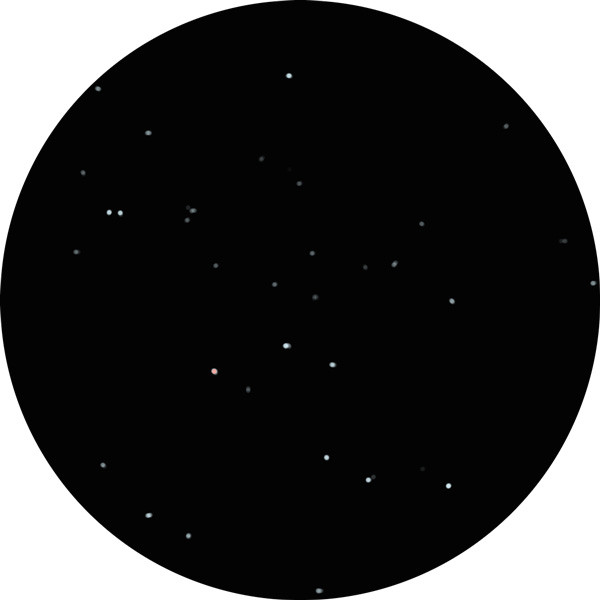
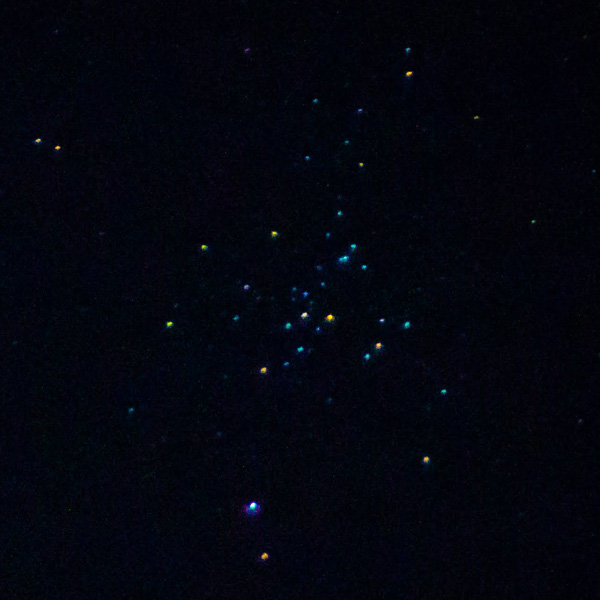
Seeing M41 is like seeing a long-lost friend. Here in the Pacific Northwest, the cluster remains quite low in the sky. The surrounding cedar trees to the south block my view. Tonight, I’ve moved my scope to a place where I can aim the telescope through a narrow break between branches. I waited patiently tonight for M41, hoping it would fly perfectly into the small opening, and it did. I sketched quickly with no time to spare for contemplation. As I finished, I took one last breath and thanked God for the cluster.
Key Stats
| Constellation | Canis Major |
| Best Viewing | Winter |
| Visual Magnitude | +4.5 |
| Absolute Magnitude | -4.76 |
| Distance from Earth | 2,300 ly |
| Diameter | 26 ly |
| Apparent Size | 39 arcmin |
| Milky Way Location | Orion Spur |
| My Viewing Grade | A |
Historical Observations
Before Charles Messier recorded M41, we know several others observed the cluster:
- Perhaps known to Aristotle about 325 B.C.
- Discovered by Giovanni Batista Hodierna before 1654.
- Discovered by John Flamsteed on February 16, 1702.
January 16 to 17, 1765 observation by Charles Messier
“In the night of January 16 to 17, 1765, I have observed below Sirius & near the star Rho of Canis Major a star cluster; when examining it with a night refractor, this cluster appeared nebulous; instead, there is nothing but a cluster of small stars.”
Sources and Notes
M41 banner photo by NOIRLab / NSF / AURA used under the Creative Commons Attribution-Share Alike 4.0 International license.
Charles Messier Observations: SEDS Messier Database
 The Garden Astronomer
4 thoughts on “Messier 41 (NGC 2287): The Little Beehive in Canis Major”