
Messier 46 is an open cluster in the constellation Puppis and is best viewed in winter. Puppis is a constellation of the southern hemisphere. Because of its location in the south, observers far up north—say in the Pacific Northwest—may find it difficult to get a clear view of M46. See my observation below on how I targeted the cluster from Seattle.
Messier 46 is rich with stars. In fact, the cluster is home to more than 500 of them and is 30 light-years in diameter. Notably, a planetary nebula appears in the same field of view, making it look like a smoke ring floating among the cluster of stars. However, based on velocity and distance studies, astronomers don’t believe the nebula is actually part of the cluster.
At a magnitude of 6, M46, it’s bright enough to view with binoculars. Also, if you are using binoculars (or a wide-field eyepiece on your scope), you may see another cluster (M47) in the same view, making Puppis a great destination for stargazing.
My Observations
| Date | February 12, 2022 |
| Time | 9:45 p.m. |
| Location | Seattle, WA |
| Magnification | 85x |
| Scope | Meade 8″ SCT |
| Eyepiece | 24mm |
| Seeing | Average |
| Transparency | Below Average |
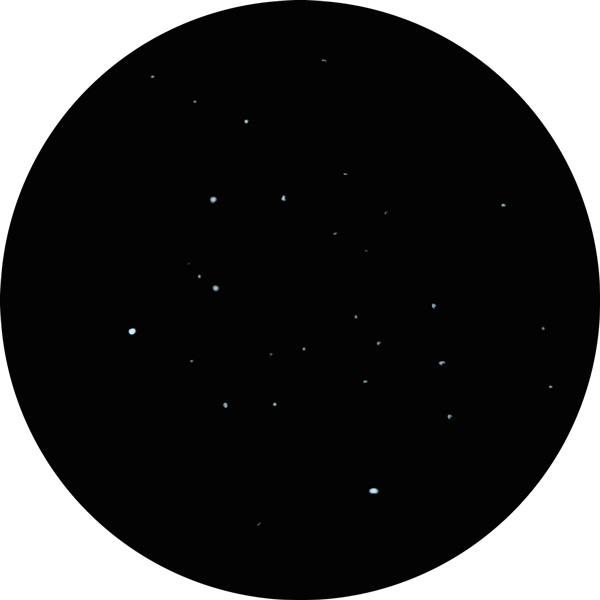
After waiting patiently for 20 minutes, Messier 46 has moved into a narrow clearing between giant fir trees south of my backyard. I’m sketching and writing quickly to get as many stars drawn. I estimate I have five minutes before M46 ducks back behind menacing branches. Making matters worse is the atmospheric turbulence created by nearby chimneys letting out their smoke and heat on this cold winter’s night.
I’m returning now to finish my thoughts as M46 has passed behind the neighbor’s trees for good tonight. Even though I was contending with light pollution and atmospheric interference, I’m glad to say M46 still makes for a good target from the suburbs. It’s tough, even with my 8-inch scope, to make out hundreds of fainter stars. I’m sure many more stars would “seep” through the darkness from a dark site farther south.
Key Stats
| Constellation | Puppis |
| Best Viewing | Winter |
| Visual Magnitude | +6.0 |
| Absolute Magnitude | -4.80 |
| Distance from Earth | 4,900 ly |
| Diameter | 30 ly |
| Apparent Size | 20 arcmin |
| Milky Way Location | Orion Spur |
| My Viewing Grade | B- |
| Designations | M46, NGC 2437, NGC 2438 (planetary nebula) |
Historical Observations
February 19, 1771, observation by Messier. It’s believed he was looking at NGC 2548.
“A cluster of very small stars, between the head of the Great Dog and the two hind feet of the Unicorn, [its position] determined by comparing this cluster with the star 2 Navis, of 6th-magnitude, according to Flamsteed; one cannot see these stars but with a good refractor; the cluster contains a bit of nebulosity.“
March 19, 1786, observation by William Herschel
“A beautiful, very rich, compressed cluster of stars of various magnitudes.“
Sources and Notes
M46 banner photo by Jose Luis Martinez and used under the Creative Commons Attribution-Share Alike 4.0 International license.
Charles Messier Observations: SEDS Messier Database
 The Garden Astronomer