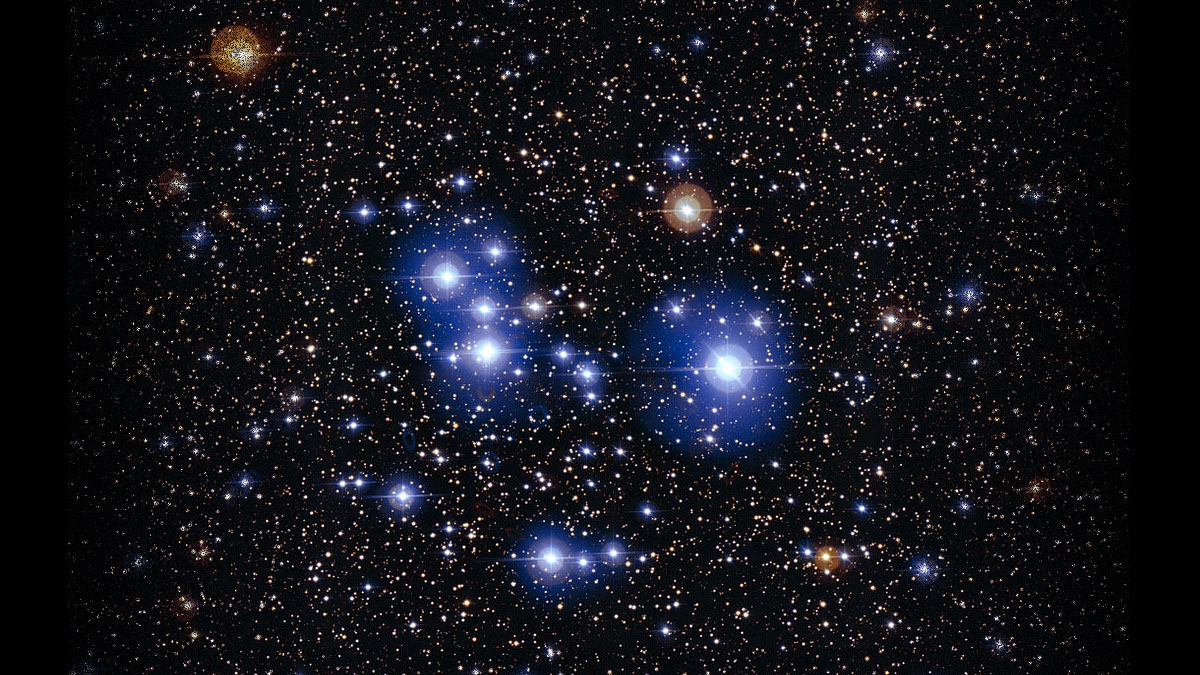
Messier 47 (M47) is an open cluster in the southern constellation of Puppis. It’s best viewed in winter, and observers in the higher northern latitudes will need an unobstructed view of the southern sky to view it. M47 is bright enough to see with the naked eye from a dark sky and big enough to be enjoyed with binoculars. In fact, this star cluster contains approximately 50 stars roughly spread out the size of the full moon.
M47 may be one of the least dense clusters in the sky, but it makes up for the lack of stars with its youth. This young cluster hosts a good number of hot, blue stars, and throws in a few older, redder stars for contrast. Quite notably, several astronomers made independent discoveries of M47—see the Historical Observations section below.
My Observations
| Date | February 12, 2022 |
| Time | 9:00 p.m. |
| Location | Seattle, WA |
| Magnification | 85x |
| Scope | Meade 8″ SCT |
| Eyepiece | 24mm |
| Seeing | Average |
| Transparency | Average |
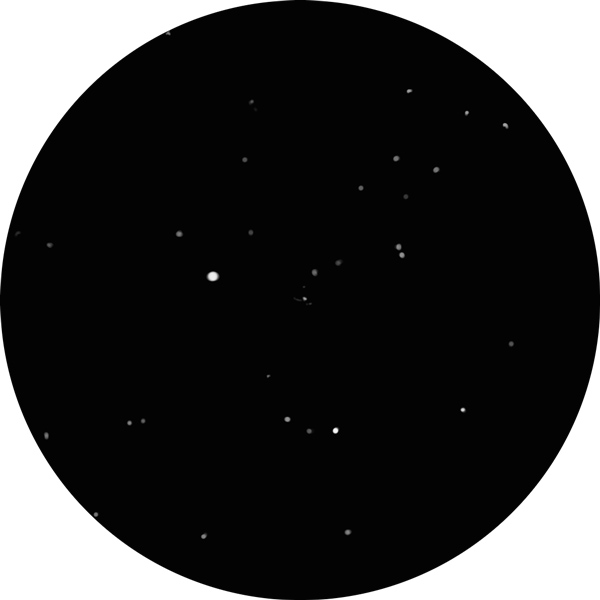
I don’t have much time to think about and observe M47 due to the narrow clearing it inhabits between several tall trees. Within minutes, I suspect it will move out of view. There are a handful of bright and moderately bright stars in view, and they fill up the 24mm eyepiece. As suspected, I don’t see many stars or any hazy patches which could indicate a large population of dimmer stars here. It appears there is a close binary star near the center.
Key Stats
| Constellation | Puppis |
| Best Viewing | Winter |
| Visual Magnitude | +4.4 |
| Absolute Magnitude | -4.0 |
| Distance from Earth | 1,600 ly |
| Diameter | 12 ly |
| Apparent Size | 25 arcmin |
| Milky Way Location | Orion Spur |
| My Viewing Grade | B+ |
Historical Observations
Astronomers credit Italian astronomer Giovanni Battista Hodierna for first documenting the cluster sometime before 1654, and then several astronomers over the years made their own independent discoveries. See historical observations below.
- Charles Messier on February 19, 1771
- Caroline Herschel in early 1783
- William Herschel on February 4, 1785
February 19, 1771, observation by Charles Messier
“Cluster of stars, little distant from the preceding; the stars are greater [brighter]; the middle of the cluster was compared with the same star, 2 Navis. The cluster contains no nebulosity.“
Sources and Notes
M47 banner photo by the European Southern Observatory (ESO). This file is licensed under the Creative Commons Attribution 4.0 International license.
Charles Messier Observations: SEDS Messier Database
 The Garden Astronomer