
The globular cluster Messier 53 (M53) lies in the constellation Coma Berenices and is best viewed in late spring through mid-summer. Within our Milky Way galaxy, M53 makes its home on the far outskirts. In fact, this cluster shines “down” on us from 59,700 light years above the galaxy!
Compared to open clusters, globular clusters are ancient objects with an abundance of older stars. Messier 53 breaks the globular mold as it contains an above-average number of stars called “blue stragglers.” These bright, younger-looking stars seem out of place, which raises the question about their existence in an old globular cluster. According to NASA, the blue stragglers are “probably formed by close encounters, possibly collisions, between stars in the crowded centers of globular clusters like M53.” 1
Historically speaking, the German astronomer Johann Elert Bode first recorded M53 on February 3, 1775, with Charles Messier making his own independent discovery two years later on February 26, 1777.
My Observations
| Date | May 20, 2022 |
| Time | 10:39 p.m. |
| Location | Seattle, WA |
| Magnification | 102x |
| Scope | Meade 8″ SCT |
| Eyepiece | 20mm |
| Seeing | Average |
| Transparency | Below Average |
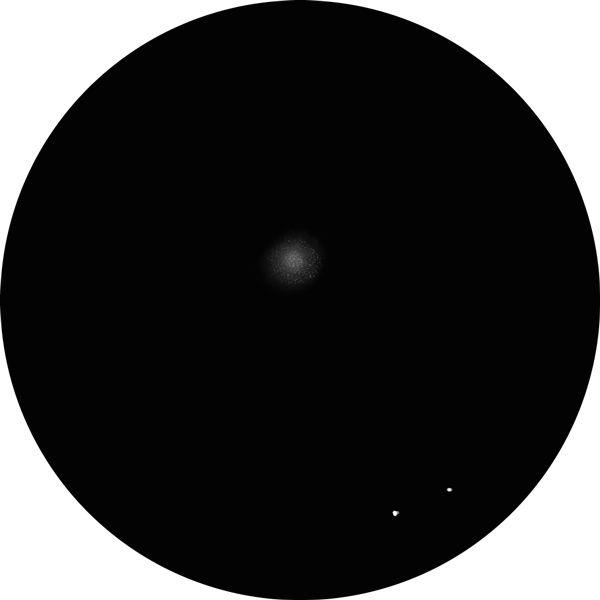
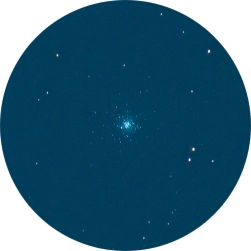
After a quick look at Spica to start the night, my daughter and I slewed the telescope to Messier 53, an object I most photographed before now (see below). Even with some hazy conditions in the upper atmosphere, M53’s distant light shows up in the eyepiece, though It’s tough to see individual stars. Compared to other globular clusters I’ve observed, this one seems to have a brighter center that quickly fades toward the edge. The width appears to match the space between the two bright stars in my field of view.
Previous observation using photography.
Date: April 30, 2021
Time: 11:00 p.m.
Location: Seattle, Washington
Camera: Canon 70d
Lens: 16-400mm Tamron
Temp: 60F
Seeing: Average
Transparency: Average
Key Stats
| Constellation | Coma Berenices |
| Best Viewing | Spring |
| Visual Magnitude | +7.6 |
| Absolute Magnitude | -8.6 |
| Distance from Earth | 58,000 ly |
| Diameter | 220 ly |
| Apparent Size | 13 arcmin |
| Milky Way Location | Above the galaxy |
| My Viewing Grade | B+ |
Historical Observations
Johann Elert Bode’s description of M53 on February 3, 1775
“Early in the morning, I discovered a nebula north of the star Epsilon or Vindemiatrix at the northern wing of Virgo, about 1 deg east of the 42nd star of Coma Berenices, which appears through the telescope rather vivid and of round shape. The 11th figure shows its position relative to the 42nd star and some smaller ones which don’t appear in the sky charts, between which several separations have been measured.” 2
Charles Messier’s description of M53 on February 26, 1777
“Nebula without stars discovered below & near Coma Berenices, a little distant from the star 42 in that constellation, according to Flamsteed. This nebula is round and conspicuous. The Comet of 1779 was compared directly with this nebula, & M. Messier has reported it on the chart of that comet, which will be included in the volume of the Academy for 1779. Observed again April 13, 1781: It resembles the nebula which is below Lepus.” 2
Sources and Notes
The banner photo of M53 is attributed to ESA / Hubble and is licensed under the Creative Commons Attribution 4.0 International license.
1 Garner, R. (2017, October 6). Messier 53. NASA. Retrieved May 21, 2022, from https://www.nasa.gov/feature/goddard/2017/messier-53
2 Guy McArthur, H. F. (n.d.). Messier 53. Retrieved May 21, 2022, from http://www.messier.seds.org/Mdes/dm053.html
Sketch by Wayne McGraw
 The Garden Astronomer
One thought on “Messier 53 (NGC 5024): An Old, Bold Globular Cluster on the Outskirts of the Milky Way”