
Messier 12, also known as NGC 6218, is a bright globular cluster in the constellation Ophiuchus and is best viewed in July. M12 is one of 21 globular clusters and seven Messier objects in Ophiuchus.1 So if you are stopping by to see this globular cluster, plan to stay a while to enjoy a good number of gems in the region.
Messier 12 is considered one of the better globular clusters for amateur astronomers because of its bright 6.7 magnitude and dense center. Though M12 is slightly dimmer than neighboring Messier 10, suburban astronomers should be able to pick it out using a smaller scope.
On an interesting note, studies show Messier 12 is an uncommon globular cluster due to its lack of low-mass stars. These low-mass stars may have been stripped away by M12 passing through the plane of the Milky Way.1 Its physical diameter is around 75 light-years and lies around 16,400 light-years away.
Charles Messier discovered M12 on May 30, 1764—a few days after finding its nearby twin M10.
My Observations
| Date | June 24, 2022 |
| Time | 11:35 p.m. |
| Location | Seattle, WA |
| Magnification | 127x |
| Scope | Meade 8″ SCT |
| Eyepiece | 16mm |
| Seeing | Above Average |
| Transparency | Above Average |
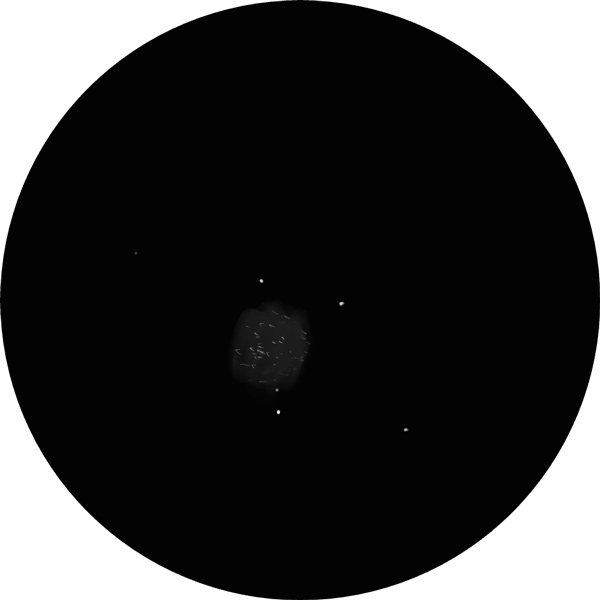
After what seems the longest season of cold and dreary weather in the Pacific Northwest, tonight’s sky is clear and crisp. The heavens have been unfolding every minute in front of me. This is my first time sailing through the constellation Ophiuchus. Until tonight, I never realized the area to be so rich! M12’s fairly bright core resembles nearby Messier 10, which I visited a few minutes ago. M12 does appear slightly fainter and hazier than M10. I advise comparing and contrasting these two globulars within the same sitting.
Key Stats
| Constellation | Ophiuchus |
| Best Viewing | Summer |
| Visual Magnitude | +6.7 |
| Absolute Magnitude | -6.6 |
| Distance from Earth | 16,400 ly |
| Diameter | 75 ly |
| Apparent Size | 16 arcmin |
| Milky Way Location | Near Norma |
| My Viewing Grade | B |
| Designations | NGC 6218, M12 |
Historical Observations
May 30, 1764, observation by Charles Messier
“In the same night of [May] 30 to 31, 1764, I have discovered a nebula in Serpens, between the arm & left side of Ophiuchus, according to the charts of Flamsteed: That nebula doesn’t contain any star; it is round, its diameter can be 3 minutes of arc, its light is faint; on sees it very well with an ordinary [non-achromatic] refractor of 3 feet [FL]. I have determined its position, by comparing with the star Delta Ophiuchi; its right ascension has been concluded at 248d 42′ 10″, & its declination at 1d 30′ 28″ south. I have marked it in the chart of the apparent path of the Comet which I have observed last year [the comet of 1769].” 2
Sources and Notes
M12 banner created from an image by Adam Block. The photo is licensed under the Creative Commons Attribution-Share Alike 4.0 International license.
1 Wikimedia Foundation. (2022, June 9). Messier 12. Wikipedia. Retrieved August 20, 2022, from https://en.wikipedia.org/wiki/Messier_12
2 Guy McArthur, H. F. (n.d.). Messier 12. Retrieved August 20, 2022, from https://www.messier.seds.org/Mdes/dm012.html.
 The Garden Astronomer