
Messier 14, also known as NGC 6402, is a relatively bright globular cluster in the constellation Ophiuchus, which is best viewed in summer.
Since Ophiuchus lies on the celestial equator, it appears above the horizon from most places on earth. Backyard suburban astronomers farther north, like myself, will need to look to the southern sky to enjoy Messier 14 along with Ophiuchus’ other rich objects.
With a pair of binoculars, you may be able to see M14 from a dark location, while an average telescope is better suited for suburban skies. M14 contains approximately 150,000 stars and is 100 light-years across. It’s also a globular cluster known for a slightly elongated shape. Unfortunately, the brightest stars in the cluster are dim at around 14-15 magnitudes, so it’s tough to pick out individual stars without a larger amateur telescope.1
Historically speaking, Charles Messier discovered the cluster on June 1, 1764, describing it as a nebula.
My Observations
| Date | June 24, 2022 |
| Time | 11:26 p.m. |
| Location | Seattle, WA |
| Magnification | 127x |
| Scope | Meade 8″ SCT |
| Eyepiece | 16mm |
| Seeing | Average |
| Transparency | Average |
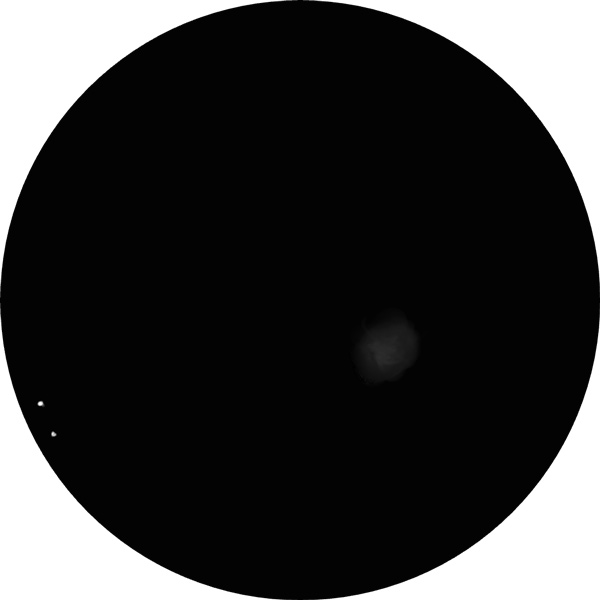
While I can see M14 as a hazy patch in the scope, I was hoping it would be brighter. Unfortunately, due to my suburban location, and average sky transparency, I cannot pick out individual stars with my 8-inch SCT. As Messier said, it appears like a starless “nebula.” A pair of equally bright stars lies nearby, which I’m marking on the sketch.
Key Stats
| Constellation | Ophiuchus |
| Best Viewing | Summer |
| Visual Magnitude | +7.6 |
| Absolute Magnitude | -7.2 |
| Distance from Earth | ~ 30,000 ly |
| Diameter | ~ 100 ly |
| Apparent Size | 11 arcmin |
| Milky Way Location | Above Galaxy |
| My Viewing Grade | B |
| Designations | M 14, NGC 6402 |
Historical Observations
June 1, 1764, observation by Charles Messier
“In the same night of June 1 to 2, 1764, I have discovered a new nebula in the garb which dresses the right arm of Ophiuchus; on the charts of Flamsteed it is situated on the parallel of the star Zeta Serpentis: that nebula is not considerable, its light is faint, yet it is seen well with an ordinary [non-achromatic] refractor of 3 feet & a half [FL]; it is round, & its diameter can be 2 minutes of arc; above it & very close to it is a small star of the ninth magnitude. I have employed for seeing this nebula nothing but the ordinary refractor of 3 feet & a half with which I have not noticed any star; maybe with a larger instrument, one could perceive one. I have determined the position of that nebula by its passage of the Meridian, comparing it with Gamma Ophiuchi, it has resulted for its right ascension 261d 18′ 29″, & for its declination 3d 5′ 45″ south. I have marked that nebula on the chart of the apparent path of the Comet which I have observed last year [the comet of 1769].”
July 30, 1783, observation by William Herschel
“With a power of 200, I see it consists of stars. They are better visible with 300. With 600, they are too obscure to be distinguished, though the appearance of stars is still preserved. This seems to be one of the most difficult objects to be resolved. With me, there is not a doubt remaining; but another person, in order to form a judgment, ought previously to go through all the several gradations of nebulae which I have resolved into stars. “1
Sources and Notes
M14 banner photo created NOIRLab/NSF/AURA. Source file. The image file is licensed under the Creative Commons Attribution 4.0 International license.
1 Admin. “Messier 14.” Messier Objects, 1 Mar. 2022, https://www.messier-objects.com/messier-14/.
 The Garden Astronomer