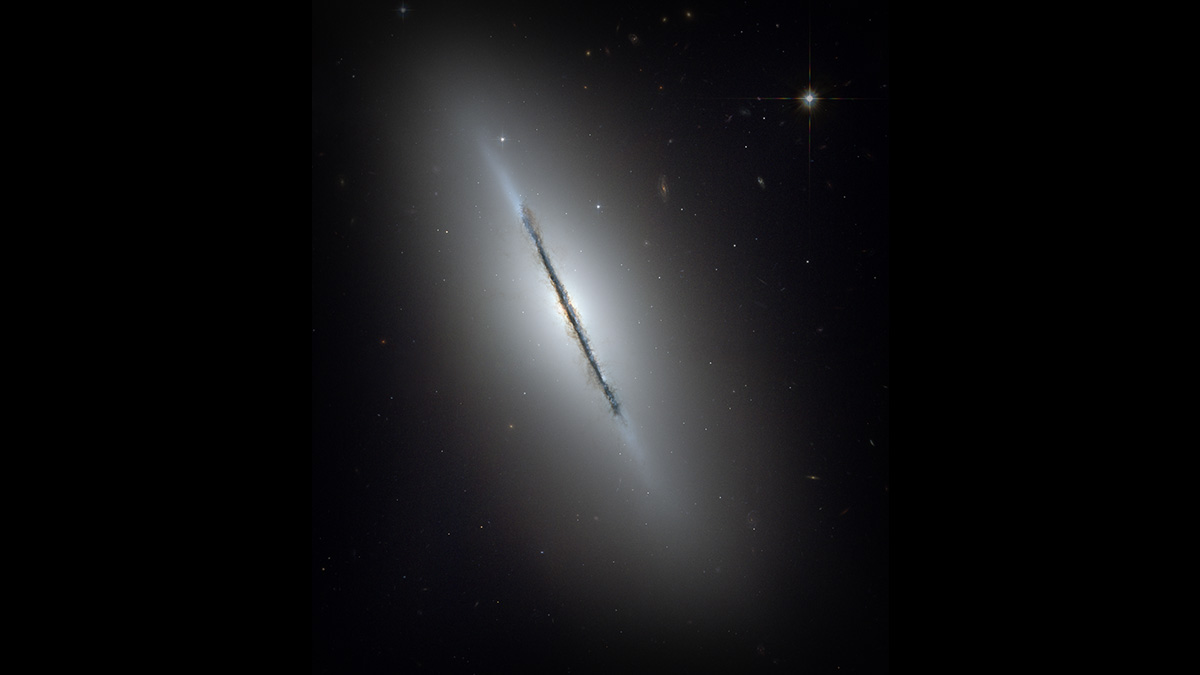
Messier 102, also known as the Spindle Galaxy, makes its home in the Draco constellation. The galaxy is best viewed on summer nights.
One cannot dismiss the allure of M102. High-resolution photographs show a brilliant sliver of light with a dark dust lane running down the middle. The galaxy appears as a thin fuzzy line because we are viewing it edge-on versus head-on. Take a look at the superb Sombrero Galaxy for a similar example. The comparison doesn’t end there. The Sombrero Galaxy and M102 are also lenticular galaxies. Lenticulars are flat and disk-shaped like many other spiral galaxies, but they lack distinctive spiral arms. Generally, they appear like a lens against the dark background of space.
With an apparent magnitude of 10.7, M102 can be a tough object to see from light-polluted locations. (Read my initial personal struggle below.) Under dark skies, however, amateur astronomers can pick up M102 using smaller scopes. The galaxy is between 40-50 million light-years away and roughly 60,000 light-years in diameter.1
Lastly, M102 has a dubious history regarding its discovery. Charles Messier’s colleague Pierre Méchain shared his observation of M102 with Messier in the spring of 1781. Due to a publication deadline, Messier didn’t validate the finding when he entered Méchain’s notes.
Two years later, upon realizing the entry for M102 may have been made in error, Méchain retracted his claim of discovering M102. While we will never know what exactly Méchain saw that spring night in 1781, many historians believe he was viewing NGC 5866, which we know as M102 today. To learn more, I suggest reading Hartmut Frommert’s article on the controversy surrounding M102.
My Observations
| Date | June 30, 2022 |
| Time | 11:45 p.m. |
| Location | Seattle, WA |
| Magnification | 102x |
| Scope | Meade 8″ SCT |
| Eyepiece | 20mm |
| Seeing | Above Average |
| Transparency | Above Average |
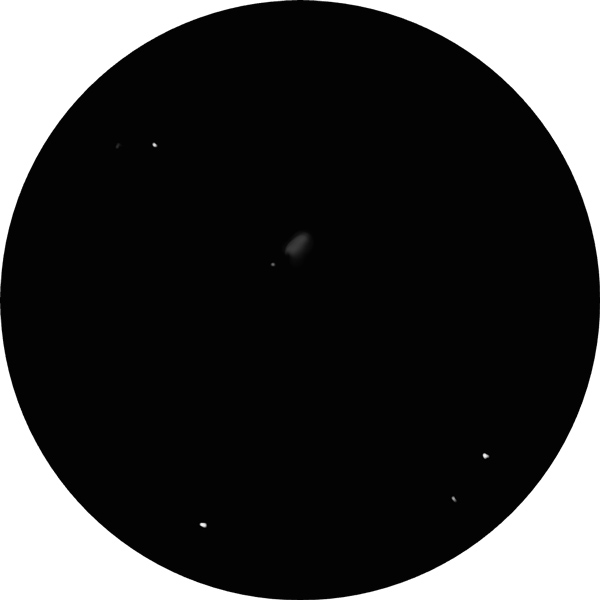
This is one of the most difficult Messier objects I’ve viewed from the suburbs. I passed over M102’s area several times and almost gave up. Before deciding to forgo my search, I closed my eyes for a few minutes to force my pupils to open as wide as possible. Looking through the eyepiece again, I noticed the faintest minuscule diagonal mist/smudge in the center of the eyepiece. I tapped the scope gently, and the dot of haze shivered. This confirmed I wasn’t simply observing a light artifact or haze on my eyepiece. The sliver resembled what I saw in sketches from other amateur astronomers. I finally had my target!
Key Stats
| Constellation | Draco |
| Best Viewing | Summer |
| Visual Magnitude | +10.7 |
| Absolute Magnitude | -20.99 |
| Distance from Earth | 40-50 million ly |
| Diameter | 60,000 ly |
| Apparent Size | 5.2 x 2.3 arcmin |
| My Viewing Grade | C |
Historical Observations
Historians believe Pierre Méchain most likely discovered M102 in March or April 1781. Méchain thought it was simply Messier 101, writing in a letter: “I will add only that No. 101 & 102 on p. 267 of the Connoissance des tems [for] 1784 are nothing but the same nebula, which has been taken for two, by an error in the [sky] charts.”2
Charles Messier wrote in 1781: “[March/April 1781]. 102. [Méchain]
Nebula between the stars Omicron [actually Theta] Bootis & Iota Draconis: it is very faint; near it is a star of the sixth magnitude.“
May 5, 1788, observations by William Herschel
“Very bright. Considerably large. Extended [elongated]. Following [lying east of] 2 stars”
Sources and Notes
The Messier 102 banner was taken with the Hubble Telescope. This photo is in the public domain in the United States because it was solely created by NASA.
1 Garner, Rob. “Messier 102 (the Spindle Galaxy).” NASA, NASA, 6 Oct. 2017, https://www.nasa.gov/feature/goddard/2017/messier-102-the-spindle-galaxy.
2 Guy McArthur, Hartmut Frommert. Messier 102 (NGC 5866), https://www.messier.seds.org/Mdes/dm102.html.
 The Garden Astronomer