
The spiral galaxy Messier 63 (M63) lies in the spring constellation Canes Venatici. M63, which is also known as the Sunflower Galaxy, contains approximately 400 billion stars and is a popular target for astrophotographers.
Take a look at a color photograph of M63. You’ll notice that the galaxy’s arms are not well-defined. The arms appear intertwined instead. This is why astronomers define M63 as a flocculent spiral galaxy, which means the arms appear patchy or flaky. In fact, the galaxy has only two arms.1
M63’s diameter is around 90,000 light years, and it lies approximately 27-29 million light years away. Photographs show M63’s immense beauty with various colors spread out like a sunflower. Meanwhile, backyard observers using an average-sized scope will see a hazy smudge.
Historically speaking, credit goes to Pierre Méchain for discovering M63, and Charles Messier confirmed the sighting on June 14, 1779. Roughly 200 years later, on May 24, 1971, the galaxy made headlines when a supernova appeared on one of its arms.2
My Observations
| Date | June 24, 2022 |
| Time | 11:30 p.m. |
| Location | Seattle, WA |
| Magnification | 102x |
| Scope | Meade 8″ SCT |
| Eyepiece | 20mm |
| Seeing | Above Average |
| Transparency | Above Average |
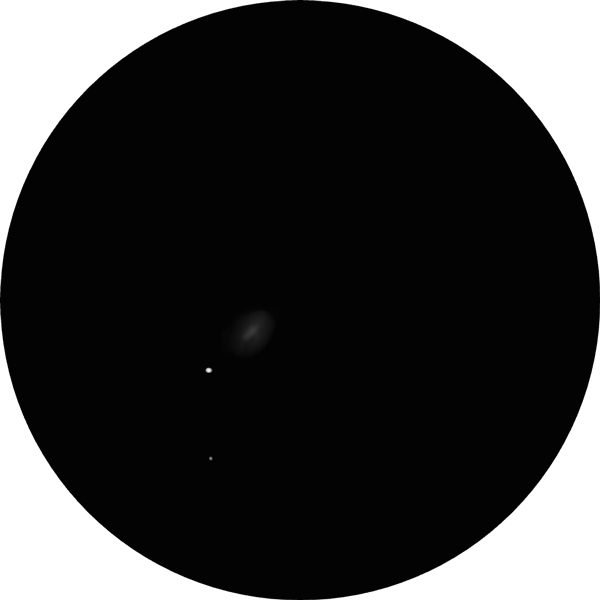
I didn’t notice M63 on the first pass over the area, so I checked my coordinates and slewed the telescope over the region again. I finally caught M63 using averted vision and didn’t take my eye off it for 30 seconds. This allowed me to see wisps of light growing out from the brighter center nucleus. Even on this clear and moonless night, this object remains tough to see from my suburban location. A bright star lies nearby.
Key Stats
| Constellation | Canes Venatici |
| Best Viewing | Spring |
| Visual Magnitude | +8.5 |
| Absolute Magnitude | -21.26 |
| Distance from Earth | 27-29 million ly |
| Diameter | 90,000 ly |
| Apparent Size | 11.8 x 7.2 arcmin |
| My Viewing Grade | C+ |
Historical Observations
June 14, 1779, observation by Charles Messier
“Nebula discovered by M. Méchain in Canes Venatici. M. Messier searched for it; it is faint, it has nearly the same light as the nebula reported under no. 59: it contains no star, & the slightest illumination of the micrometer wires makes it disappear: it is close to a star of 8th magnitude, which precedes the nebula on the hour wire. M. Messier has reported its position on the Chart of the path of the Comet of 1779.” 3
May 6, 1828, observations by John Herschel
“Bright; pretty much extended; very suddenly much brighter toward the middle, almost to a star [starlike nucleus], position angle 30deg north preceding [NW] to south following [SE]. The south following [SE] end [is] more diffused. Has a bright star north preceding [to the NW] and a double star following [to the East].” 3
Sources and Notes
The Messier 63 banner was taken with the Hubble Telescope. This photo is in the public domain in the United States because it was solely created by NASA.
1 Garner, R. (2017, October 6). Messier 63 (The sunflower galaxy). NASA. Retrieved August 21, 2022, from https://www.nasa.gov/feature/goddard/2017/messier-63-the-sunflower-galaxy
2 Wikimedia Foundation. (2022, June 9). Messier 63. Wikipedia. Retrieved August 21, 2022, from https://en.wikipedia.org/wiki/Messier_63
3 Guy McArthur, H. F. (n.d.). Messier 63. Retrieved August 21, 2022, from https://www.messier.seds.org/Mdes/dm063.html
 The Garden Astronomer