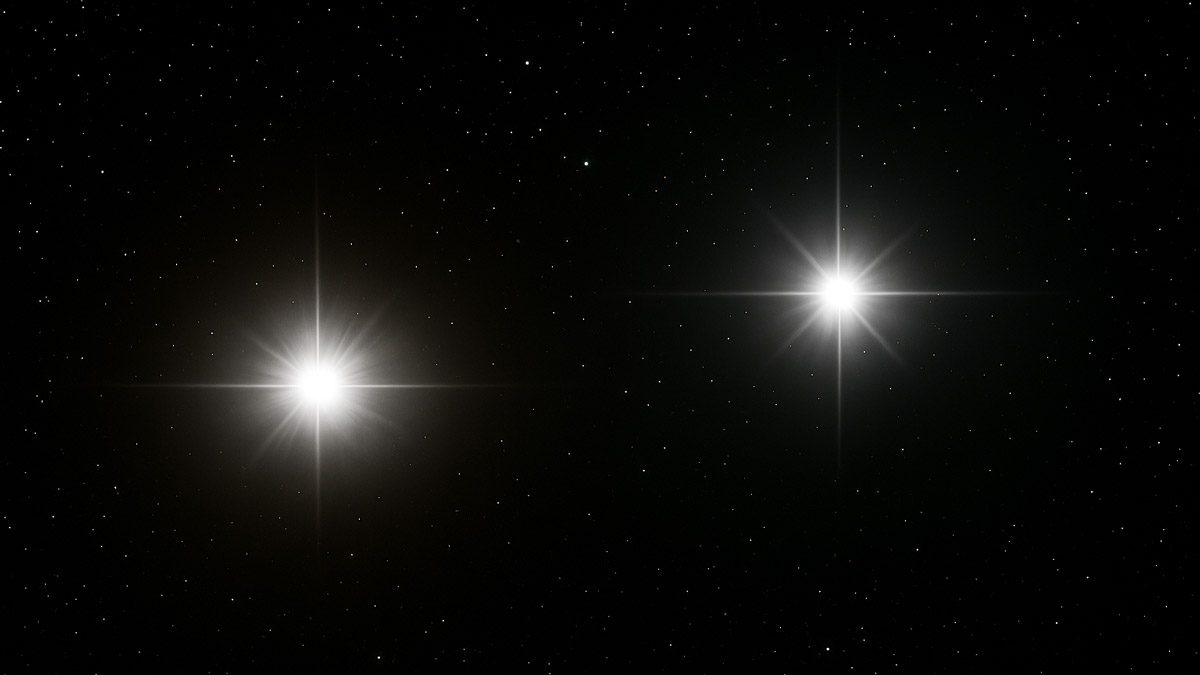
100 Herculis shines from above on hot summer nights as a close pair of white stars, making its home in the constellation Hercules. The stars are equally bright and only 14 arcseconds apart, so they make a pretty, quaint pair to view. While 100 Herculis is not as dazzling and colorful as nearby 95 Herculis, it’s still worth studying on summer nights.
My Observations
| Date | July 29, 2022 |
| Time | 10:48 p.m. |
| Location | Seattle, WA |
| Magnification | 169x |
| Scope | Meade 8″ SCT |
| Eyepiece | 12mm |
| Seeing | Average |
| Transparency | Average |

A few minutes ago, I drew 95 Herculis and have now made my way to 100 Herculis. 95 and 100 Herculis are good to study and compare in one session. 100 Herculis doesn’t have the color that 95 Her does, but it’s still an attractive double. In my eyepiece, 95 Her lines up nearly horizontally, while 100 Her lines up vertically.
Key Stats
| Constellation | Hercules |
| Best Viewing | Summer |
| Visual Magnitude | +5.81 | +5.82 |
| Absolute Visual Magnitude | +2.89 |
| Distance from Earth | 126 ly |
| Separation | 14.4″ | 556 AU |
| Orbital Period | Unknown |
| Milky Way Location | Orion Spur |
| My Viewing Grade | A- |
Sources and Notes
Banner illustration was created by the European Southern Observatory (ESO) and is under the Creative Commons Attribution 4.0 International License. Per ESO agreement: Here is the original image on the ESO website.
AKA: SAO 85752, 100 Her, HDF 166046, STF 2280
 The Garden Astronomer