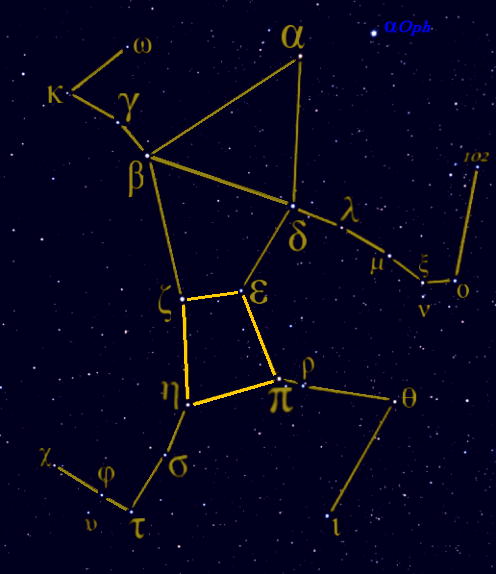
Marsic is an optical double star in the constellation Hercules, best viewed between May and August. The traditional name for Marsic is Al-Mirfaq, meaning “the elbow,” as it represents Hercules’ elbow (see “k” on the illustration to the right). Backyard astronomers with smaller telescopes should be able to see the two stars.
While Marsic may look like any binary star system in the eyepiece, the two stars are far apart. Specifically, the brighter star, called Kappa Herculis A, is a mere 360 light-years away from our sun. Meanwhile, the dimmer companion, called Kappa Herculis B, is 2000 light-years away from the Sun. 1
My Observations
| Date | July 29, 2022 |
| Time | 10:35 p.m. |
| Location | Seattle, WA |
| Magnification | 169x |
| Scope | Meade 8″ SCT |
| Eyepiece | 12mm |
| Seeing | Good |
| Transparency | Good |
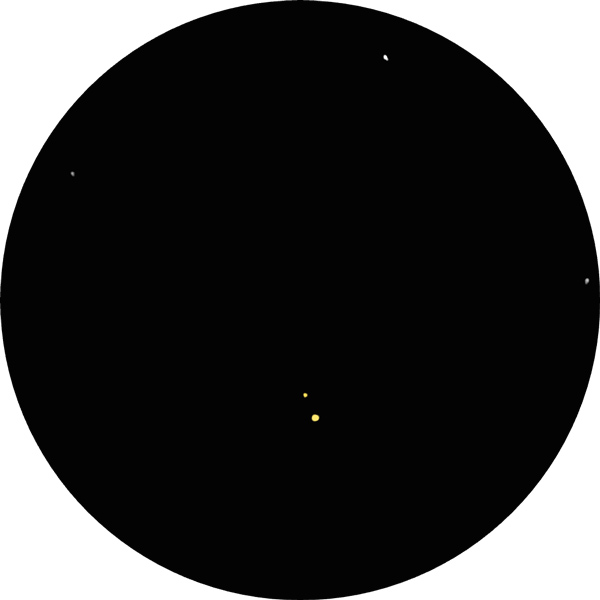
Marsic is a pretty optical double star. The brighter star, Kappa Herculis A, resembles a yellow topaz gem, while the smaller Kappa Herculis B is a reddish-yellow companion. I’ve been walking through Hercules, which has a nice collection of doubles. I appreciate this one for its warm colors.
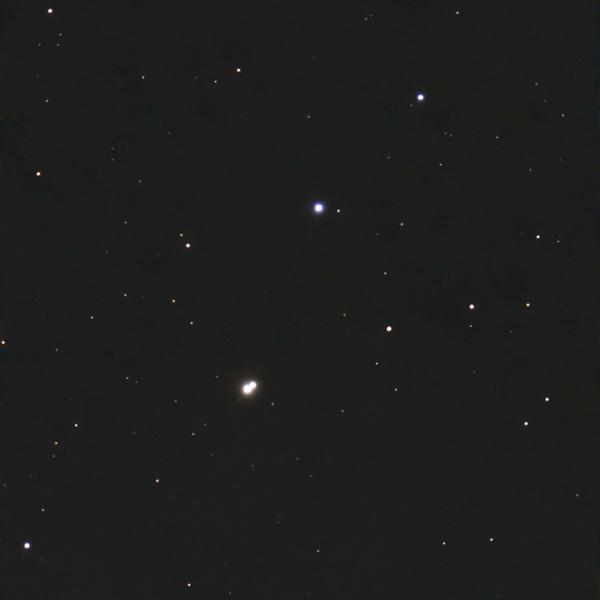
Seestar S50 Observation on October 15, 2025, Tampa, Florida
In this one-minute exposure (10-second individual shots stacked), Marsic and its companion appear below center.
Key Stats
| Constellation | Hercules |
| Best Viewing | Summer |
| Visual Magnitude | +5.6, +6.2 |
| Absolute Visual Magnitude | -0.26 |
| Distance from Earth | 360 & 2000 ly |
| Separation | 27.1″ |
| Milky Way Location | Orion Spur |
| My Viewing Grade | B |
| Other names | SAO 101951, STF 2010, κ Herculis, κ Her |
Sources and Notes
1 “Kappa Herculis.” Wikipedia, Wikimedia Foundation, 27 Mar. 2022, https://en.wikipedia.org/wiki/Kappa_Herculis
Sketch by Wayne McGraw
_
 The Garden Astronomer