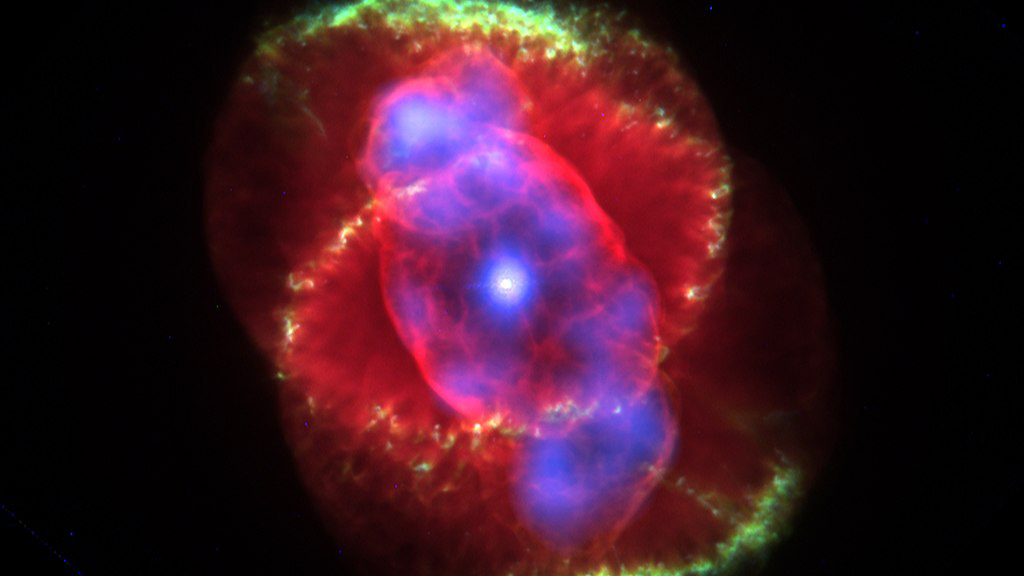
NGC 6543, also known as the Cat’s Eye Nebula, looks down from the constellation Draco in late summer skies. A dying star makes this beautiful object.
According to NASA, this star ejected gas in 1,500-year intervals, which created the rings or shells that you see today. But 1,000 years ago, these pulsating intervals stopped. Since then, the nebula has been forming inside these shells.1 Observers celebrate the Cat’s Eye Nebula as one of the brightest planetary nebulas in the night sky. In smaller scopes, it looks like a small blue fuzzy patch. Larger scopes will allow you to see the star in the middle.
My Observations
| Date | July 30, 2022 |
| Time | 11:00 p.m. |
| Location | Seattle, WA |
| Magnification | 169x |
| Scope | Meade 8″ SCT |
| Eyepiece | 12mm |
| Seeing | Above Average |
| Transparency | Average |
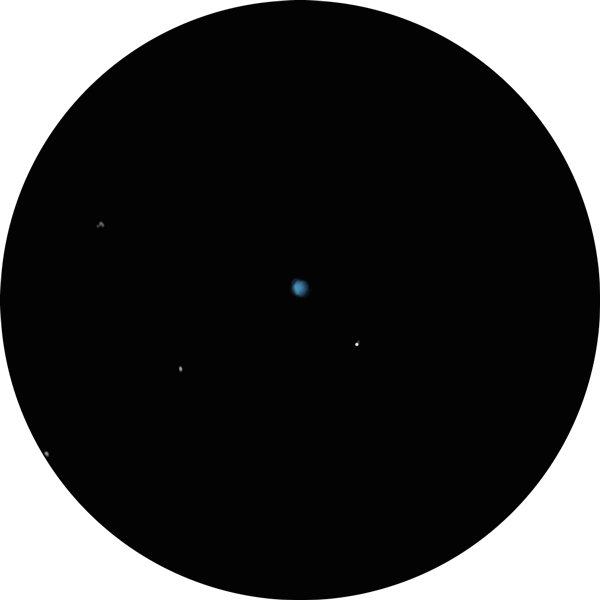
I return tonight to this hauntingly beautiful deep blue orb. It floats silently on this hot summer night almost directly above my head. The summer days are passing too quickly, and soon the fall will arrive with a wall of clouds. To slow the time, and to prevent the moment from dissolving into mist, I ran to the garage and called out to my family to come to look at the cat’s eye—eye to eye.
I suggest visiting NGC 6826 Blinking Planetary to compare to Cat’s Eye. I viewed NGC 6826 only fifteen minutes ago. NGC 6826 is smaller and not as bright as the Cat’s Eye, so maybe start with the Cat’s Eye and move across the sky to view the dimmer, smaller Blinking Planetary.
Previously viewed on August 18, 2020, at 10:40 p.m. Description: I almost missed the object using the lower power eyepiece as it looked like a slightly fuzzy star. I realized I had found the target because there is a “cleaner” (not fuzzy) star below it. Raising the magnification, up to a 14mm eyepiece, brought out the nebula, which also has a bluish color. It’s a little smaller than seeing the Ring Nebula in this scope, but the faintness is about the same.
Key Stats
| Constellation | Draco |
| Best Viewing | Summer |
| Visual Magnitude | +8.10 |
| Absolute Magnitude | -1.81 |
| Distance from Earth | 3,100 ly |
| Diameter | .3ly |
| Apparent Size | .4 x .3 arcmin |
| Milky Way Location | Orion Spur |
| My Viewing Grade | B+ |
Historical Observations
August 29, 1864, observation by William Huggins
“On the evening of August 29, 1864, I directed the telescope…to a planetary nebula in Draco. The reader may be able to picture to himself…the feeling of excited suspense, mingled with a degree of awe, with which, after a few moments of hesitation, I put my eye to the spectroscope. Was I not about to look into a secret place of creation?
I looked into the spectroscope. No such spectrum as I expected! A single bright line only! … The light of the nebula was monochromatic, and so, unlike any other light I had yet subjected to prismatic examination, could not be extended out to form a complete spectrum…A little closer looking showed two other bright lines on the side towards the blue. The riddle of the nebulae was solved. The answer, which had come to us in the light itself, read: Not an aggregation of stars, but a luminous gas” [emissions being characteristic of hot gases under low pressure].”
Sources and Notes
- The photo of NGC 6543 is by J.P. Harrington and K.J. Borkowski (University of Maryland). This file is in the public domain because it was created by NASA and ESA.
- 1https://hubblesite.org/contents/media/images/2004/27/1578-Image.html
- Quote from William Huggins from The Scientific Papers of Sir William Huggins, London: William Wesley and Sons, 1909.
- Sketch by Wayne McGraw
- AKA: Caldwell 6
 The Garden Astronomer
One thought on “NGC 6543: A Cat’s Eye Looks Down at You”