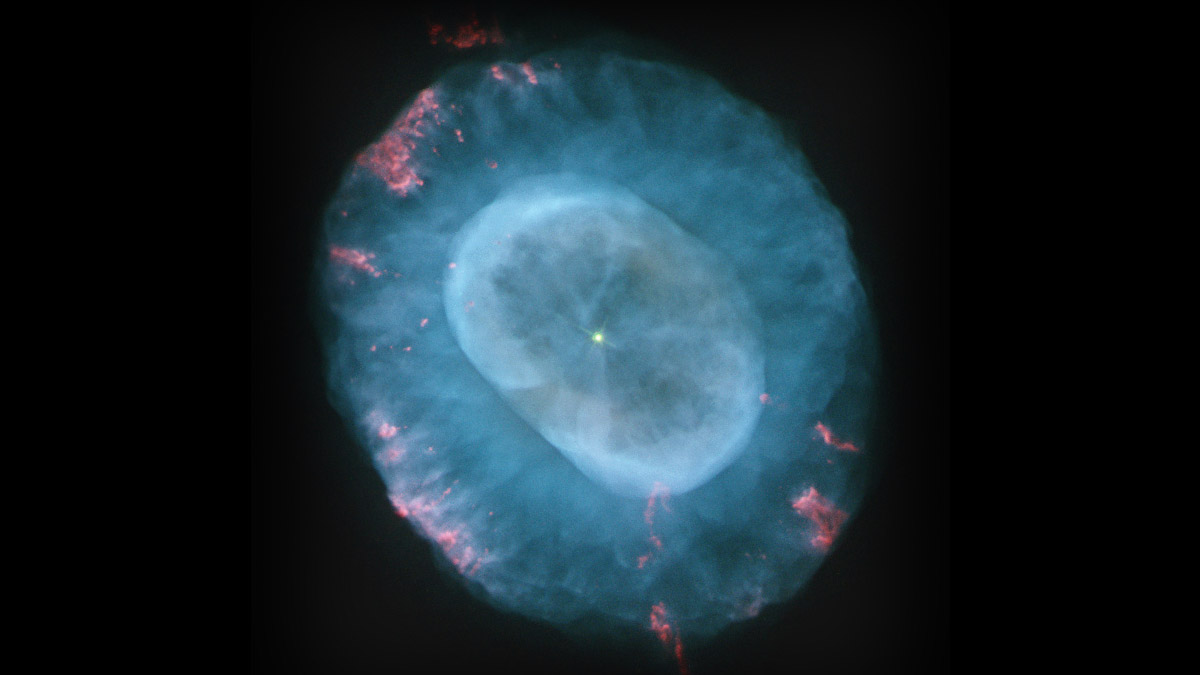
NGC 7662, also known as Caldwell 22 and the Snowball Nebula, is a planetary nebula in the constellation Andromeda, which is best viewed in autumn.
A dying low-mass star created NGC 7662 as it expanded and subsequently expelled gas during this process. The star eventually shrank down to what it is today: a very hot white dwarf star that continually irradiates the surrounding gas. The star will eventually fade away, and NASA reminds us that our own sun will meet a similar fate. 1
Backyard astronomers should be able to spot this planetary nebula fairly easily with smaller scopes, appearing as a fuzzy patch of light or a smudge.
Historically speaking, the astronomer William Herschel first recorded the object back in 1784.
My Observations
| Date | September 19, 2022 |
| Time | 10:15 p.m. |
| Location | Seattle, WA |
| Magnification | 169x |
| Scope | Meade 8″ SCT |
| Eyepiece | 12mm |
| Seeing | Average |
| Transparency | Average |
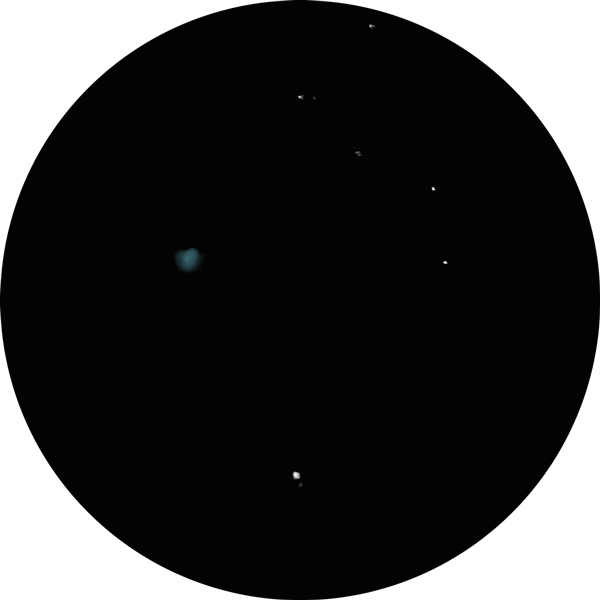
I’ve been anxiously waiting for the blue snowball to clear the treetops to the east. The wait was worth it. Even though I’ve read this is a popular target for backyard observers, I didn’t realize this little gem existed until tonight. Like most planetary nebulae, this one looks like a faint smudge on the eyepiece. On first examination, it looks much like the Saturn nebula.
Key Stats
| Constellation | Andromeda |
| Best Viewing | Autumn |
| Visual Magnitude | +8.3 |
| Absolute Magnitude | -1.9 |
| Distance from Earth | 3,600 ly |
| Diameter | .6 ly |
| Apparent Size | .5 x .5 arcmin |
| Milky Way Location | Orion Spur |
| My Viewing Grade | B+ |
Sources and Notes
Banner photo credited to Judy Schmidt. This file is licensed under the Creative Commons Attribution 2.0 Generic license. Citation here.
1 Henderson, Edward. “Caldwell 22.” NASA, NASA, 18 Nov. 2019, https://www.nasa.gov/feature/goddard/caldwell-22.
Sketch by Wayne McGraw
AKA: Snowball Nebula, Caldwell 22, Emission Nebula
 The Garden Astronomer
One thought on “NGC 7662: The Blue Snowball Nebula”