
HD 189751 is a 7th magnitude variable double star, also known as STT 394, in the constellation Cygnus. Backyard astronomers can aim for this double star, and the pretty string of stars around it, on late summer and autumn nights.
The primary star itself is classified as a type K1III, an orange giant. The secondary star lies at 11 arcseconds away, which is fairly close for smaller telescopes to split. Making this duty more difficult for backyard astronomers is the dim +10.3 magnitude for this companion.
Of note, the immediate region around this star has other stars that are double and multiple-star systems. In fact, another brighter star nearby, known as HD 189864 (aka Webb 9), is a multiple-star system as well. That star makes a colorful triangle pattern with stars ranging from white, pale blue, and red. See my observation below for more information.
My Observations
| Date | October 28, 2022 |
| Time | 7:50 p.m. |
| Location | Seattle, WA |
| Magnification | 169x |
| Scope | Meade 8″ SCT |
| Eyepiece | 24mm |
| Seeing | Good |
| Transparency | Good |
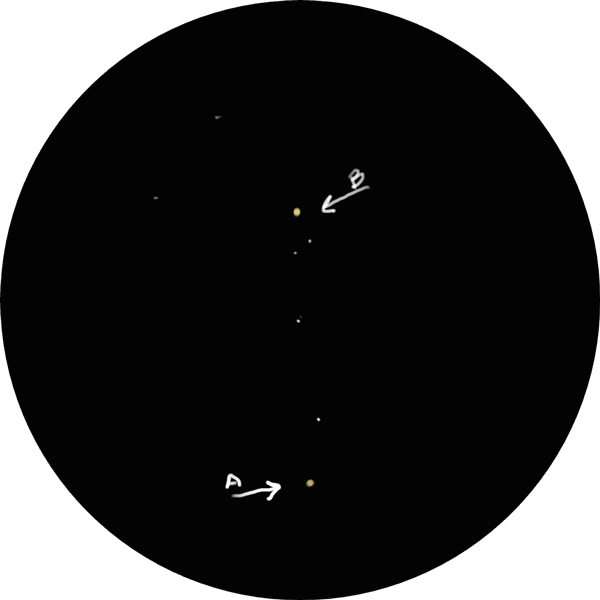
While it’s pretty tough to even see a secondary star to HD 189751, the stars showing up in the eyepiece have been an unexpected surprise for me.
To make things clear: The letter “A” in the sketch points to the primary star HD 189751. Since I was observing with a wider field eyepiece (24mm), I didn’t even notice the star’s secondary companion just 11 arcseconds away, so the companion is not included in the sketch above.
Honestly, I didn’t “dive” in deeper with a more powerful view because I was intrigued by the other stars in the field. For instance, HD 189864 is a 6th-magnitude double star also in the area. This primary star is shown as the letter “B” in the sketch above. It has a white to slightly blue tint. It makes the top point of a colorful triangle of stars of red and pale blue.
All to say, stick around this region and try out different magnifications to get the most out of this nice collection of stars!
Key Stats
| Constellation | Cygnus |
| Best Viewing | Autumn |
| Visual Magnitude | +7.0, +10.3 |
| Separation | 11″ | 1680 AU |
| Position Angle | 294° |
| Spectral Class | A=K1III |
| Absolute Visual Magnitude | +1.09 |
| Distance from Earth | 500 ly |
| Milky Way Location | Orion Spur |
| My Viewing Grade | A- |
| Designations | Letter A sketched: STT 394, HIP 98448, Letter B sketched: HD 189864, SAO 69252 |
Sources and Notes
Banner illustration was created by the European Southern Observatory (ESO) and is under the Creative Commons Attribution 4.0 International License. Per ESO agreement: Here is the original image on the ESO website.
Sketch by Wayne McGraw
 The Garden Astronomer