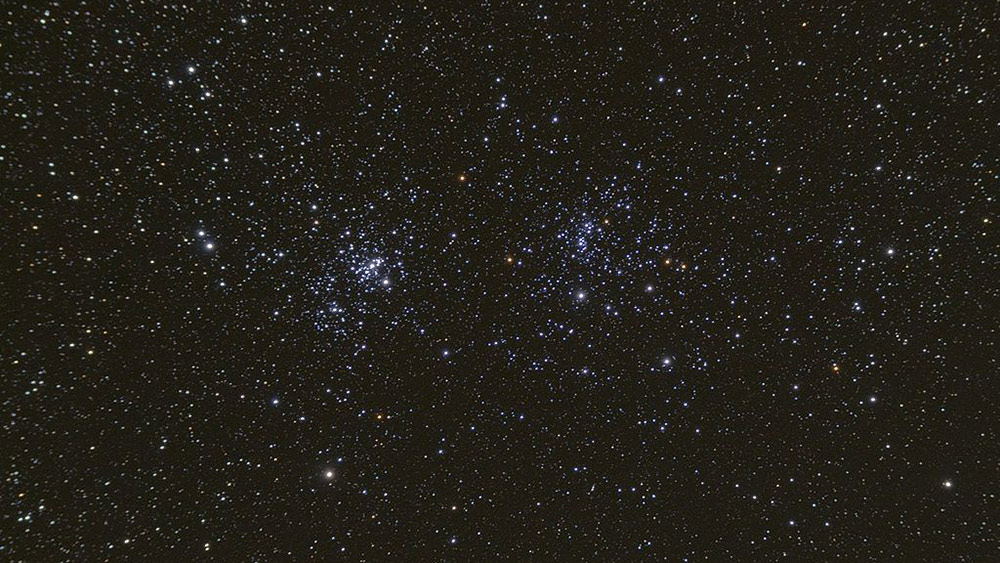
NGC 869 along with NGC 884 create a breathtaking cluster of stars floating in the constellation of Perseus. Like sparkling diamonds in a dark room, the Double Cluster lights up the autumn sky as it spreads itself as wide as two full moons.
Observers will find that the two clusters are made up of many bright blue young stars. In fact, they contain more than 300 blue-white supergiant stars shining their light down to us from 7,200 light years away. Even at this far distance, the Double Cluster appears as a fuzzy patch to the naked eye under good sky conditions. And for those of us backyard astronomers under light-polluted skies, the cluster doesn’t disappoint. Anyone with a small telescope or binoculars can see it well.
To give some perspective when looking at the well known clusters in the sky, it’s good to know the Double Cluster is one of the nearer star clusters to Earth, along with Messier 13 (6,500 light years) Messier 26 (7,500 light years), and Messier 44 (5,000 light years).
Historically speaking, skywatchers have enjoyed viewing the Double Cluster since antiquity. In fact, Hipparchus first cataloged the object around 130 B.C. and Ptolemy listed the cluster as a nebulous object in the sky. Centuries later, astronomer William Herschel cataloged the famous object as two separate clusters of stars.1
My Observations
| Date | November 12, 2022 |
| Time | 9:38 p.m. |
| Location | Seattle, WA |
| Magnification | 85x |
| Scope | Meade 8″ SCT |
| Eyepiece | 24mm |
| Seeing | Good |
| Transparency | Good |
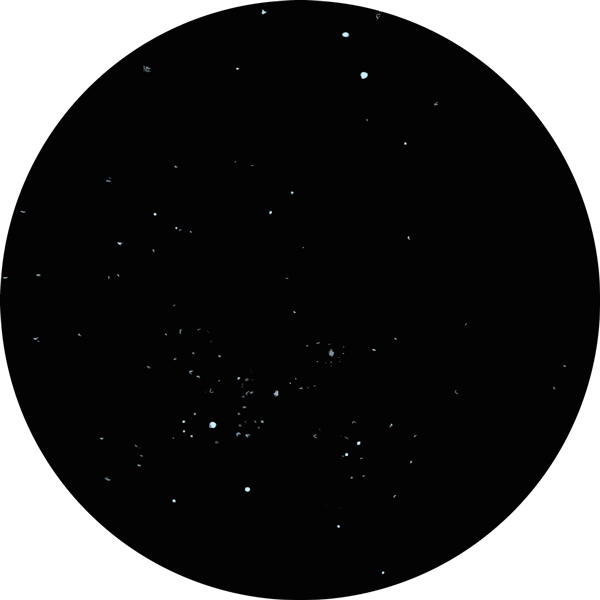
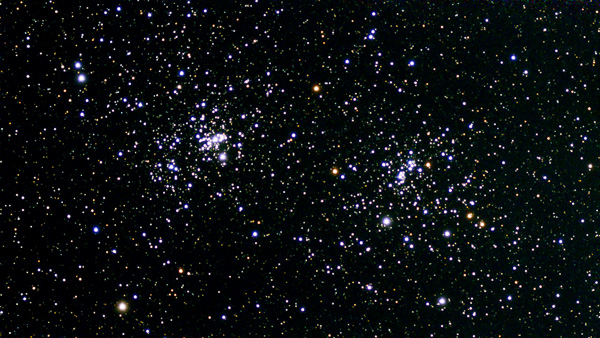
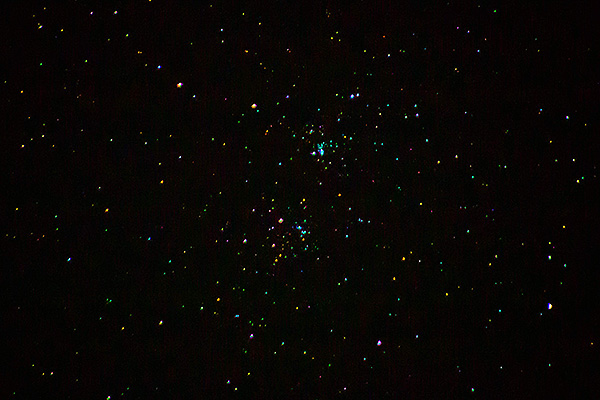
Even with a half waning moon lighting up the sky, the cluster looks amazing in my 24mm wide eyepiece. Until this evening, I’ve only viewed the Double Cluster with binoculars and by photographing it (below). Seeing this object in a 8-inch scope is breathtaking. Tonight, I’m contending with near freezing conditions with high humidity, but I celebrate that the late autumn Seattle skies are clear. The warmth and sparkling light of this cluster erases any thought of my freezing fingers trying to draw it.
Key Stats
| Constellation | Perseus |
| Best Viewing | Autumn |
| Visual Magnitude | +6.4 |
| Distance from Earth | 7,900 ly |
| Milky Way Location | Perseus Arm |
| My Viewing Grade | A+ |
Sources and Notes
Photo of NGC 869 by Lukáš Kalista and is licensed under the Creative Commons Attribution-Share Alike 3.0 Unported license.
1 Hcraig. “Featured Celestial Object: Perseus Double Cluster.” Lowell Observatory, 4 Dec. 2018, https://lowell.edu/perseus-double-cluster/.
AKA: Caldwell 14, h Persei and χ Persei, Chi Persei,
 The Garden Astronomer
One thought on “NGC 869 and 884: The Famous Sparkling Double Cluster”