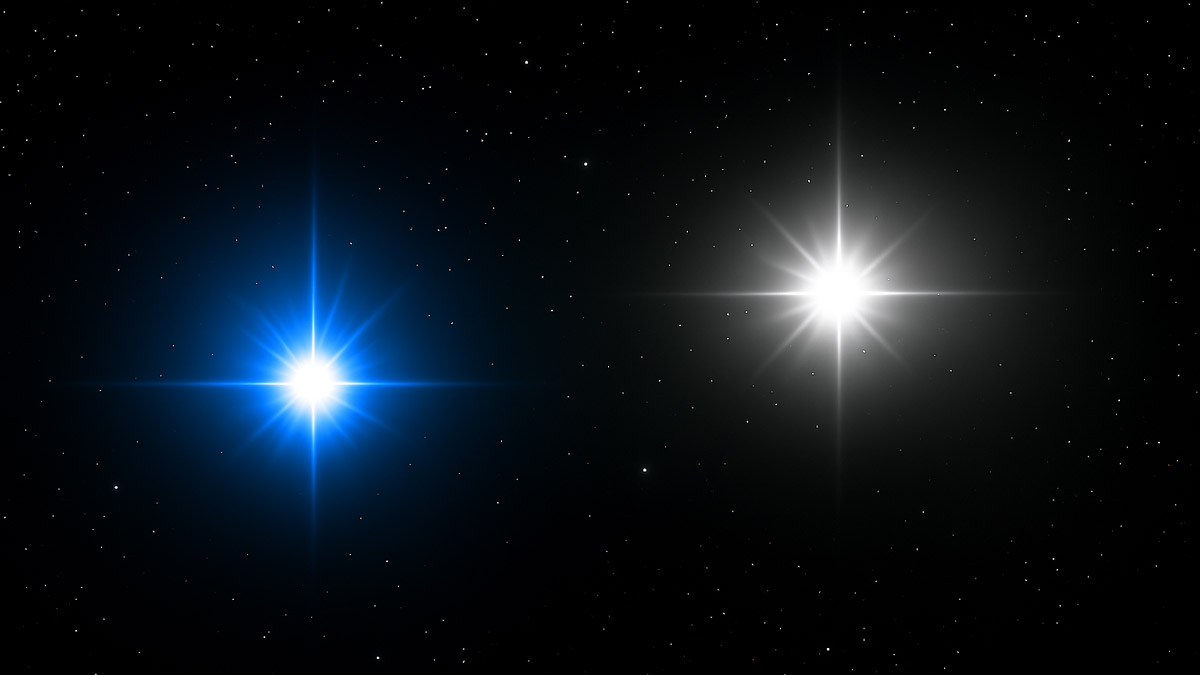
23 Orionis is a double star in the Orion constellation best viewed on winter nights.
As a 4th magnitude variable double star, 23 Orionis will appear as a faint point of light to the naked eye, but backyard astronomers will need to employ binoculars or a telescope to resolve the blue-white pair. The primary star is classified as a bluish-white main sequence star classified as a B1V spectral type. It’s nearly eight times the size of our sun!
Meanwhile, the dimmer 6.8 magnitude secondary star appears 31.5 arcseconds away from the primary and is a spectral type of B3V. The two have an unknown orbit and have been cataloged as a spectroscopic binary, which means they are a visual double star, but not gravitationally bound like a true binary star.1
Historically speaking, the astronomer William Herschel recorded 23 Orionis on October 2, 1782.
My Observations
| Date | January 20, 2023 |
| Time | 7:26 P.M. |
| Location | Seattle, WA |
| Magnification | 113x |
| Scope | Meade 8″ SCT |
| Eyepiece | 18mm |
| Seeing | Below Average |
| Transparency | Below Average |
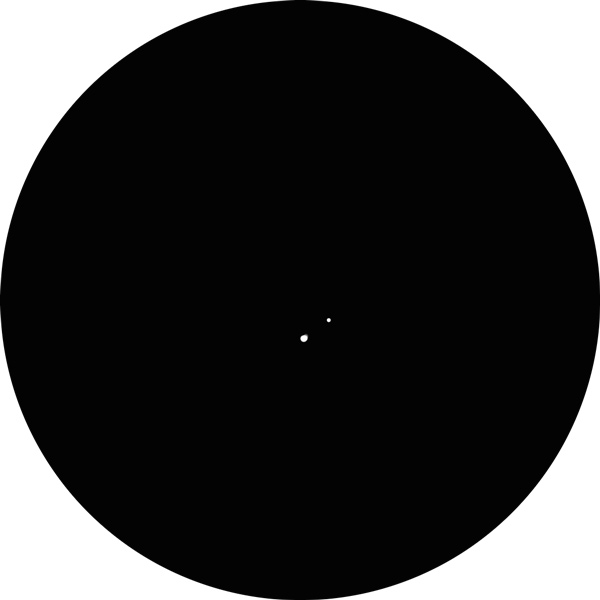
Tonight is hazy and the cold seeps into my socks. My attention has been mostly fishing for stars in the north, but I’ve decided to move the scope to the south and east to check out this double. I’m afraid 23 Orionis is a fair unremarkable pair that is easily separated. Both stars are dull, off-white. The faint blue, which many report, is not registering with my eyes on this evening.
Key Stats
| Constellation | Orion |
| Best Viewing | Winter |
| Visual Magnitude | +5.0, +6.8 |
| Separation | 31.5″ | 10,000 AU |
| Position Angle | 29° |
| Spectral Class | A=B1V, B=B3V |
| Absolute Visual Magnitude | -3.4 |
| Distance from Earth | 1,600 ly |
| Milky Way Location | Orion Spur |
| My Viewing Grade | B- |
| Designations | 23 Ori, STF 696, SAO 112697, Struve 696 |
Sources and Notes
Banner illustration was created by the European Southern Observatory (ESO) and is under the Creative Commons Attribution 4.0 International License. Per ESO agreement: Here is the original image on the ESO website.
1 “23 Orionis.” Wikipedia, Wikimedia Foundation, 6 May 2022, https://en.wikipedia.org/wiki/23_Orionis.
Sketch by Wayne McGraw
 The Garden Astronomer