
Beta Camelopardalis is a double star in the constellation Camelopardalis, viewable much of the year as it circles close to the North Star.
At a magnitude 4, Beta Camelopardalis, or Beta Cam for short, claims the brightest star status for all the stars in the dim constellation Camelopardalis. The suburban astronomer will most likely struggle to find Beta Cam with the naked eye. Still, a decent pair of binoculars or any sized scope should resolve the double stars satisfactorily.
The primary star is light yellow and is a G-type supergiant classified as a G1 star. Astronomers have pointed out that it spins at a velocity much higher than other stars of its type. Some speculate that the star engulfed a large object, like a planet.1
The smaller and dimmer secondary companion shines at a magnitude of 7 and is classified as an A5 star.
My Observations
| Date | January 20, 2023 |
| Time | 7:17 p.m. |
| Location | Seattle, WA |
| Magnification | 169x |
| Scope | Meade 8″ SCT |
| Eyepiece | 12mm |
| Seeing | Average |
| Transparency | Below Average |
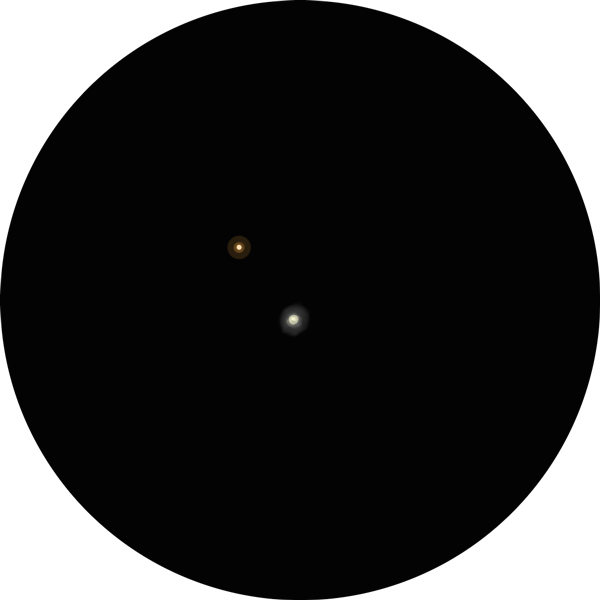
This star lies in the remote region of the far northern skies. Seemingly, it’s a beacon of light that stays close to the North Star. The primary appears yellow with a tinge of orange mixed in. Meanwhile, the fainter companion lies a reasonable distance away and appears white in color to me. Other than the lovely color that belongs to the brighter primary star, this pair is unremarkable.
Key Stats
| Constellation | Camelopardalis |
| Best Viewing | Winter |
| Visual Magnitude | +4.0 | +7.4 |
| Separation | 84.2″ |
| Position Angle | 209° |
| Spectral Class | A=G1 Ib–IIa, B=A5 |
| Absolute Visual Magnitude | -3.11 |
| Distance from Earth | 870 ly |
| Milky Way Location | Orion Spur |
| My Viewing Grade | B |
| Designations | 10 Cam, SAO 13351, HD 31910, HIP 23522 |
Other Observations in Camelopardalis
Sources and Notes
The banner illustration was created by the European Southern Observatory (ESO) and is under the Creative Commons Attribution 4.0 International License. Per ESO agreement: Here is the original image on the ESO website.
1 “Beta Camelopardalis.” Wikipedia, Wikimedia Foundation, 5 Mar. 2023, en.wikipedia.org/wiki/Beta_Camelopardalis. Accessed 16 Mar. 2023.
Sketch by Wayne McGraw
 The Garden Astronomer
One thought on “Beta Camelopardalis: A Double Dancing Around the Celestial Pole”