
m Persei, also known as 57 Per, appears in the constellation Perseus and is best viewed on winter nights.
The double star is both bright (both stars are in the 6th magnitude range) and wide at 121 arcseconds apart. The brighter primary star is a little more than twice the diameter of our sun and is a yellow-white main-sequence star, shining with an off-white appearance. The slightly dimmer companion is warmer with a yellow hue. 57 Per makes for a great backyard target using either binoculars or any sized telescope. The stars lie nearly 200 light years away from our solar system.
My Observations
| Date | January 20, 2023 |
| Time | 6:45 p.m. |
| Location | Seattle, WA |
| Magnification | 127x |
| Scope | Meade 8″ SCT |
| Eyepiece | 16mm |
| Seeing | Below Average |
| Transparency | Below Average |
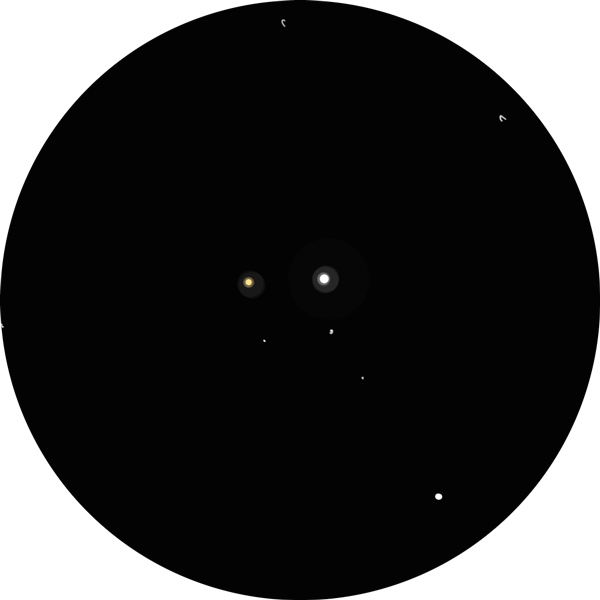
This is the second observation of the night for me, and the sky is staying clear enough to continue. Bands of high clouds pass through the Perseus region, but objects like this one pop out just fine. Overall, this is a nice wide pair to observe. The double sits among several other brighter stars. In fact, two equally bright stars lie underneath (with my telescope), making a square pattern. Another bright white star sits nearby at the corner of the eyepiece.
Key Stats
| Constellation | Perseus |
| Best Viewing | Winter |
| Visual Magnitude | +6.1 | 6.8 |
| Separation | 121.4″ |
| Position Angle | 197° |
| Spectral Class | A=F0V |
| Absolute Visual Magnitude | +2.23 |
| Distance from Earth | 193 ly |
| Milky Way Location | Orion Spur |
| My Viewing Grade | B+ |
| Designations | 57 Per, SHJ 44, SAO 39604 |
Sources and Notes
Banner illustration was created by the European Southern Observatory (ESO) and is under the Creative Commons Attribution 4.0 International License. Per ESO agreement: Here is the original image on the ESO website.
Sketch by Wayne McGraw
 The Garden Astronomer