
Omega Aurigae is both a variable and double star in the Auriga constellation, best viewed on winter nights.
As a 4th magnitude variable star, Omega Aurigae is known as an eruptive variable star. These are “stars with eruptions or flaring on the surface or interaction with other interstellar matter.”1 As an eruptive star, it becomes brighter and dimmer irregularly. The primary is registered as a white main-sequence star. Meanwhile, the fainter orange star companion nestles itself nearby only 4.7 arcseconds away.
My Observations
| Date | January 20, 2023 |
| Time | 6:38 p.m. |
| Location | Seattle, WA |
| Magnification | 254x |
| Scope | Meade 8″ SCT |
| Eyepiece | 8mm |
| Seeing | Average |
| Transparency | Below Average |
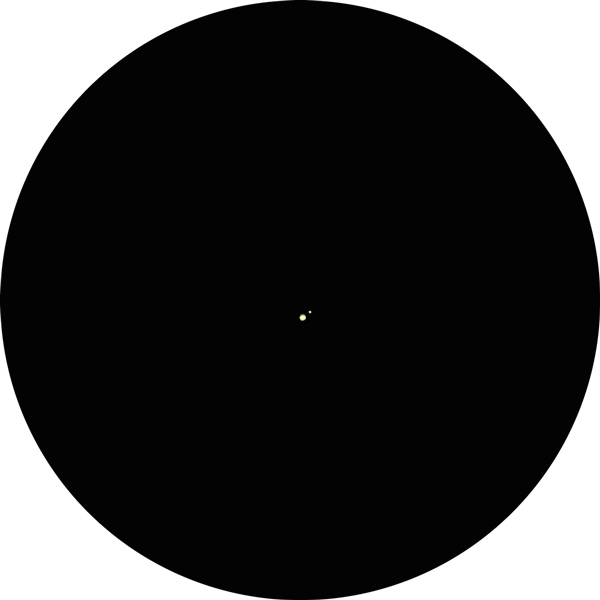
This is the first observation of the night for me. Even though the seeing conditions are not excellent, I wanted to get some time under the stars since it has been many weeks since I’ve seen a clear sky. Unfortunately, bands of high clouds wash past Auriga, but my telescope and I can reach and pick out some doubles.
The primary (drawn as the left star on my sketch) appears yellow, while the secondary has a warmer hue, making it seem light orange.
Key Stats
| Constellation | Auriga |
| Best Viewing | Winter |
| Visual Magnitude | +5.0 | 8.2 |
| Separation | 4.7″ |
| Position Angle | 5° |
| Spectral Class | A=, B=A1V |
| Absolute Visual Magnitude | +1.4 |
| Distance from Earth | 170 ly |
| Milky Way Location | Orion Spur |
| My Viewing Grade | B |
| Designations | 4 Aur, SAO 57548, STF 616 |
Sources and Notes
Banner illustration was created by the European Southern Observatory (ESO) and is under the Creative Commons Attribution 4.0 International License. Per ESO agreement: Here is the original image on the ESO website.
1 “Types of Variable Stars: Cepheid, Pulsating and Cataclysmic.” Space.com, Space, 29 Jan. 2015, https://www.space.com/15396-variable-stars.html.
Sketch by Wayne McGraw
 The Garden Astronomer