
Phi Tauri, also known as Phi Tau or 52 Tau, appears in the constellation Taurus and is best viewed on winter nights.
This double star features a bright golden primary star with a blue companion at magnitudes 5 and 7.5, respectively. The contrasting colors make for an attractive pair. The stars themselves are not a true binary system, as they are not gravitationally bound. Nevertheless, Phi Tauri is a great target for backyard astronomers with any sized scope or a pair of binoculars because the stars are bright and fairly far apart at 48.7 arcseconds.
Historically speaking, the astronomer William Herschel first discovered this attractive pair on October 30, 1779.
My Observations
| Date | January 23, 2023 |
| Time | 7:35 p.m. |
| Location | Seattle, WA |
| Magnification | 169x |
| Scope | Meade 8″ SCT |
| Eyepiece | 12mm |
| Seeing | Average |
| Transparency | Below Average |
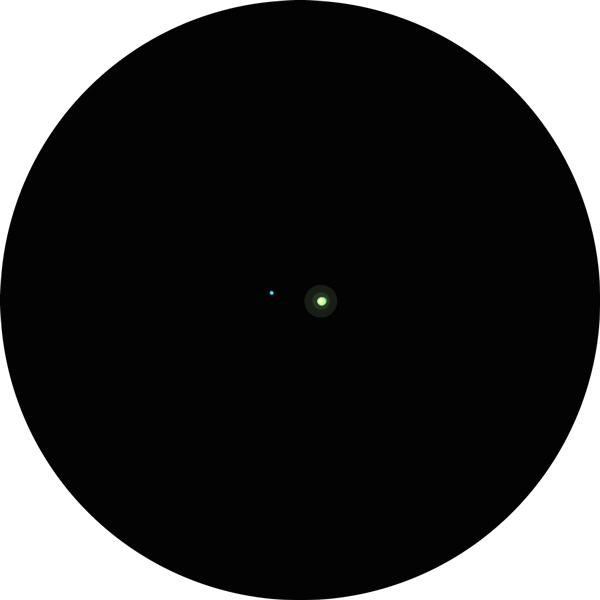
This is a beautiful pair that somewhat matches the pair I just observed a few minutes. See my observation for Struve 698. The stars in Struve 698 are closer to each other, but the colors of gold and blue look similar. The blue in Phi Tauri does have a deeper, darker blue—quite alluring in the eyepiece. I just wish the skies were crystal clear to take this pair in. I’m fighting with random waves of high atmosphere clouds that bloom and deflate rapidly, slicing through Auriga and Taurus.
Key Stats
| Constellation | Taurus |
| Best Viewing | Winter |
| Visual Magnitude | +4.9 | +7.5 |
| Separation | 48.7″ | 4790AU |
| Position Angle | 259° |
| Spectral Class | A=K1III |
| Absolute Visual Magnitude | -.03 |
| Distance from Earth | 321 ly |
| Milky Way Location | Orion Spur |
| My Viewing Grade | A- |
| Designations | 52 Tau, SAO 76558, HIP 20250, Phi Tau, SHJ 40 |
Sources and Notes
Banner illustration was created by the European Southern Observatory (ESO) and is under the Creative Commons Attribution 4.0 International License. Per ESO agreement: Here is the original image on the ESO website.
Sketch by Wayne McGraw
 The Garden Astronomer