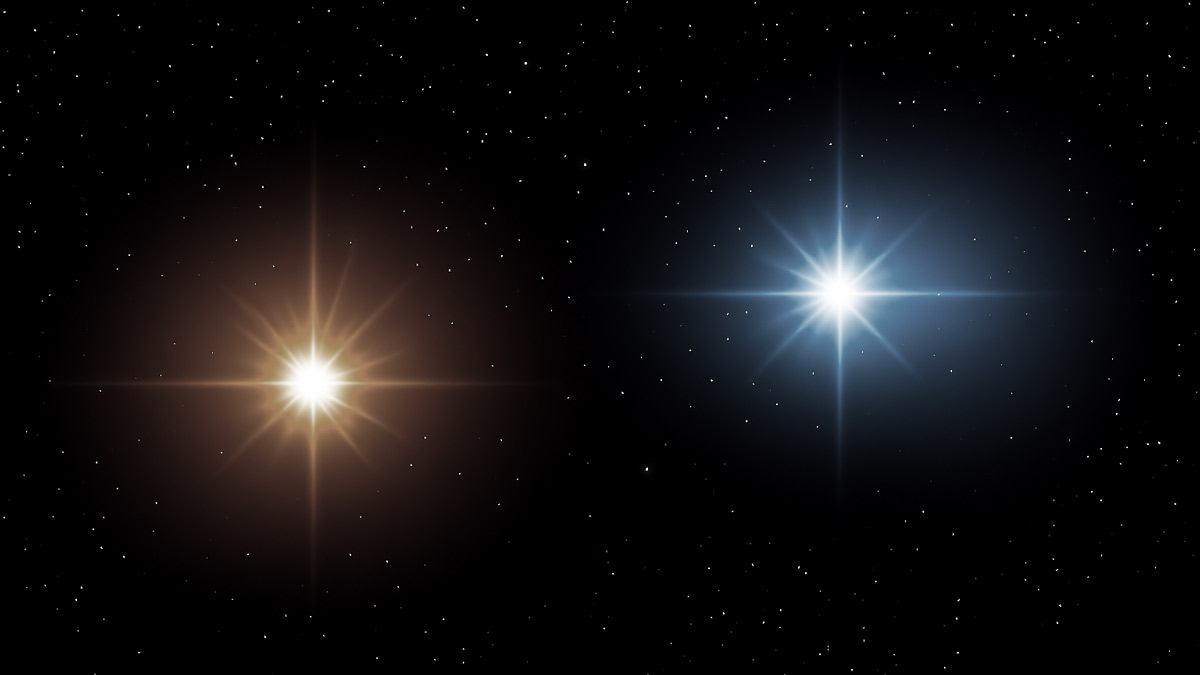
6 Leonis is a double star in the constellation Leo. It’s best viewed in the spring.
I think backyard astronomers will enjoy this pair because we can all guess the secondary star’s color. Various reports online differ. Famed astronomer William Hershel called the dim star “dusky,” while viewing it on February 21, 1781. British astronomer T.W. Webb years later referred to it as green.1 Meanwhile, Greg Stone saw the secondary star as a “violent puffball.”2 I struggled with the color as well, but ended up writing down faint blue (see observations below).
Making out the primary star’s color is much easier. It’s a bright orange-red giant star designated as spectral type K and lies nearly 500 light-years away from us.
My Observations
| Date | February 24, 2023 |
| Time | 10:00 p.m. |
| Location | Seattle, WA |
| Magnification | 169x |
| Scope | Meade 8″ SCT |
| Eyepiece | 12mm |
| Seeing | Below Average |
| Transparency | Below Average |
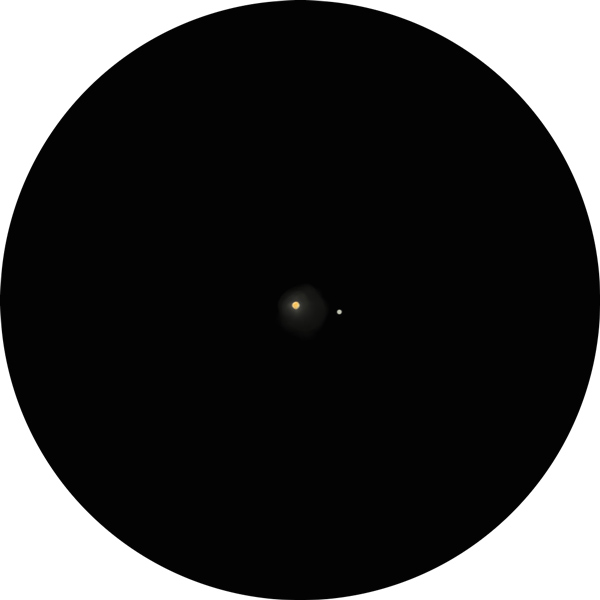
I’ve only had 30 minutes at the scope, and I’m afraid I’ll have to end my session soon. The skies are quickly filling up with high-altitude clouds, acting like a blurry glaze on the firmament. The night is cold as well, as the temperature is hovering around 29° F. Apparently, I’m not the only one who has gazed at 6 Leo in frigid temps. I found this article from Greg Stone on the excellent Star Splitters website. Greg also looked upon the double during a very cold night.
Back to observing: the primary looks like a rusty yellow—if that could be a color. Meanwhile, I’m having trouble telling the color of the dim secondary. I’m just glad I can make it out through the haze! If I were forced to vote, I would say the color is blue.
Key Stats
| Constellation | Leo |
| Best Viewing | Spring |
| Visual Magnitude | +5.2 | +9.3 |
| Absolute Visual Magnitude | -.86 |
| Distance from Earth | 130 ly |
| Separation | 37.4″ | 5680 AU |
| Position Angle | 76° |
| Orbital Period | Unknown |
| Milky Way Location | Orion Spur |
| My Viewing Grade | B |
| Designations | 6 Leo, SAO 117751, SHJ 107, HR 3779, HD 82381 |
Sources and Notes
Banner adapted from an illustration created by Pablo Budassi. The illustration is licensed under the Creative Commons Attribution-Share Alike 4.0 International license. Full details here.
1 Argyle, Bob. “Double Star of the Month – March 2013.” Webb Deep-Sky Society: Double Star of the Month: 6 Leo, https://www.webbdeepsky.com/double-stars/object?object=6%2BLeo.
2 Stone, Greg. “6 Leonis – an Orange with a Violet Puff Ball as Viewed from an Icebox.” Star-Splitters, 28 Dec. 2010, https://bestdoubles.wordpress.com/2010/12/28/6-leonis-an-orange-with-a-violet-puff-ball-as-viewed-from-an-icebox/.
 The Garden Astronomer